You need a development team. The job boards are full of profiles labelled MERN Stack Developer and Full Stack Developer – sometimes used interchangeably, but they are not the same thing. Hiring the wrong fit for your project type can slow delivery, inflate costs, and create technical debt you will spend the next two years unwinding.
This guide cuts through the confusion. Whether you are a startup with a tight runway, a SaaS company scaling fast, or an enterprise modernising legacy systems – here is exactly how to think about this hiring decision in 2026.
Understanding the MERN Stack Ecosystem
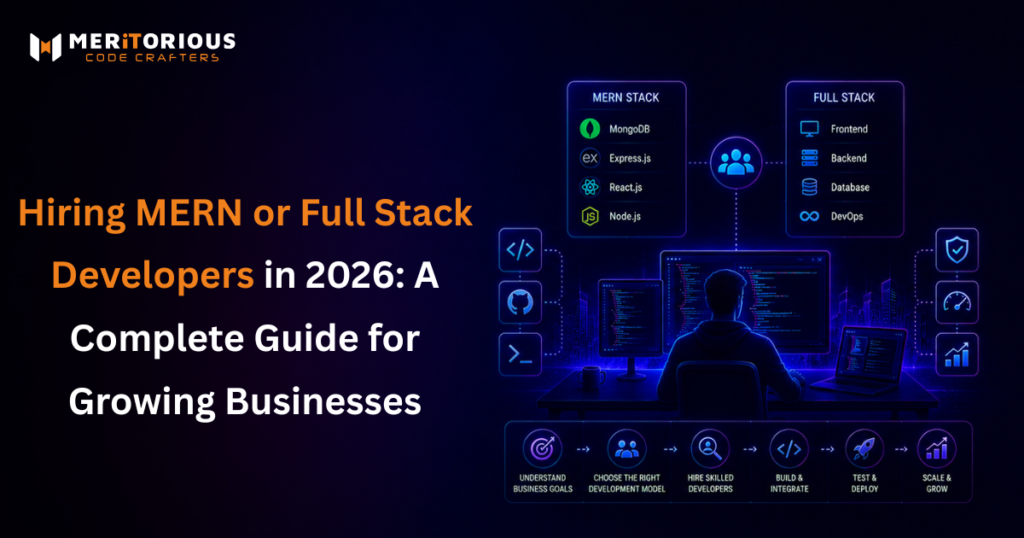
MERN is an acronym for four technologies: MongoDB, Express.js, React, and Node.js. Every layer runs on JavaScript, which is the defining advantage of this stack.
Here is what each layer does in a production application:
• MongoDB: A NoSQL document database. Flexible schema design makes it well-suited for applications where data structures evolve frequently – typical in early-stage startups.
• Express.js: A lightweight Node.js framework for building RESTful APIs and handling server-side routing.
• React: Meta’s UI library for building dynamic single-page applications. It is component-based, which supports fast iteration and reuse.
• Node.js: A JavaScript runtime that handles backend logic. Because it is non-blocking and event-driven, it performs well under high concurrency – useful for real-time features like notifications, chat, or live dashboards.
The main business benefit of the MERN stack is that a single developer – or a small team – can own the entire product, from database to UI. This matters when you are trying to ship fast without a large engineering headcount. For frontend rendering and SEO strategy, it is worth reviewing the React JS vs Next.js comparison to understand how to extend MERN for SEO-driven use cases.
What Full Stack Developers Actually Do
A full stack developer can handle both frontend and backend development, but unlike a MERN developer, they are not tied to a specific technology set. Their stack might include Python and Django, PHP and Laravel, Java Spring Boot, or Ruby on Rails – paired with Vue.js, Angular, or plain JavaScript on the frontend.
This breadth is valuable in specific contexts. An enterprise that runs a legacy PHP backend alongside a React frontend needs developers who can navigate both environments. A company with a microservices architecture using multiple languages needs engineers who are not constrained to one ecosystem.
Full stack developers are typically more expensive to hire because they carry a wider skill profile. They are also harder to evaluate – “full stack” is one of the most overused terms in developer hiring, and the depth of knowledge behind it varies significantly across candidates.
MERN Stack vs Full Stack Developers: Side-by-Side
Use this table to map your project requirements to the right developer profile:
| Criteria | MERN Stack Developer | Full Stack Developer |
| Tech Focus | MongoDB, Express, React, Node.js | Varies (LAMP, MEAN, Python, Ruby, etc.) |
| Frontend Skills | React (strong) | Varies – React, Vue, Angular, or plain JS |
| Backend Skills | Node.js / Express | Node, PHP, Python, Java, .NET, etc. |
| Database | MongoDB (NoSQL) | SQL + NoSQL, often both |
| Best For | JS-first startups, SPAs, SaaS | Diverse tech stacks, legacy systems, enterprises |
| Dev Speed | Fast for JS ecosystem | Depends on stack depth |
| SEO-Readiness | Needs Next.js layer | Flexible – can integrate any rendering |
| Hiring Cost (India) | ₹30K – ₹1.2L/month | ₹35K – ₹1.5L/month |
| Team Size Needed | 1–3 for full product | 1–2 for simple, 3–5 for complex |
| Long-Term Maintenance | Easier (unified JS) | Depends on tech diversity |
When to Hire MERN Stack Developers
MERN developers are the practical choice when:
• Your product is JavaScript-first. If your team already works in JS, adding MERN developers keeps the codebase consistent and reduces context-switching.
• You are building a SaaS or startup MVP. The MERN stack allows one developer to own the full lifecycle, which keeps early-stage costs down.
• You need real-time features. Node.js handles WebSocket connections and event-driven architecture well – relevant for live collaboration tools, notifications, and chat systems.
• Your data model is dynamic. MongoDB’s flexible schema is useful when your product is still evolving and you cannot afford to run migrations every sprint.
• You want a unified hiring profile. Interviewing and evaluating MERN developers is more straightforward than assessing “full stack” candidates with undefined stacks.
If this describes your situation, you can hire MERN stack developers in India with access to a deep talent pool at competitive rates.
When to Hire Full Stack Developers
A broader full stack team makes more sense when:
• You have an existing tech stack that is not JavaScript-based. Migrating a Django or Rails codebase to MERN just to hire more uniformly is rarely justified.
• You are building complex integrations. Enterprise applications that connect to SAP, Oracle, or legacy ERP systems often require backend engineers with Java or .NET experience.
• Your team needs polyglot problem-solving. Microservices architectures with services written in multiple languages need engineers who can operate across boundaries.
• You are scaling an eCommerce platform. Large eCommerce operations often run on Magento, Shopify Plus, or custom PHP – not Node.js.
• Long-term flexibility matters more than short-term speed. Full stack developers give you the option to evolve your architecture without being locked into a single ecosystem.
To explore this option for your team, hire full stack developers in India through a partner that can pre-screen candidates for your specific tech stack.
Key Factors to Consider Before Hiring
1. Define Your Tech Stack First
Do not start hiring until you have committed to a technology direction. Hiring a MERN developer for a Python-Django project, or a full stack Java developer for a React SPA, creates a mismatch that is expensive to correct.
2. Assess Your Project’s SEO Requirements
MERN apps built with plain React are client-side rendered. If your product needs to rank organically, you will need developers who can implement Next.js server-side rendering within the MERN ecosystem – or choose full stack developers who can architect this from the start.
3. Consider Team Structure and Collaboration
A solo MERN developer can own a small product end to end. A full stack developer in a larger team needs clear ownership boundaries between frontend and backend. Misaligned team structures cause more delivery failures than technical skill gaps.
4. Evaluate Long-Term Maintenance Needs
MERN codebases are easier to maintain when your team is stable and JavaScript-fluent. Full stack projects with multiple languages and frameworks require ongoing documentation and knowledge transfer investment – factor this into your total development cost.
Cost of Hiring MERN vs Full Stack Developers in India
India offers strong value across both profiles. Approximate monthly rates in 2026:
• Junior MERN Developer: ₹25,000 – ₹45,000/month
• Mid-Level MERN Developer: ₹50,000 – ₹85,000/month
• Senior MERN Developer: ₹90,000 – ₹1,20,000/month
• Junior Full Stack Developer: ₹30,000 – ₹50,000/month
• Mid-Level Full Stack Developer: ₹55,000 – ₹95,000/month
• Senior Full Stack Developer: ₹1,00,000 – ₹1,50,000/month
These figures vary based on domain expertise, notice period, and whether you hire through an agency, a freelance platform, or direct sourcing. Agency-sourced developers carry a premium but typically come pre-vetted for communication quality, code standards, and reliability – which reduces onboarding time significantly.
For global businesses, Indian developers cost 60–70% less than equivalent hires in North America or Western Europe, making India the default market for cost-efficient, quality-first development hiring.
Frequently Asked Questions (FAQs)
1. Is a MERN stack developer the same as a full stack developer?
Not exactly. A MERN stack developer is a type of full stack developer who specialises in MongoDB, Express, React, and Node.js. A full stack developer is a broader category – they can work across any combination of frontend and backend technologies, not just the MERN stack.
2. Which is better for a startup – MERN or a general full stack developer?
For most JavaScript-first startups, MERN developers are the better early hire. They can own the entire product in a single language, which reduces communication overhead, hiring complexity, and code context-switching. Full stack developers with mixed stacks become more valuable as the product matures and architecture diversifies.
3. How long does it take to hire a MERN or full stack developer in India?
Through a specialist hiring partner, you can onboard a vetted developer within five to ten business days. Direct hiring through job boards typically takes three to six weeks, depending on the seniority level and how clearly the role requirements are defined.
4. Can a MERN developer handle SEO for my website?
MERN developers build React applications, which are client-side rendered by default. For SEO-critical applications, they need to implement Next.js or server-side rendering techniques. A MERN developer with Next.js experience can handle this – ask specifically about SSR and Core Web Vitals experience during interviews.
5. What is the typical team size for a MERN-based product?
For an MVP, one to two mid-level MERN developers can deliver a functional product. For a growth-stage SaaS with multiple user roles, API integrations, and a production-grade backend, a team of three to four – including at least one senior developer and a QA engineer – is a reasonable structure.
Conclusion: Hire for Your Stack, Not the Label
The MERN vs full stack debate is ultimately about fit. MERN developers bring speed, consistency, and JavaScript depth to products that are built for the modern web. Full stack developers bring flexibility and breadth to products with diverse, complex, or legacy technology requirements.
Both profiles are strong, and India’s developer talent pool offers competitive quality at every level. The decision should come down to your product type, existing tech stack, team structure, and the specific outcomes you need to drive in the next 12 to 18 months.
If you are ready to build your team the right way, work with a trusted mobile app development company India that can match you with pre-vetted MERN and full stack developers who fit your technical requirements and company culture – not just your job description.