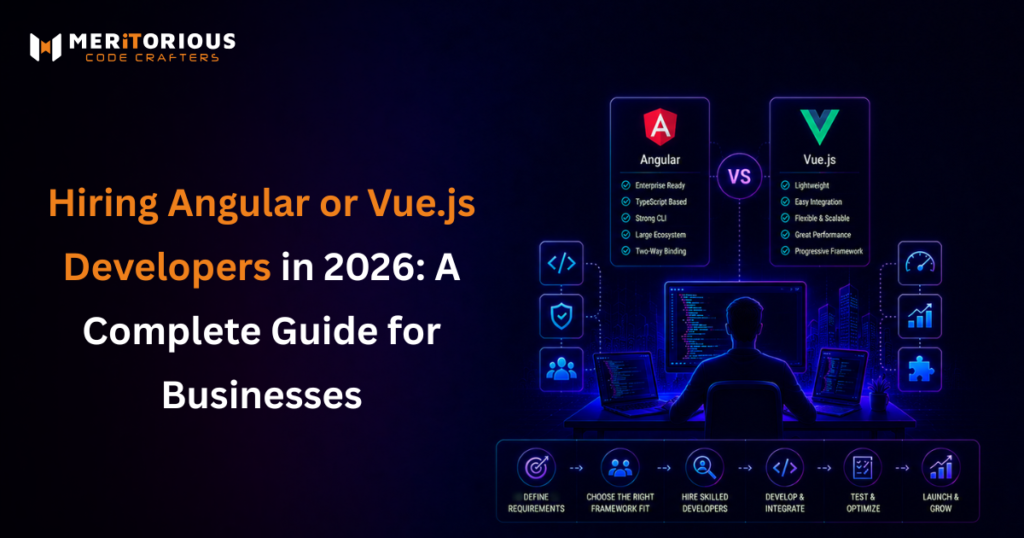
Frontend framework choice shapes more than your codebase – it determines your hiring pool, development speed, long-term maintenance cost, and how quickly your team can onboard new engineers. In 2026, Angular and Vue.js remain two of the most widely used frontend frameworks, and both have strong cases for adoption depending on your business context.
This guide is built for decision-makers: business owners, CTOs, and product managers who need a clear-eyed answer to a common question – Angular or Vue.js, and which developer profile fits our goals? No stack evangelism. Just practical, business-grounded guidance.
What Is Angular? Architecture and Ecosystem Explained
Angular is a full MVC framework maintained by Google. It provides a complete, opinionated toolkit for building large-scale web applications – including routing, state management, form handling, dependency injection, and HTTP services – all within a single, structured package.
Angular enforces TypeScript as its primary language, which adds static typing, better IDE tooling, and long-term code maintainability. This matters significantly when multiple developers work on a shared codebase over an extended period.
Key characteristics of Angular that affect your hiring decision:
• Opinionated architecture: Angular enforces how you structure modules, services, and components. This is a constraint for small teams but a significant advantage for large engineering organisations that need consistency.
• Enterprise-grade tooling: Built-in CLI, testing scaffolding with Jasmine and Karma, and Angular Material for UI components reduce the number of third-party dependencies your team must manage.
• Two-way data binding: Changes in the UI automatically reflect in the model and vice versa, reducing boilerplate for form-heavy applications.
• Strong Google backing: Angular follows a predictable release cycle with long-term support (LTS) versions, which matters for enterprises with compliance and vendor risk requirements.
What Is Vue.js? Architecture and Ecosystem Explained
Vue.js is a progressive JavaScript framework created by Evan You and maintained by an open-source community. Unlike Angular, Vue is not prescriptive – you can adopt it incrementally, starting with a single component on an existing page and expanding from there.
Vue’s component-based architecture is intuitive and well-documented, making it one of the fastest frameworks to learn and ship with. It uses a virtual DOM and reactive data binding, and its single-file component (SFC) structure keeps HTML, CSS, and JavaScript co-located, which improves developer experience.
Key characteristics of Vue.js relevant to your hiring decision:
• Gentle learning curve: Vue developers are faster to onboard than Angular developers. Teams can achieve productivity within days rather than weeks.
• Flexible integration: Vue works well as a layer on top of server-rendered applications, making it useful for teams migrating away from legacy monoliths.
• Composition API (Vue 3): The Composition API brings Vue closer to React in terms of logic reuse and code organisation, making it a strong choice for complex UI logic.
• Nuxt.js for SSR: Vue’s counterpart to Next.js enables server-side rendering and static site generation, which is valuable for SEO-driven products.
Angular vs Vue.js: Side-by-Side Comparison
Use this table to match your project type and team profile to the right framework:
| Criteria | Angular | Vue.js |
| Type | Full MVC Framework (Google) | Progressive UI Framework (Community) |
| Language | TypeScript (mandatory) | JavaScript / TypeScript (optional) |
| Architecture | Opinionated, structured | Flexible, component-based |
| Learning Curve | Steep | Gentle to moderate |
| Performance | Excellent at scale | Excellent for lightweight apps |
| Bundle Size | Larger (with tree-shaking) | Smaller out of the box |
| Best For | Enterprise, large SaaS, dashboards | Startups, SPAs, progressive web apps |
| Two-Way Binding | Yes (built-in) | Yes (v-model) |
| Testing Support | Strong (Jasmine, Karma) | Good (Vue Test Utils, Jest) |
| Hiring Cost (India) | ₹35K – ₹1.5L/month | ₹25K – ₹1.1L/month |
| Community | Large (enterprise-backed) | Large (open source, growing) |
For a deeper dive into how these frameworks compare alongside React, see our Angular vs Vue comparison that covers architecture, ecosystem, and performance trade-offs in detail.
When Should You Hire Angular Developers?
Angular is the right choice under the following business conditions:
• Large-scale enterprise applications. Banks, insurance platforms, and government portals that require standardised code, team-wide consistency, and maintainability over five-plus years.
• Complex, form-heavy workflows. ERP dashboards, CRM systems, and internal admin tools with intricate data entry, validation, and multi-step processes.
• TypeScript-first engineering teams. If your team already works in TypeScript and values strict typing across the stack, Angular is a natural fit.
• Regulated industries. Angular’s predictable release cycle, LTS guarantees, and Google’s organisational backing make it easier to manage vendor and security risk in compliance-heavy environments.
• Distributed development teams. Angular’s structure and conventions reduce ambiguity for teams where 10 or 20 developers contribute to the same codebase simultaneously.
If these scenarios describe your context, hire Angular developers in India where a large pool of enterprise-experienced developers is available at competitive rates.
When Should You Hire Vue.js Developers?
Vue.js is the better fit when:
• Speed to market is the priority. Vue’s low learning curve and minimal boilerplate let small teams ship faster – particularly valuable for early-stage startups and MVPs.
• You are building a progressive web application. Vue integrates cleanly with existing server-rendered apps and is well-suited for gradual frontend modernisation.
• Your product is content-driven and needs SEO. With Nuxt.js, Vue supports static site generation and server-side rendering, making it a strong choice for marketing sites, SaaS landing pages, and eCommerce storefronts.
• You have a smaller development team. Vue’s flexibility and concise syntax mean fewer developers can maintain a larger surface area without the structural overhead Angular requires.
• You are migrating a legacy frontend. Vue can be introduced into a page-by-page migration without a full rewrite, reducing risk during the transition.
For projects that match this profile, hire Vue.js developers in India to access skilled developers experienced with Nuxt.js, Vue 3, and modern component architecture.
Key Factors to Consider Before Hiring
1. What Is the Scale of Your Application?
Angular is built for scale. If you are planning a product that will grow to hundreds of components, multiple developer teams, and years of active development, Angular’s structure pays long-term dividends. For smaller or medium-complexity applications, Vue provides equivalent power with less overhead.
2. What Does Your Existing Team Know?
Switching frameworks mid-project is expensive. If your current developers are proficient in Vue.js, adding Angular to the mix requires significant retraining. Evaluate your team’s current skills before defining your hiring requirements.
3. How Important Is SEO to Your Product?
Neither Angular nor Vue.js is inherently SEO-friendly in their default client-side rendering modes. Angular Universal and Nuxt.js add server-side rendering support, but this adds complexity. Factor in whether your hiring requirements should include SSR experience.
4. How Long Will This Product Be Maintained?
Angular’s LTS roadmap and enforced conventions make it easier to hand off between teams. Vue projects vary significantly in structure depending on the team, which can create maintenance challenges when developers turn over. For long-lived products, this is a real risk to quantify.
Cost of Hiring Angular vs Vue.js Developers in India
Indicative monthly hiring rates in India for 2026:
• Junior Angular Developer: ₹28,000 – ₹50,000/month
• Mid-Level Angular Developer: ₹55,000 – ₹95,000/month
• Senior Angular Developer: ₹1,00,000 – ₹1,50,000/month
• Junior Vue.js Developer: ₹22,000 – ₹42,000/month
• Mid-Level Vue.js Developer: ₹45,000 – ₹80,000/month
• Senior Vue.js Developer: ₹85,000 – ₹1,10,000/month
Angular developers typically command a slight premium due to TypeScript expertise and the steeper learning curve. Vue.js developers are more accessible at junior and mid levels, which can reduce costs for teams building standard web applications without enterprise complexity.
In both cases, hiring through a specialist partner in India versus direct recruiting via job boards reduces time-to-hire by two to four weeks and significantly improves candidate quality through pre-screening.
Frequently Asked Questions (FAQs)
1. Is Angular better than Vue.js for enterprise applications?
For most enterprise use cases – large teams, long development cycles, strict code consistency requirements – Angular is the stronger default choice. Its opinionated architecture enforces standards across the codebase, which reduces technical debt at scale. Vue.js can support enterprise applications but requires more deliberate architectural discipline from the team.
2. Is Vue.js faster to develop with than Angular?
Yes, in most cases. Vue’s simpler syntax, lower learning curve, and minimal boilerplate allow developers to move faster, especially in the early stages of a project. Angular’s overhead pays off at scale but adds setup time on smaller or less complex applications.
3. Which framework has a larger developer community in India?
Angular has a larger established talent pool in India, particularly among enterprise and corporate development teams. Vue.js has a strong and growing community, especially among startup and product-focused developers. Both have sufficient talent availability for commercial hiring.
4. Can Angular and Vue.js be used together in the same project?
This is technically possible via micro-frontend architecture but is generally not recommended for new projects. Mixing frameworks increases build complexity, bundle size, and hiring requirements significantly. Choose one framework per product and stick to it unless there is a specific, well-justified reason to do otherwise.
5. How long does it take to hire a skilled Angular or Vue.js developer in India?
Through a vetted hiring partner, you can onboard a pre-screened developer within five to ten business days. Freelance or direct hiring timelines range from three to six weeks depending on seniority level and how precisely the role requirements are defined at the start of the search.
Conclusion: Choose the Framework That Matches Your Business Reality
Angular and Vue.js are both production-proven, well-supported frameworks. The right choice is not determined by which one is more popular – it is determined by your team size, product complexity, SEO requirements, and how long you plan to maintain what you build.
Angular gives you structure, TypeScript discipline, and a clear path for large-scale applications. Vue.js gives you speed, flexibility, and a gentler onboarding experience for smaller teams moving fast. Neither is universally superior.
When you are ready to hire, working with a reliable
mobile app development company India ensures you get pre-vetted developers who match not just the framework requirements but also your team culture, communication standards, and delivery expectations.
Tell us your project requirements and we will match you with the right Angular or Vue.js developer within 48 hours – no guesswork, no wasted interviews.