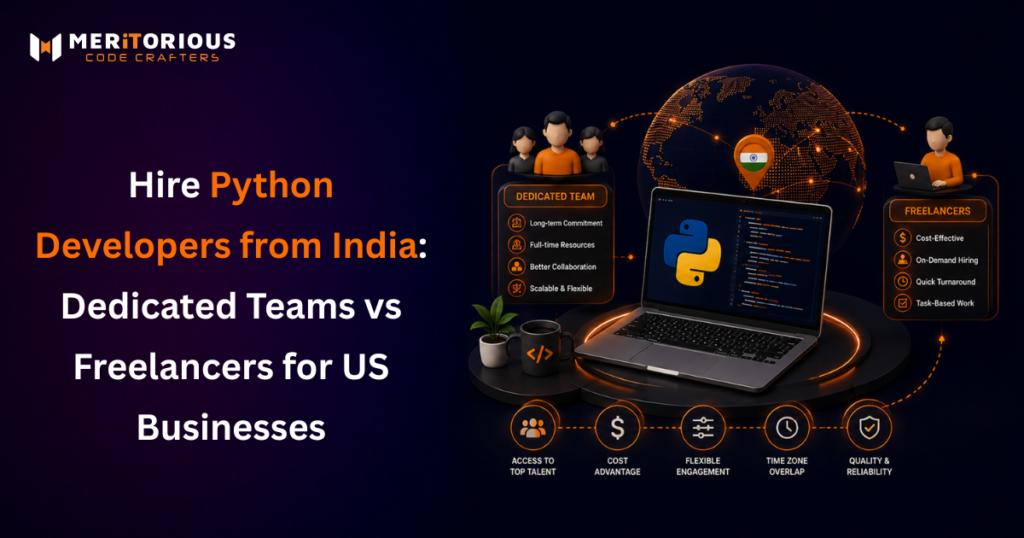
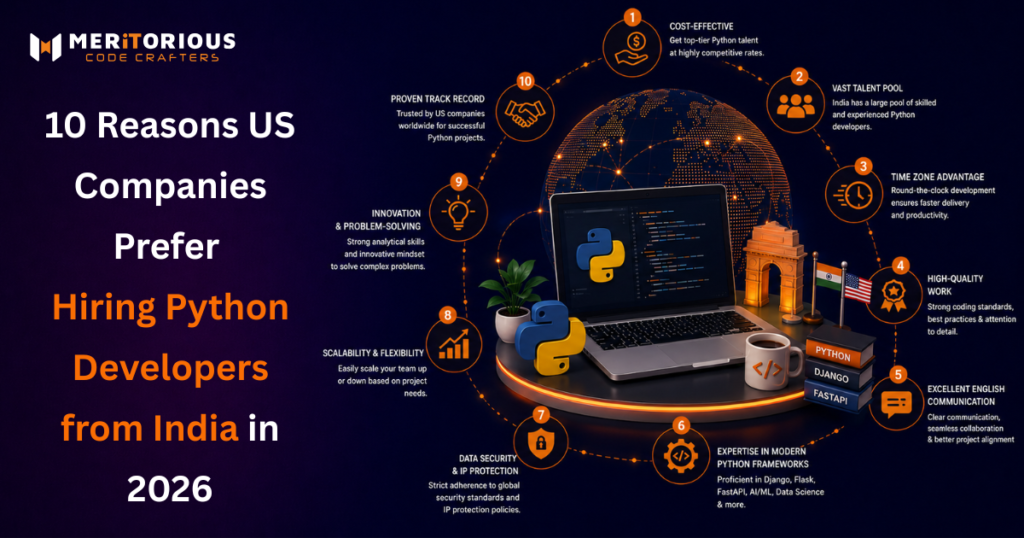
Offshore development has been around for decades, but the argument for hiring Python developers specifically from India has never been stronger than it is in 2026. Advances in AI tooling, the global demand for Python skills, India’s maturing tech ecosystem, and remote-first work infrastructure have converged to create a hiring environment that meaningfully favours Indian talent. Here are ten concrete reasons US companies keep coming back to India for Python development – backed by real business logic, not marketing generalisations.
1. Python Is India’s Strongest Technical Specialisation
India produces over 1.5 million engineering graduates annually, and Python has become the dominant language across their curricula – from IITs and NITs to thousands of private engineering colleges and bootcamps. Stack Overflow’s 2025 Developer Survey ranked India among the top three countries by Python developer concentration. The talent pool is not just large – it is specifically deep in the skills US companies most need: Django, FastAPI, data engineering, and ML frameworks.
2. Cost Advantage Is Structural, Not Cyclical
The cost differential between US and Indian Python developers is not a temporary market anomaly – it is structural. Lower cost of living, different market wage dynamics, and currency exchange rates combine to make Indian developers consistently 60–75% more affordable than comparable US hires. For a company replacing three US engineers with three Indian engineers of equal calibre, the annual saving typically exceeds $300,000 – capital that can fund product features, marketing, or additional engineering capacity.
3. English Proficiency Is Exceptionally High
India’s education system is conducted in English from primary school. Professional developers – especially those working with international clients – communicate, document, and present in fluent business English. This eliminates the communication barrier that undermines offshore engagement with some other markets and makes daily standups, sprint reviews, and async documentation genuinely effective.
4. India Has Mature Remote Work Infrastructure
The pandemic-era shift to remote work permanently upgraded India’s professional infrastructure. High-speed internet access is widespread across tier-1 and tier-2 cities, collaborative tooling (GitHub, Jira, Slack, Notion) is universally understood, and most developers working with international clients have multi-year experience in distributed team environments. The operational friction of working across time zones has been solved – by culture and process, not just technology.
5. AI and ML Expertise Is Concentrated Here
Python’s dominance in AI and machine learning has made India one of the world’s top concentrations of ML practitioners. From data scientists working with scikit-learn and pandas to MLOps engineers deploying PyTorch models on AWS SageMaker, the depth of applied AI expertise in India is significant. For US companies building AI-integrated products, this is a decisive advantage.
Explore python development services india to understand the full range of capabilities available through Indian Python teams.
6. Time Zone Overlap Enables Real Async Collaboration
IST is 10.5 hours ahead of US Pacific time, which enables a productive handoff model: US teams define tasks at end-of-day, Indian developers execute overnight, and results are ready for review the next US morning. For teams that have set up async processes properly, this is not a limitation – it is a 24-hour development cycle that compresses timelines.
7. India’s Tech Ecosystem Has Matured Significantly
Bangalore, Hyderabad, Pune, Chennai, and Delhi NCR have all developed deep enterprise tech ecosystems over the past decade. Indian developers are not only technically proficient – they have experience working on large-scale, production systems for Fortune 500 clients, including financial platforms, healthcare systems, and logistics networks. The ‘junior offshore resource’ stereotype is outdated for this market.
8. Flexible Engagement Models Reduce Hiring Risk
Indian development partners offer engagement flexibility that US hiring markets cannot match: dedicated developers on monthly terms, staff augmentation to bridge specific skill gaps, project-based delivery for scoped builds, and the ability to scale the team up or down without the legal and HR complexity of local employment. This flexibility lowers the risk of expanding your engineering capacity.
If you are evaluating whether to hire python developers india on a dedicated or project basis, most reputable partners offer trial periods of two to four weeks to validate fit before a full commitment.
9. Quality Standards Have Risen Dramatically
Indian developers working with US clients have been exposed to agile processes, code review cultures, CI/CD pipelines, and test-driven development through years of international collaboration. Top-tier Indian Python developers are not just coders – they understand sprint-based delivery, product thinking, and the business context of the features they build. Code quality, documentation discipline, and architectural judgment are all meaningfully higher than they were five years ago.
10. The ROI Is Measurable and Repeatable
Companies that have built successful offshore Python teams in India consistently report: faster delivery timelines (due to time zone handoffs), lower total engineering cost (60–70% savings), and equivalent or better code quality (due to structured hiring and review processes). The ROI is not speculative – it is documented across SaaS companies, AI startups, data platforms, and enterprise software businesses that have made India their primary engineering hub.
Working with a reliable web and mobile app development company india ensures these outcomes are structured into your engagement from day one – not left to chance.
Frequently Asked Questions
1. Is the quality of Python code from Indian developers comparable to US developers?
Yes, for mid-to-senior level profiles hired through vetted partners. Quality varies significantly across individual developers and hiring channels. The key differentiator is not geography – it is hiring rigour, code review culture, and clear quality standards set at the engagement level.
2. Which Indian cities have the strongest Python developer talent pools?
Bangalore leads in ML/AI Python talent, Hyderabad has strong enterprise Python development expertise, Pune and Chennai are strong for full-stack Python web development, and Delhi NCR has a large pool of mid-level developers across all Python specialisations.
3. How do US companies handle IP protection when hiring Python developers from India?
IP protection requires properly structured agreements: NDAs before any project discussion, work-for-hire clauses in contracts, IP assignment agreements, and a reliable partner who enforces these at the operational level. Reputable Indian development agencies maintain these as standard practice for international clients.
4. Can I hire a Python team in India for a long-term product, not just a project?
Absolutely. Many US companies run their core engineering teams from India on a long-term dedicated basis – not as contractors but as embedded team members who stay on the product for years. This model requires investment in onboarding, culture alignment, and communication infrastructure but consistently delivers excellent long-term outcomes.
5. What Python specialisations are most in demand from Indian developers in 2026?
The highest-demand specialisations are: ML/AI engineering (PyTorch, TensorFlow, LangChain), data engineering (Airflow, Spark, dbt), FastAPI and Django backend development, and Python-based DevOps automation. Data science profiles with strong Python and SQL skills are also heavily sought after by US analytics and fintech companies.
Conclusion
The reasons US companies hire Python developers from India are structural, not transactional. Deep technical specialisation, proven AI expertise, mature remote infrastructure, cost-efficiency, and flexible engagement models create a hiring environment that is difficult to match in any other market in 2026.
The companies that do this best treat their Indian Python teams as permanent engineering partners – not disposable resources. That shift in mindset is what separates successful offshore teams from failed ones.