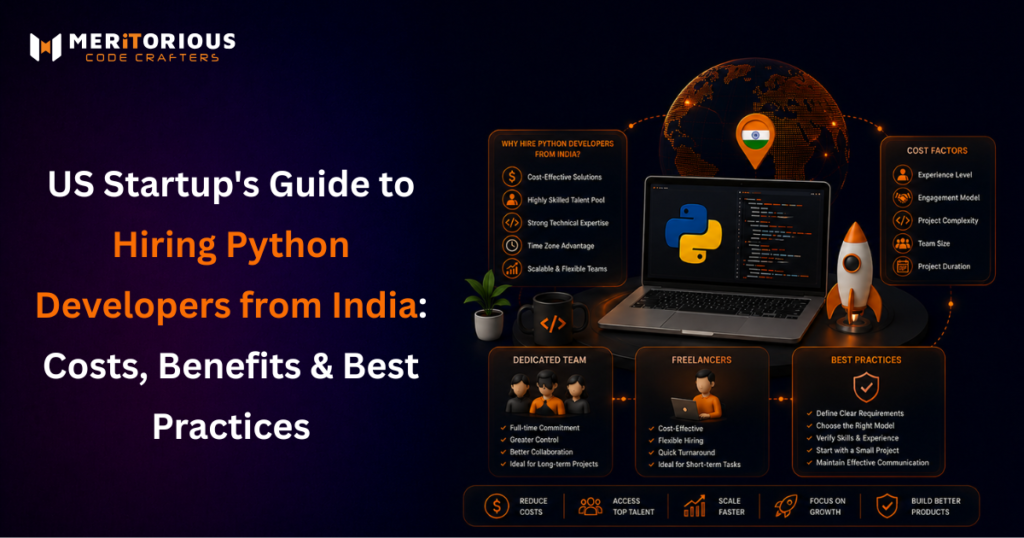
For a US startup, every engineering hire is a high-stakes decision. Hire wrong and you burn runway. Hire right and you compress timelines, extend your runway, and build technical leverage. Hiring Python developers from India in 2026 is one of the highest-ROI decisions an early-stage startup can make – if you do it with the right structure. This guide is built specifically for founders and technical leads making this call for the first time.
Why Startups Are Different From Enterprises When It Comes to Offshore Hiring
Enterprise companies hire offshore teams to reduce costs on established, well-documented codebases. Startups hire offshore teams to extend their runway and ship faster – a very different problem. Startups operate with rapidly changing requirements, limited documentation, high ambiguity, and founders who are often technical but stretched across ten priorities simultaneously.
This context shapes every hiring decision. A startup needs a Python developer who can operate with autonomy, think beyond individual tasks, and communicate proactively when requirements are unclear. Senior developers – not juniors – deliver this in a startup environment. The temptation to hire junior offshore talent to maximise savings is a common and expensive mistake.
What Does It Actually Cost to Hire a Python Developer from India as a Startup?
A realistic startup budget breakdown for Indian Python developer engagement in 2026:
- Part-time mid-level developer (20hr/week): $1,200 – $2,500/month
- Full-time mid-level developer (40hr/week): $2,000 – $4,500/month
- Full-time senior developer (40hr/week): $4,500 – $8,000/month
- Small dedicated team (2 mid + 1 senior): $8,000 – $16,000/month
Compare these figures to US hiring costs – a single mid-level US Python developer costs $90,000–$130,000 annually in salary alone. The math strongly favours offshore hiring for startups with limited Series A or bootstrap budgets. To hire python developers india at startup-appropriate rates, clarify your scope before engagement to avoid scope creep inflating your effective cost.
The Three Biggest Mistakes Startups Make When Hiring From India
Mistake 1: Hiring Too Junior to Save Money
Junior developers need management, direction, and review – resources a lean startup team does not have. A mid-level developer who can own a backend module autonomously is worth three times a junior who requires daily supervision. Invest in the right seniority level for your team’s management capacity.
Mistake 2: Starting Without Documentation
Offshore developers cannot read your mind. Before your first offshore developer starts, document your architecture decisions, API contracts, code standards, and product roadmap at the level you would expect for a US hire. This documentation exercise also forces useful clarity in the startup’s own thinking.
Mistake 3: Treating the Developer as a Task Executor
The best offshore Python developers bring architectural judgment and proactive problem-solving. Startups that treat them as ticket-closers miss this value entirely. Include your developer in sprint planning, product discussions, and technical trade-off conversations. The return on that inclusion is significant.
What Python Skills Matter Most for Startups?
Startup Python development typically spans these technical needs:
- FastAPI or Django: For building REST or GraphQL backends that your frontend or mobile app connects to
- Database design: PostgreSQL for relational data, Redis for caching, DynamoDB or MongoDB for flexible schemas
- Cloud deployment: AWS, GCP, or Azure – startups need developers who can deploy and maintain their own infrastructure
- Testing and CI/CD: pytest, GitHub Actions, code coverage standards that keep a fast-moving codebase from breaking
- Integration experience: Payment APIs, authentication systems, third-party data providers, and webhook architectures
For startups comparing frontend options alongside Python backend work, the Hiring React JS Developer: Australia vs India Cost 2026 resource provides useful parallel data on frontend hiring costs and models.
Best Practices for Onboarding an Offshore Python Developer
- Week 1: Access provisioning, codebase walkthrough, architecture documentation review, pair programming session on a small task
- Week 2: First independent task with clear acceptance criteria, daily check-in, code review feedback
- Week 3–4: Sprint participation, async autonomy, escalation protocol established
- Month 2+: Full sprint ownership, independent architectural decisions within defined scope
Legal and Contractual Considerations for US Startups
Startups often overlook contracts when moving fast. At minimum, you need: a services agreement with clear deliverable definitions, an NDA covering all business logic and proprietary information, an IP assignment clause transferring all code ownership to your company, and a termination clause with reasonable notice periods on both sides.
The right web and mobile app development company india will have these agreements standard – but read them carefully and ensure your legal counsel reviews IP clauses before you commit.
Comprehensive guidance on python development services india covers the technical scope you can expect at each engagement level.
Frequently Asked Questions
1. Should a pre-revenue startup hire offshore Python developers or wait?
If you have a defined product and the runway to support a 3-month engagement, offshore hiring is often the fastest path to a shippable MVP. Waiting until post-revenue to hire developers typically means slower growth. The risk is real but manageable with proper scoping and a vetted partner.
2. How do I know if an Indian Python developer is senior enough for a startup?
Give candidates a technical assessment that mirrors your actual work: a take-home exercise involving API design, database schema decisions, and a brief code review of intentionally flawed code. Senior developers ask clarifying questions, justify architectural choices, and identify trade-offs – not just complete the task.
3. What is the minimum viable documentation a startup needs before hiring offshore?
At minimum: a system architecture diagram, a README with setup instructions, a brief product requirements document for the current sprint, and a list of in-flight architectural decisions with their rationale. This documentation takes 4–8 hours to create and saves weeks of confusion during onboarding.
4. Can an Indian Python developer work on my US startup’s equity-based model?
Equity grants to Indian developers in US startups are legally complex due to FEMA regulations and tax implications on both sides. Most startups pay Indian developers in cash through their agency partner and offer performance bonuses rather than equity. Consult a cross-border legal specialist if equity compensation is important to your model.
5. How many Python developers does a startup MVP typically need?
For a focused MVP with a clear scope, one senior Python developer can deliver a production-ready backend in 10–16 weeks. Adding a mid-level developer to handle supporting features and testing can reduce that timeline to 6–10 weeks. Two senior developers on a well-scoped MVP is typically over-resourced and adds coordination overhead without proportional speed gain.
Conclusion
Hiring Python developers from India is one of the most powerful levers a US startup can pull in 2026 – but it rewards preparation and punishes shortcuts. Senior profiles, clear documentation, structured onboarding, and formal agreements are the four factors that consistently separate successful offshore startup teams from expensive failures.
Get the structure right, and your offshore Python developer becomes a founding engineering team member in everything but location.