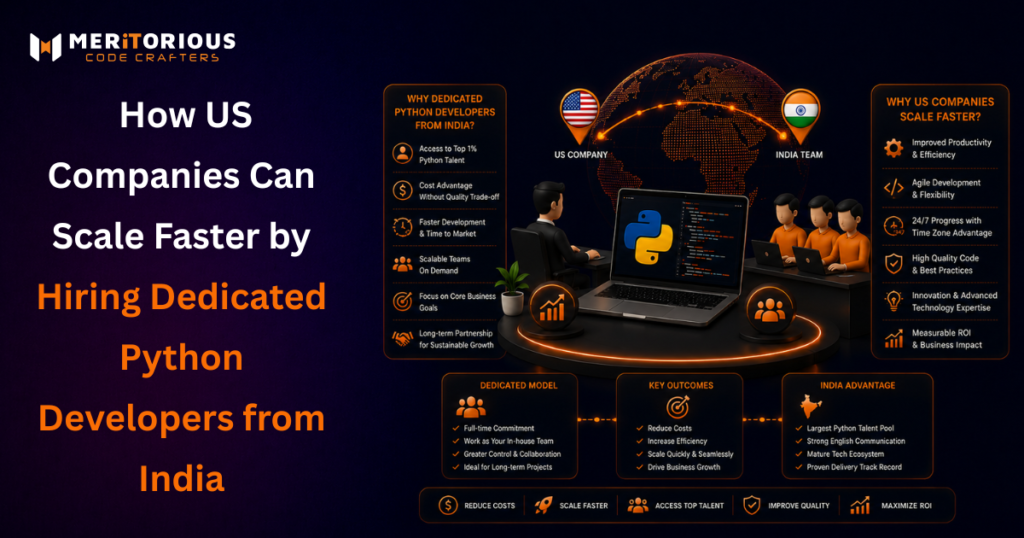
Scaling an engineering team is not just a hiring problem – it is a timing, cost, and velocity problem. US companies that try to scale exclusively through local hiring face a slow, expensive process: 60 to 90-day recruitment cycles, $180,000+ fully-loaded senior engineer costs, and a highly competitive market where top Python talent has multiple offers. Hiring dedicated Python developers from India solves all three constraints simultaneously – and does it without the trade-offs that most people assume.
What Does ‘Scaling With Offshore Python Developers’ Actually Mean?
Scaling with offshore developers is not the same as outsourcing a project. Outsourcing is transactional – you hand off a defined deliverable and receive it back. Scaling with dedicated offshore developers means growing your engineering team’s capacity with developers who are embedded in your team, own their parts of the codebase, and contribute to your roadmap continuously.
This distinction matters because it changes the outcome. Project outsourcing produces external artefacts. Dedicated offshore scaling produces internal engineering capability at a fraction of the domestic cost.
The Engineering Velocity Equation
Velocity – the amount of meaningful engineering work completed per unit of time – is what your business actually needs, not headcount. Hiring three junior developers does not produce three times the velocity of one senior developer. In Python development specifically, a senior engineer who owns a domain deeply often outperforms three mid-level developers working on the same surface area.
When US companies hire python developers india at the senior level, they frequently find that one well-structured offshore senior hire increases their effective velocity by 40–60% without adding management complexity – because that developer owns work autonomously.
Six Ways Dedicated Indian Python Developers Accelerate US Company Growth
1. Parallel Development Across Time Zones
With a dedicated Indian Python team, your US and India engineers can work in parallel on separate features or layers of the stack. US engineers handle daytime requirements clarification and design; Indian engineers execute overnight. The result is a compressed development cycle that effectively runs 16–18 hours of active engineering per day.
2. Lower Cost Per Feature Delivered
Total cost per feature is determined by developer cost multiplied by time-to-deliver. Indian developers cost 60–75% less per hour. For equivalent delivery times, this directly translates to 60–75% lower cost per feature – extending your product budget significantly without extending your timeline.
3. Faster Access to Specialised Python Skills
AI integration, data pipeline engineering, ML model deployment, and FastAPI microservices are all Python-specific specialisations that are scarce and expensive in the US market. The same profiles are available in India with shorter hiring timelines and lower cost – making it possible to add specialised Python capability in weeks rather than months.
Access to python development services india that spans web backends, data engineering, and AI integration allows US companies to staff across Python’s full ecosystem without running separate hiring processes for each specialisation.
4. Reduced Engineering Bottlenecks
Many US product teams have a single senior engineer who is the bottleneck on architectural decisions, code reviews, and complex feature work. Adding a dedicated senior Indian Python developer distributes these bottlenecks – creating a second node of architectural judgment and reducing the single-point-of-failure risk.
5. Scalable Team Structure Without HR Overhead
Scaling a US team from 3 to 6 engineers involves recruiter fees, employment taxes, benefits administration, office infrastructure, and HR complexity. Scaling a dedicated offshore team from 3 to 6 developers involves a conversation with your agency partner. The operational leverage is significant, particularly for companies scaling rapidly post-funding.
For companies evaluating how full-stack hiring complements Python-focused scaling, the Hire MERN or Full Stack Developers: 2026 Guide covers the adjacent hiring decision in detail.
6. Capital Efficiency That Compounds
The capital saved by hiring Python developers from India versus the US does not disappear – it gets redeployed. Companies that scale efficiently through offshore Python teams consistently use the saved capital to fund marketing, customer acquisition, or additional engineering specialisations. The compounding effect of capital efficiency early in a company’s life is difficult to overstate.
What Processes Need to Be in Place for Offshore Scaling to Work?
Offshore scaling fails when these fundamentals are missing:
- Async-first communication: Documentation, recorded demos, detailed tickets, and clear async escalation paths must exist before you scale.
- Defined ownership model: Each developer should own a specific domain or module – not just work on whatever is assigned. Ownership drives accountability.
- Regular synchronous touchpoints: Daily standups, weekly sprint reviews, and monthly architecture discussions keep offshore teams aligned with product direction.
- Code review culture: Establish PR review standards before your first offshore developer starts. This is non-negotiable for codebase quality at scale.
- Metrics and output tracking: Story points completed, deployment frequency, bug rates, and sprint velocity give you objective visibility into performance.
When Is the Right Time to Scale With Offshore Python Developers?
You are ready to scale offshore when:
- Your codebase has enough documentation for a new engineer to navigate independently
- Your product roadmap extends beyond 6 months with defined feature priorities
- You have an internal technical lead who can review and integrate offshore work
- Your current team is bottlenecked on delivery capacity, not requirements clarity
If you are still in early exploration and requirements are undefined, delay offshore scaling until you have internal clarity. Offshore developers amplify execution – they do not substitute for product thinking.
Working with a trusted web and mobile app development company india gives you access to structured scaling pathways – from a single developer addition to a full dedicated team – within a managed engagement framework that handles the HR, compliance, and talent continuity elements.
Frequently Asked Questions
1. How quickly can I scale my Python team using Indian developers?
Through a structured agency partner, you can add a pre-vetted developer within 5–10 business days. Scaling from 1 to 3 developers can happen within a month, assuming your onboarding documentation and access provisioning are ready. Direct hiring timelines are 3–6 weeks longer.
2. What is the right ratio of US to India engineers for a scaling tech company?
There is no universal ratio, but a common structure for post-Series A companies is 1–2 senior US engineers (product and architecture ownership) to 3–5 dedicated Indian developers (execution, features, data, and testing). This ratio optimises for velocity while keeping strategic technical decisions onshore.
3. How do I maintain code quality when scaling with offshore Python developers?
Mandatory PR reviews before any merge, defined coding standards in a shared document, automated linting (flake8, black) and test coverage gates in CI, and weekly architecture reviews. These are the same quality controls that apply to any scaling engineering team – offshore or local.
4. Can offshore Python developers handle production incidents and on-call responsibilities?
Yes, and the time zone difference can be an advantage. Indian developers can cover US overnight incidents, effectively providing 24-hour incident response coverage without paying US after-hours rates. This requires clear incident runbooks, monitoring access, and defined escalation protocols.
5. What Python frameworks should I prioritise when scaling my India team?
Prioritise the frameworks already in your stack. If you are greenfield, FastAPI has become the dominant choice for high-performance Python microservices in 2026. Django remains the strongest choice for feature-complete web applications with complex data models. Data-focused teams should prioritise Airflow, pandas, and cloud-native ML tooling.
Conclusion
Scaling faster in 2026 does not require hiring faster locally – it requires hiring smarter globally. Dedicated Python developers from India give US companies access to deep technical skills, flexible team structures, and capital efficiency that domestic hiring cannot match at the same velocity.
The companies that build this well treat offshore scaling as a permanent engineering strategy, not a short-term cost measure. That long-term mindset is what turns a cost saving into a genuine competitive advantage.