KEY TAKEAWAYS
- Testing Python fundamentals alone is insufficient – strong hires demonstrate architectural judgment, code ownership habits, and the ability to communicate trade-offs, not just syntax recall.
- The most reliable signal of a senior Python developer is how they respond to ambiguity: they ask clarifying questions, propose structured options, and acknowledge what they do not know.
- Framework expertise (Django, FastAPI) should be assessed through real design decisions – not tutorial-level questions – to distinguish candidates who understand internals from those who follow documentation.
- Red flags during technical interviews include inability to explain why a design choice was made, no personal testing discipline, and vague answers on production experience.
- A structured interview process with defined evaluation criteria – not ad-hoc questions – consistently produces better hiring outcomes and reduces bias-driven decisions.
Hiring the wrong Python developer costs more than the salary. It costs refactoring time, delayed features, and compounding technical debt. The Python job market in 2026 is crowded with developers who are proficient at writing code but lack the system design judgment, testing discipline, and communication skills that high-functioning engineering teams require. A structured interview process – not a collection of random algorithm puzzles – is what separates developers who perform on paper from those who deliver in production.
This guide is designed for hiring managers, CTOs, and founders who need a rigorous framework for evaluating Python candidates – whether they are hiring locally or offshore. Every section maps directly to what matters in real product engineering, not competitive programming exercises.
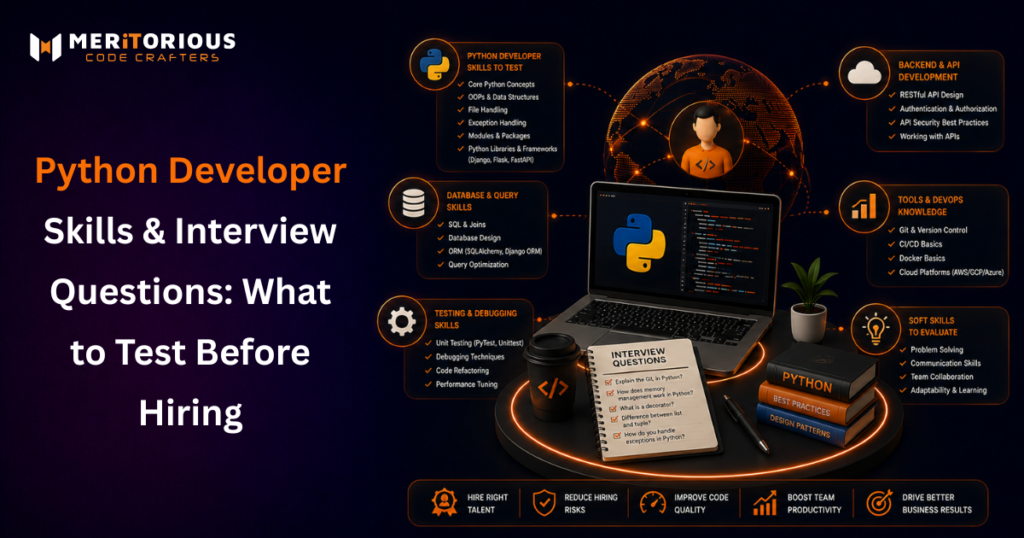
What Core Python Skills Should Every Developer Demonstrate?
Core Python proficiency means more than knowing syntax.
It means understanding how the language works – memory management, execution model, and the trade-offs between different approaches to the same problem. The following are non-negotiable for any Python hire above junior level.
Object-Oriented and Functional Programming
A strong Python developer understands when to use classes and when functions suffice. Ask candidates to explain inheritance vs composition, when to use dataclasses, and how decorators work at the implementation level – not just as usage patterns. Candidates who can only describe what a decorator does without explaining how it works are operating at a tutorial depth, not an engineering depth.
Asynchronous Python
Async/await, the event loop, and the difference between threading, multiprocessing, and asyncio are core knowledge for any developer working on modern Python backends. Ask: “When would you choose asyncio over threading, and why?” The answer reveals whether the candidate understands I/O-bound versus CPU-bound workloads – a distinction that directly affects backend architecture decisions.
Memory Management and Performance
Questions around garbage collection, memory leaks in long-running processes, and generator-based approaches to handling large datasets reveal whether a developer thinks about production behaviour, not just feature delivery. This is particularly relevant for data engineering and ML pipeline roles.
How Should You Test Framework and Backend Skills?
Framework questions should probe design decisions, not documentation knowledge. The best way to assess framework proficiency is to present a realistic scenario and ask how the candidate would approach it – what they would use, what they would avoid, and why.
Django
For Django candidates, go beyond “what is an ORM”. Ask about query optimisation using select_related and prefetch_related, custom middleware, signal handling trade-offs, and when they would bypass the ORM entirely for raw SQL. Candidates with real production Django experience will reference specific performance problems they have solved – not abstract feature lists.
FastAPI
FastAPI is the dominant choice for new Python API work in 2026. Test candidates on dependency injection patterns, background task handling, Pydantic model design, and how they manage authentication and rate limiting in production. Ask them to walk through how they would structure a FastAPI project for a multi-module service – this reveals their architectural instincts quickly.
API Design Principles
Framework-agnostic API knowledge matters more than framework familiarity. Test for: REST resource naming conventions, idempotency, versioning strategies, error response standards, and how they handle backward compatibility. A developer who cannot explain idempotency in HTTP has gaps that will surface in production.
Python Developer Skills Assessment Matrix
Use this framework to structure your technical evaluation across all interview rounds:
| Skill Area | What to Test | Signal to Look For | Red Flag |
| Core Python | OOP, decorators, generators, async/await | Explains trade-offs, not just syntax | Memorised answers, no rationale |
| Frameworks | Django ORM, FastAPI routing, DRF serialisers | Framework internals, not just tutorials | Only knows one framework superficially |
| Databases | Query optimisation, indexing, schema design | Discusses N+1, caching strategies | Can only write basic SELECT queries |
| APIs | REST design, auth, rate limiting, versioning | Names real design decisions made | Builds APIs without security thinking |
| Testing | pytest, mocking, coverage, CI integration | Writes tests by habit, not request | No testing experience or skips it |
| System Design | Scalability, trade-offs, architecture | Structured thinking, acknowledges limits | Overcomplicates or oversimplifies |
For teams building assessment processes for offshore hiring, the Python hiring guide for US startups provides a parallel framework specific to remote hiring contexts and offshore team evaluation.
What Database and Infrastructure Questions Should You Ask?
Database proficiency separates mid-level from senior Python developers. Most developers can write queries. Fewer can design schemas that perform at scale, identify indexing gaps, or explain when to use a NoSQL store versus a relational database.
- Schema design: “Walk me through how you would design the database schema for a multi-tenant SaaS application.” This tests normalisation judgment, tenant isolation strategies, and awareness of future migration complexity.
- Query performance: “How would you identify and fix a slow query in a Django application serving 100K daily users?” Strong candidates will mention EXPLAIN plans, index analysis, query profiling tools, and caching strategies.
- Caching: “When would you use Redis caching, and how would you handle cache invalidation?” Cache invalidation is a notoriously complex problem – a thoughtful, honest answer with acknowledged trade-offs signals genuine experience.
- Infrastructure awareness: Ask about deployment experience – Docker, CI/CD pipelines, environment management. A Python developer who has never deployed what they build creates dependency on a separate DevOps function that many lean teams cannot afford.
How Do You Evaluate System Design and Architecture Thinking?
System design ability is the clearest differentiator between a developer who executes tasks and one who owns outcomes. It cannot be assessed with coding puzzles. It requires open-ended scenario discussions.
A reliable system design question for Python roles: “Design a background job processing system that handles 50,000 tasks per day with retry logic and monitoring.” Listen for: queue selection rationale (Celery, RQ, cloud-native queues), idempotency handling, failure modes, observability approach, and how they would scale under increased load. Candidates who jump to implementation before asking clarifying questions are signalling execution-first thinking – a risk for roles requiring architectural judgment.
What Makes a Strong System Design Answer?
- Asks 2–3 clarifying questions before proposing a solution
- Proposes a simple solution first, then discusses how it would evolve under scale
- Acknowledges trade-offs explicitly – no design choice is presented as universally correct
- References real tools and explains why they fit the specific constraints
- Identifies what they would monitor and how they would know the system is healthy
What Soft Skills and Communication Signals Should You Assess?
Technical skills determine whether a developer can write good code. Communication skills determine whether that code gets built into the right product. For remote and offshore teams especially, communication quality is as operationally critical as Python proficiency.
Assess these qualities during the interview:
- Proactive clarification: Does the candidate ask questions before diving into solutions, or do they make assumptions and proceed?
- Honest uncertainty: Does the candidate say “I don’t know” when they don’t, or do they confabulate? Intellectual honesty correlates strongly with trustworthy engineering.
- Documentation discipline: Ask: “What does your typical PR description look like?” Developers who cannot describe their own code changes clearly create review and maintenance problems.
- Ownership language: Listen for “I built”, “I decided”, “I debugged” versus “the team did” for everything. Ownership language signals accountability.
When running this assessment process for offshore hiring, python development services india outlines the skill and communication standards applied during pre-screening – which can complement your internal evaluation process.
What Are the Most Revealing Python Interview Questions in 2026?
The following questions consistently produce the clearest signal about a developer’s real capability – not their ability to study for interviews:
- “Describe the most complex Python system you have owned end-to-end. What would you design differently today?” – Tests ownership, reflection, and growth.
- “How do you decide when a piece of code needs a test?” – Distinguishes developers with testing discipline from those who test only when required.
- “Walk me through how you would debug a memory leak in a long-running Python service.” – Tests production thinking: profiling tools, isolation techniques, systematic investigation.
- “What is the difference between a Python list and a deque, and when does it matter?” – Tests data structure judgment beyond interview-prep knowledge.
- “If you were reviewing a PR and disagreed with an architectural decision, how would you handle it?” – Tests collaboration and communication under technical disagreement – critical for team fit.
Frequently Asked Questions
1. What is the most important Python skill to test when hiring a backend developer?
For backend roles, API design judgment and database proficiency are the most predictive of on-the-job performance. Developers who understand query performance, schema design trade-offs, and REST API best practices consistently outperform those who only know framework usage patterns.
2. How long should a Python technical interview take?
A structured evaluation spread across two to three rounds is more effective than a single long session. A typical structure: 45–60 minutes for technical fundamentals and framework knowledge, 45 minutes for a system design discussion, and 30 minutes for a practical code review exercise. Total: 2–2.5 hours across separate sessions.
3. Should you use coding challenges or real-world scenarios to assess Python developers?
Real-world scenarios produce better signal than algorithm puzzles for most product engineering roles. Unless you are hiring for a role that genuinely involves algorithm-heavy work (ML research, competitive data science), time-pressured LeetCode-style assessments measure interview preparation, not job performance.
4. How do you assess a Python developer’s testing discipline during an interview?
Ask them to review a piece of code and identify what they would test and why. Alternatively, ask them to describe their approach to writing tests for a feature they have recently built. Developers with genuine testing discipline will describe what they test, what they skip, and why – not just confirm that they write tests.
5. What red flags should immediately disqualify a Python candidate?
Inability to explain why a design decision was made (not just what was done), no demonstrable testing practice, vague or evasive answers about production experience, and poor communication during technical explanation are the four most reliable disqualifying signals. Job title and years of experience are poor predictors of these qualities.
Conclusion: Build a Process, Not a Question List
The difference between a good Python hire and a costly mistake is rarely visible in a CV. It emerges during a structured evaluation that tests judgment, communication, and production thinking alongside technical syntax. The framework in this guide gives you a repeatable process – not a one-time checklist – that improves with every hiring round.
For teams looking to Hire Python Developers in India, pre-screened candidates who have already passed technical and communication assessments significantly reduce the interview burden on your internal team while maintaining the hiring standard your product requires.
Whether you are building your first Python engineering team or scaling an existing one, a rigorous evaluation process is the single highest-leverage investment you can make before a developer writes their first line of production code.