KEY TAKEAWAYS
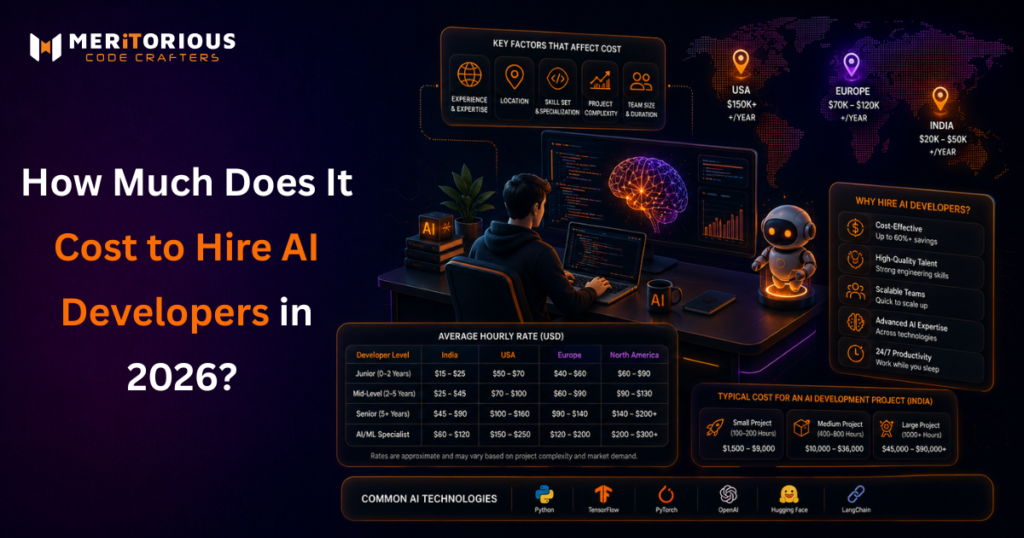
- AI developer hiring costs span a wide range – from $1,200/month for a junior ML engineer in India to $40,000+/month for a senior generative AI specialist in the US – making role definition and geography the two most impactful cost variables.
- Generative AI and LLM engineers command the highest premiums in 2026 due to concentrated demand and limited supply; they cost 30–50% more than equivalent ML engineers across all markets.
- Project-based AI development in India costs 65–75% less than equivalent work in the US or UK – with no reduction in model quality when the data preparation and success criteria are well defined before development begins.
- MLOps and AI infrastructure roles are frequently under-budgeted: deploying an AI model to production reliably typically adds 30–40% to the cost of the model development phase itself.
- The most reliable predictor of AI project cost overrun is insufficient data preparation – teams that invest in data audit and cleaning before development consistently deliver closer to initial budget estimates.
Budgeting for AI development in 2026 is not straightforward. “AI developer” covers at least seven distinct specialisations – each with its own skill requirements, market rate, and project fit. A generative AI engineer working with large language models operates in a different market from a computer vision specialist or an MLOps engineer deploying inference infrastructure. Treating them as interchangeable leads to hiring the wrong profile and budgeting the wrong number.
This guide gives business leaders, CTOs, and hiring managers a complete picture of what AI development actually costs in 2026 – by specialisation, experience level, geography, and project type – so you can build a realistic budget before the first developer conversation.
What Is an AI Developer? Understanding the Specialisations
An AI developer is not a single job category. It is an umbrella term covering multiple distinct engineering specialisations that overlap in the AI space. Hiring budget depends almost entirely on which profile you actually need.
- Machine Learning (ML) Engineer: Designs, trains, evaluates, and deploys ML models. Works with structured data and standard prediction tasks – classification, regression, ranking, clustering.
- NLP / Natural Language Processing Engineer: Specialises in text-based AI – sentiment analysis, entity extraction, document classification, language models, and chatbot pipelines.
- Computer Vision Engineer: Builds image and video analysis systems – object detection, facial recognition, quality inspection, medical imaging.
- Generative AI / LLM Engineer: Works with large language models (GPT-4, Claude, Gemini, Llama), prompt engineering, RAG architectures, fine-tuning, and LLM application pipelines.
- MLOps Engineer: Deploys, monitors, and maintains AI models in production – CI/CD for ML, model versioning, drift detection, inference infrastructure.
- Data Scientist (ML-focused): Explores data, identifies patterns, builds experimental models, and communicates findings – closer to research than production engineering.
- AI Product Engineer: Combines frontend, backend, and AI integration skills to build full AI-powered applications – a generalist profile for teams that cannot staff separately.
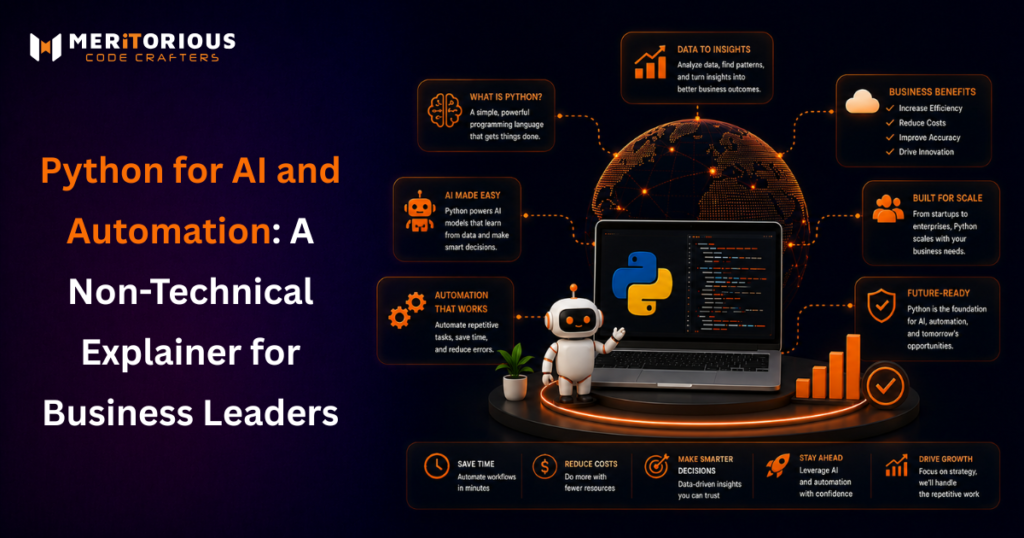
Understanding what Python for AI and Automation actually covers from a business perspective is useful context before defining which AI developer profile your project requires.
AI Developer Monthly Rates in 2026: India vs US
All figures below represent dedicated monthly engagement rates. Hourly freelance rates run higher per hour but typically cost more in aggregate for sustained workloads.
| AI Developer Profile | India Junior | India Mid | India Senior | US Senior (equiv.) |
| ML Engineer | $1,200–$2,000 | $3,000–$5,500 | $6,000–$10,000 | $18,000–$28,000 |
| AI/NLP Engineer | $1,500–$2,500 | $3,500–$6,000 | $6,500–$11,000 | $20,000–$30,000 |
| Computer Vision Engineer | $1,800–$2,800 | $4,000–$7,000 | $7,000–$12,000 | $22,000–$32,000 |
| MLOps / AI Infrastructure | $1,500–$2,500 | $3,500–$6,500 | $7,000–$13,000 | $20,000–$35,000 |
| Data Scientist (ML focus) | $1,200–$2,200 | $3,000–$5,500 | $5,500–$9,500 | $16,000–$26,000 |
| Generative AI / LLM Engineer | $2,000–$3,500 | $4,500–$8,000 | $8,000–$15,000 | $25,000–$40,000 |
| AI Product Engineer (full-stack AI) | $2,000–$3,200 | $4,000–$7,000 | $7,500–$13,000 | $22,000–$35,000 |
India delivers 65–75% cost savings at senior level versus US equivalents. For a 3-person AI team (1 senior ML engineer + 1 MLOps engineer + 1 data scientist), the annual saving through Indian hiring versus US hiring typically exceeds $500,000 – without requiring any reduction in technical output quality when hiring through a structured, vetted engagement.
For the parallel Python developer rate landscape that underpins most AI work, Cost to Hire Python Developers from India provides granular benchmarks by experience tier and specialisation.
What Makes Generative AI Developers More Expensive?
Generative AI and LLM engineering is the most expensive AI specialisation in 2026 due to a sharp demand-supply imbalance. The commercial explosion of LLM-powered products from 2023 onward created hiring demand that outpaced talent development by two to three years. Engineers with hands-on experience in RAG architecture, LLM fine-tuning, vector database integration, and prompt pipeline engineering are scarce globally – not just in any single market.
The premium reflects real skill scarcity – not just market hype. A generative AI engineer needs:
- Deep understanding of transformer architecture and attention mechanisms
- Experience with embedding models and vector similarity search (Pinecone, Weaviate, pgvector)
- Prompt engineering discipline – including chain-of-thought, few-shot, and structured output techniques
- Production LLM integration patterns – streaming, token cost management, fallback handling, evaluation pipelines
- Familiarity with LLM observability tooling – LangSmith, Helicone, or equivalent frameworks
In India, senior generative AI engineers with this full stack of capabilities typically command ₹1,20,000–₹2,50,000/month – still 50–60% below US rates for the same profile but commanding a 30–50% premium over standard ML engineers in the same market.
What Does an AI Project Actually Cost? Real Budget Ranges
Monthly developer rates are one dimension of cost. The other is scope – how long the project takes and how many developers it requires. The table below reflects project-level costs using Indian development rates:
| Project Type | Scope | India Cost (USD) | Timeline |
| AI chatbot (LLM-powered) | Intent classification, API integration, basic UI | $15,000–$40,000 | 6–12 weeks |
| Custom ML model (prediction) | Data prep, training, evaluation, deployment | $25,000–$70,000 | 8–16 weeks |
| Computer vision system | Model training, inference API, integration | $35,000–$90,000 | 10–20 weeks |
| Recommendation engine | Data pipeline, model, A/B testing layer | $40,000–$100,000 | 12–20 weeks |
| NLP / document processing | Entity extraction, classification, output API | $20,000–$60,000 | 8–14 weeks |
| Full AI SaaS product | Backend, ML services, frontend, MLOps | $80,000–$200,000+ | 5–9 months |
| Generative AI feature (RAG) | Vector DB, LLM integration, prompt pipeline | $30,000–$75,000 | 8–14 weeks |
These ranges assume clean, accessible data going into the project. Data preparation – cleaning, labelling, structuring, and pipeline engineering – frequently adds 20–35% to project cost when not budgeted separately. Budget for data infrastructure before the AI engineering phase begins, not after.
What Is the Cost of MLOps – and Why Is It Underestimated?
MLOps – the infrastructure for deploying, monitoring, and maintaining AI models in production – is the most consistently under-budgeted phase of AI projects. Business teams often budget for model development and treat deployment as a minor final step. In practice, building reliable inference infrastructure that handles real production load typically costs 30–40% of the model development budget again.
MLOps scope includes:
- Model serving infrastructure: APIs that expose model predictions to your application – with latency requirements, scaling, and fallback logic.
- Model versioning and rollback: Registries that track model versions and allow safe rollback when a new model underperforms.
- Monitoring and drift detection: Alerts when model performance degrades because the production data distribution shifts from the training distribution.
- Retraining pipelines: Automated or scheduled processes that retrain models on new data without manual developer intervention.
An AI model that works in a Jupyter notebook is not a product. The MLOps layer is what converts research output into production capability – and it requires dedicated engineering time that must be included in any realistic AI project budget.
What Factors Cause AI Project Budgets to Overrun?
Budget overruns in AI projects have consistent, identifiable causes – most of which appear before a single model is trained.
1. Unclear Problem Definition
“Build an AI that improves customer experience” is not a problem definition – it is a direction. Projects without a specific, measurable target output (“reduce customer churn by identifying accounts likely to cancel 30 days in advance with at least 70% precision”) cannot be scoped accurately, and scope creep is virtually guaranteed.
2. Underestimated Data Preparation Time
AI teams consistently report that data cleaning and preparation takes 40–60% of project time on real business datasets. If your budget assumes clean, structured, labelled data and the reality is spreadsheets with inconsistent formats across three years, the timeline and cost will be wrong from the start.
3. Skipped Evaluation Framework
Projects that do not define how model quality will be measured before training begins often discover – after significant investment – that their model performs well on the training dataset and poorly on real data. Building the evaluation framework first is not overhead; it is risk management.
4. No MLOps Budget
Teams that budget only for model development, not deployment, end up with a model that cannot safely go to production – or that goes to production without monitoring, creating invisible quality degradation over time.
When building teams to avoid these failure modes, Hire AI Developers in India through a partner who screens for production AI experience – not just model training – significantly reduces the risk of scope and cost overrun.
How Do You Hire AI Developers Cost-Effectively From India?
India has the deepest concentration of AI and ML talent outside the US and China, with the largest cost advantage of any comparable market. Effective hiring requires a clear profile, a structured evaluation process, and the right engagement model for your project type.
Define the Specific Profile Before Posting the Role
“AI developer” is too broad to hire well. Define: the ML framework (TensorFlow, PyTorch, scikit-learn), the domain (NLP, CV, tabular data), the deployment environment (AWS SageMaker, GCP Vertex, self-hosted), and the production experience level required. Hiring a strong ML researcher for a production MLOps role – or vice versa – is a common and expensive mismatch.
Test for Production Thinking, Not Just Model Knowledge
The gap between developers who can train a model and developers who can maintain one in production is significant. Interview questions should include: “How would you detect when a deployed model is underperforming?” and “Walk me through how you would structure a retraining pipeline for a classification model on monthly data.”
Consider Data Scientists and AI Developers as Distinct Hires
For teams building both exploratory analytics and production AI systems, data scientists and AI engineers are different profiles with different cost structures. Hire Data Scientists in India to handle data exploration, feature engineering, and model evaluation – while AI/ML engineers handle productionisation and infrastructure.
Frequently Asked Questions
1. What is the average cost to hire an AI developer in India in 2026?
Monthly rates range from $1,200–$2,800 for junior AI/ML profiles to $6,000–$15,000 for senior specialists in generative AI, computer vision, or MLOps. Mid-level ML engineers – the most commonly hired profile for production AI work – typically cost $3,000–$6,500/month through a vetted Indian development partner.
2. Is it cheaper to hire AI developers in India than build an in-house US team?
Yes, significantly. A 3-person AI team in India (senior ML engineer + MLOps engineer + data scientist) costs $120,000–$250,000/year all-in. The same team in the US costs $450,000–$700,000+ in total employment cost. The saving funds meaningful product investment – additional engineering capacity, data infrastructure, or go-to-market resources.
3. How long does it take to hire a qualified AI developer from India?
Through a specialist engagement partner with pre-screened AI talent, onboarding typically takes 1–2 weeks. Direct hiring through job boards takes 4–8 weeks for standard ML profiles and 8–14 weeks for senior generative AI specialists, due to supply constraints at that level.
4. Do I need separate data engineers and AI/ML engineers, or can one person do both?
For most small team budgets, a mid-to-senior ML engineer can handle both data pipeline work and model development – but not at high quality simultaneously. Data engineering is a full-time function on products with significant data volume or complexity. For lean teams, prioritise the ML engineer and budget for a data engineer as the second hire when data volume justifies it.
5. What hidden costs should I budget for beyond AI developer salaries?
Cloud compute for model training and inference (GPU instances on AWS/GCP can run $2,000–$10,000/month for active training workloads), data labelling if your training data is not already labelled, vector database or MLOps tooling subscriptions, and the MLOps engineering time to build production infrastructure – which typically adds 30–40% to model development cost.
Conclusion: Build Your AI Budget Around the Full Scope
AI developer costs in 2026 vary more by specialisation than by any other factor. A junior ML engineer and a senior generative AI architect are both “AI developers” – but they serve entirely different project needs, sit in different talent markets, and cost three to five times apart. Getting the profile definition right before you start hiring is the most important cost-control decision you will make.
India offers the strongest combination of technical depth, production AI experience, and cost efficiency of any market available to US and UK businesses in 2026. The savings are structural – not dependent on economic conditions – and the talent pool at senior level has grown materially in the last two years as Indian engineers gained production LLM and MLOps experience on international products.
To build your AI team with the right profiles at the right cost, work with a trusted Mobile App Development Agency in India that brings structured AI hiring processes, pre-vetted specialisations, and engagement models that match your project stage – from a single ML engineer to a full AI product team.