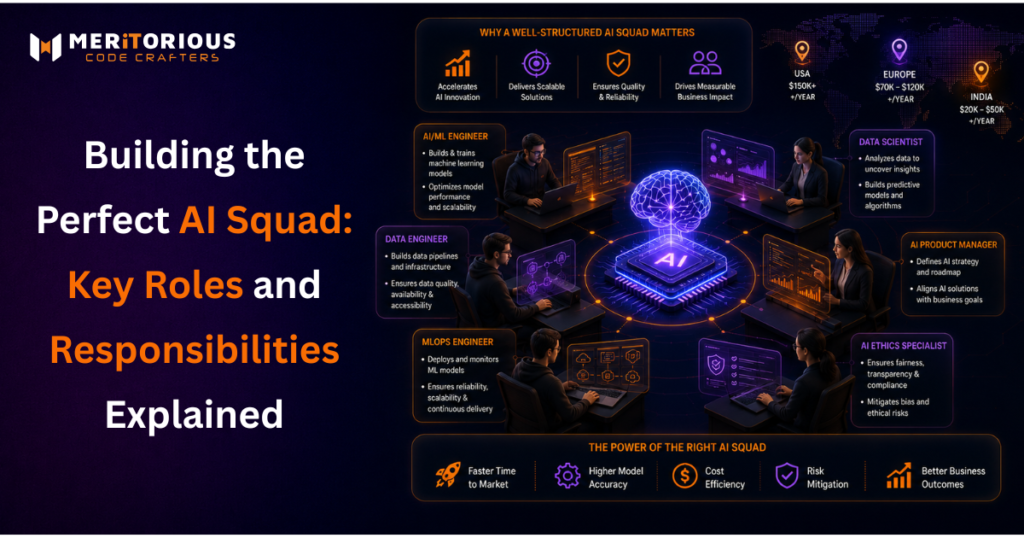
KEY TAKEAWAYS
- An AI development team is not a single function – it spans at least five distinct roles (AI architect, ML engineer, data scientist, data engineer, MLOps engineer), each owning a different stage of the AI delivery lifecycle.
- The most common AI team failure is building a team strong in experimentation but weak in production – models that work in notebooks but never deploy reliably because MLOps and data engineering roles were deprioritised.
- Team size and composition should match company stage: a two-person ML squad is right for MVP; a cross-functional squad with dedicated MLOps and product management is the minimum for production AI at scale.
- AI architects are the most under-hired senior role – teams that skip this function accumulate architectural debt that slows delivery and creates costly refactors within 12–18 months of initial build.
- Agile sprint structures applied to AI teams require modification – model training cycles, data availability, and experiment tracking do not map cleanly to standard two-week sprints and need adapted delivery frameworks.
Most companies that struggle with AI delivery do not have a technology problem – they have a team structure problem. They hired data scientists but skipped data engineers. They built models but had no MLOps function to deploy them. They started with a solution and assigned whoever was available to “do the AI.” The result is a project that produces interesting experiments and no production capability.
Building an AI development team that actually ships requires understanding what each role does, where the boundaries sit, and how the team operates as a system – not just a collection of individual contributors. This guide defines the core roles of a high-performing AI squad, what each one owns, how they interact, and how to structure the team for your company’s current stage.
What Is an AI Development Team?
An AI development team is a cross-functional group responsible for building, deploying, and maintaining AI-powered systems in production. Unlike a traditional software team, an AI squad spans data infrastructure, statistical modelling, software engineering, and product management – often requiring five to eight distinct role types to cover the full delivery lifecycle.
The defining characteristic of a well-structured AI team is end-to-end ownership: from raw data through to a reliable, monitored, production-grade AI system. Teams that own only part of this chain – usually the modelling phase – consistently underdeliver because the work that makes AI valuable in business is what happens before and after the model is trained.
Core AI Team Roles: Responsibilities at a Glance
Every role in a high-performing AI development team owns a distinct phase of the AI delivery lifecycle:
| Role | Primary Responsibility | Core Skills | Reports To / Works With |
| AI Architect | System design, framework selection, technical governance | System design, cloud AI, MLOps, API architecture | CTO / Product Lead |
| ML Engineer | Model development, training, evaluation, productionisation | Python, PyTorch/TF, scikit-learn, feature engineering | AI Architect, Data Engineer |
| Data Scientist | Data exploration, experimentation, statistical analysis | Statistics, Python, SQL, visualisation, A/B testing | ML Engineer, Product Manager |
| Data Engineer | Data pipelines, ETL, data quality, storage infrastructure | Spark, Airflow, dbt, SQL, cloud storage | ML Engineer, Data Scientist |
| MLOps Engineer | Model deployment, monitoring, retraining pipelines, CI/CD | Kubernetes, Docker, model registries, drift detection | AI Architect, ML Engineer |
| AI Product Manager | Requirements, roadmap, success metrics, stakeholder alignment | Product sense, data literacy, agile, communication | All technical roles |
| GenAI / LLM Engineer | LLM integration, RAG architecture, prompt pipelines, fine-tuning | LangChain, vector DBs, prompt engineering, embeddings | AI Architect, ML Engineer |
| AI QA / Evaluation Engineer | Model quality testing, bias detection, regression evaluation | Testing frameworks, statistical sampling, LLM eval | ML Engineer, MLOps Engineer |
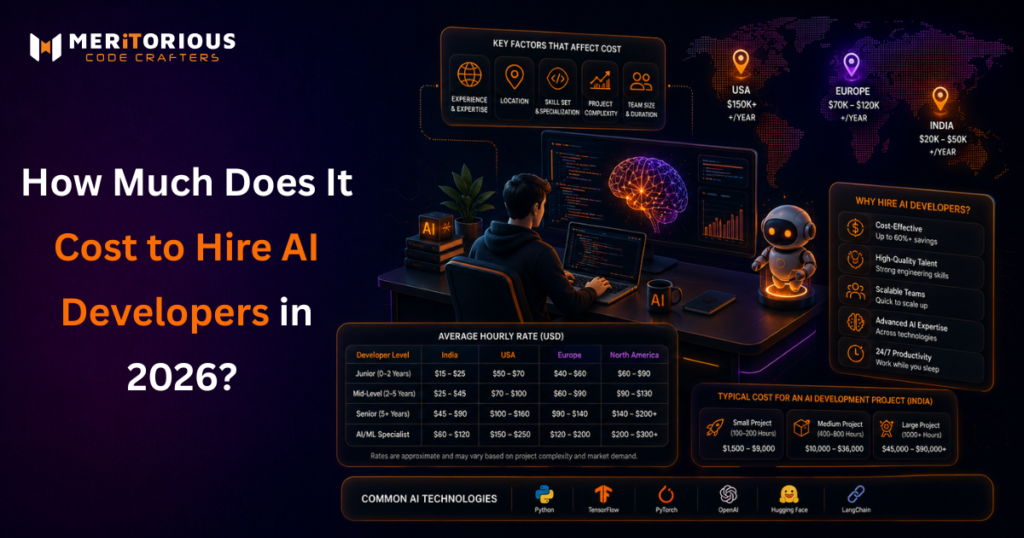
The roles above represent the full complement of a mature AI squad. Early-stage teams staff the critical path first – ML engineer and data scientist – and add supporting roles as product complexity grows. Budget and hiring guidance for each profile is covered in detail in cost to hire AI developers.
Key Role Deep Dives: What Each Person Actually Owns
AI Architect: The Most Under-Hired Senior Role
The AI architect owns the technical vision of the entire AI system – not individual models, but the infrastructure, integrations, and design patterns that make multiple models and services work together reliably. In small teams, this responsibility defaults to the most senior ML engineer, which is a workable short-term arrangement that creates architectural debt at scale.
The AI architect’s remit includes:
- Selecting the core ML frameworks, cloud platform, and serving infrastructure
- Defining how AI services integrate with the broader product architecture
- Setting standards for model versioning, experiment tracking, and deployment pipelines
- Governing technical decisions that affect multiple model types or product areas
- Evaluating build vs buy decisions for AI tooling and infrastructure components
Teams that skip the AI architect role consistently report the same problem 12–18 months in: a collection of disconnected models, inconsistent deployment patterns, and no clear path to scaling. Hiring this profile early is one of the highest-leverage decisions in AI team structure.
ML Engineer: The Engine of the Team
The ML engineer is the core technical contributor in most AI development teams – responsible for translating business problems into trained, evaluated, and production-ready models. This is not a research role. The ML engineer’s primary output is a model that works in the real world, under real data conditions, with acceptable latency and reliability.
Day-to-day responsibilities span:
- Feature engineering from raw data provided by the data engineer
- Model selection, training, and hyperparameter optimisation
- Evaluation against business-defined success metrics – not just accuracy
- Collaborating with MLOps to build the deployment and retraining pipeline
- Debugging model behaviour when production performance degrades
The ML engineer’s relationship with the data scientist is collaborative but distinct: the data scientist runs exploratory analysis and validates hypotheses; the ML engineer takes validated findings and builds the production system.
Data Scientist: The Hypothesis Engine
A data scientist’s primary value is in understanding data deeply enough to identify where AI can create business value – and validating whether a proposed model approach actually works before committing engineering resources to build it. This is fundamentally an analytical and experimental role, not a software engineering one.
Core responsibilities:
- Exploratory data analysis to identify predictive signals and data quality issues
- Statistical experimentation – A/B tests, hypothesis validation, significance testing
- Feature importance analysis and model interpretability reporting
- Communicating model behaviour and limitations to non-technical stakeholders
- Evaluating model outputs against business outcomes, not just technical metrics
To build this function with experienced practitioners, Hire Data Scientists india through a partner that screens for both statistical depth and business communication ability – the combination that makes data scientists genuinely useful in cross-functional AI teams.
Data Engineer: The Foundation Layer
No AI team delivers consistently without strong data engineering. The data engineer is responsible for the infrastructure that makes data available, clean, and accessible to the modelling team – on schedule, at scale, and with sufficient quality to train reliable models. Poor data engineering is the single most common reason AI projects take longer and cost more than planned.
What the data engineer owns:
- Building and maintaining ETL/ELT pipelines from source systems to the feature store
- Data quality monitoring – detecting schema changes, missing values, and distribution drift
- Designing and managing data storage appropriate to model training requirements
- Coordinating with ML engineers on feature availability and pipeline timing
- Ensuring data governance and access controls meet compliance requirements
MLOps Engineer: The Delivery Enabler
MLOps engineers are the bridge between model development and production AI. Without this role, models frequently work in development and fail in production – inconsistent environments, missing dependencies, unpredictable inference latency, and no monitoring for when performance degrades. This profile is consistently under-resourced relative to its impact on AI team output.
MLOps responsibilities:
- Containerising and deploying ML models to cloud inference infrastructure
- Building CI/CD pipelines for model updates – automated testing, staged rollouts
- Implementing model monitoring: latency, throughput, prediction quality, data drift
- Managing model registries and experiment tracking (MLflow, Weights & Biases)
- Building automated retraining triggers when model performance falls below threshold
Generative AI / LLM Engineer: The Newest Critical Role
In 2026, most product-facing AI development teams need at least one engineer who specialises in large language model integration. This is a distinct skill profile from standard ML engineering – it focuses on prompt architecture, retrieval-augmented generation (RAG), vector database management, and LLM evaluation, rather than training custom models from scratch.
Core GenAI engineering responsibilities:
- Designing RAG pipelines that retrieve relevant context and pass it to the LLM reliably
- Managing embedding models and vector databases (Pinecone, Weaviate, pgvector)
- Building prompt evaluation frameworks to measure output quality systematically
- Implementing LLM cost management – caching, token optimisation, model routing
- Fine-tuning smaller models where latency or cost makes full LLM calls impractical
AI Product Manager: The Scope Keeper
The AI PM owns the definition of what the AI team is building and why – translating business requirements into model success criteria, managing the roadmap, and communicating AI capabilities and limitations to stakeholders who do not have technical backgrounds. Without this role, AI teams frequently build technically impressive systems that do not align with product needs.
The AI PM does not need to be able to train models. They need sufficient data literacy to understand what questions are answerable with AI, what data is required, and what constitutes a production-ready outcome. Strong AI PMs reduce scope creep, prevent premature deployment, and keep the team focused on measurable business outcomes.
How Should You Structure Your AI Team by Company Stage?
AI team structure should match your product maturity – not your ambition. Overstaffing an AI team before you have defined the right problem creates expensive overhead. Understaffing creates delivery bottlenecks that delay the value you are trying to unlock.
| Company Stage | Minimum AI Team | Add When Scaling | Hiring Priority |
| Pre-product / MVP | 1 ML Engineer + 1 Data Scientist | Data Engineer as data volume grows | ML Engineer first |
| Early SaaS (Seed–A) | ML Eng + Data Sci + AI PM | MLOps when first model ships to production | AI PM to define scope |
| Growth (Series A–B) | Full squad: all core roles | GenAI Engineer for LLM features | MLOps + Data Engineer |
| Enterprise / Scale | Squads per AI product area | AI QA Engineer for compliance | AI Architect for governance |
How Does a High-Performing AI Team Collaborate?
The defining characteristic of effective AI team collaboration is shared ownership of outcomes, not handoffs between functions. A team where the data scientist throws a trained model over the wall to the ML engineer – who hands it to MLOps – produces slower delivery and lower quality than one where all three roles participate in problem definition, evaluation criteria, and deployment planning from the start.
Adapting Agile for AI Development
Standard two-week sprints do not map cleanly to AI development. Model training runs take variable time. Data availability determines what experiments are possible. Evaluation results change the direction of the next sprint. AI-adapted agile typically uses:
- Experiment-based sprints: Sprints defined by hypotheses to test and questions to answer, not features to ship
- Parallel workstreams: Data engineers work ahead of the modelling sprint to ensure data is available when needed
- Definition of ready for models: Clear criteria – data quality, sample size, labelling completeness – before training begins
- Model review gates: Structured evaluation before any model progresses from experiment to production candidate
Cross-Functional Communication Standards
AI teams that communicate well share one consistent habit: they translate model performance into business impact before presenting to stakeholders. Precision, recall, and F1 scores are internal team metrics. “This model reduces false fraud alerts by 40%, saving 12 hours of analyst review per week” is a business metric. The AI PM typically owns this translation.
Where and How Do You Hire These Roles?
Building a cross-functional AI team quickly and cost-effectively is one of the strongest arguments for hiring from India. The Indian AI talent market has matured significantly – particularly in ML engineering, data engineering, and MLOps – and offers senior-level practitioners at 60–70% of US market rates, with sufficient English proficiency and remote collaboration experience for distributed team structures.
The most important hiring principle for AI teams is not to hire the same profile multiple times. A team of five data scientists with no data engineer, ML engineer, or MLOps function has a research capability and no delivery capability. Define the team’s critical path – what it needs to ship its first production model – and hire against that path, not against familiar job titles.
To build your AI development team with pre-vetted engineers across all the roles covered in this guide, Hire AI Developers india through a partner that matches specialisations to project requirements – not just language and framework familiarity.
Frequently Asked Questions
1. What is the minimum viable AI team for a product company?
For a product company building its first AI feature, the minimum viable AI team is one mid-to-senior ML engineer and one data scientist. The ML engineer owns model development and deployment; the data scientist validates that the problem is solvable and the data is sufficient. A data engineer should be the third hire as soon as the data pipeline becomes a bottleneck – typically within 2–3 months of starting model development.
2. What is the difference between an ML engineer and a data scientist on an AI team?
A data scientist focuses on understanding data, running experiments, and validating hypotheses – their primary output is insight and validated models. An ML engineer focuses on building, optimising, and deploying production systems – their primary output is a reliable, monitored model serving real users. Both roles are essential; they are not interchangeable, and hiring only one profile creates a gap the team will feel within the first delivery cycle.
3. Does every AI team need an AI architect?
Not at the earliest stage. A senior ML engineer can carry architectural responsibility for a single model or feature. The AI architect becomes essential when: the team is building more than two distinct AI systems, multiple teams are contributing to shared AI infrastructure, or the product has compliance and governance requirements that demand formal technical oversight. Hiring the AI architect role too late is more common than hiring it too early.
4. How do you manage an AI team differently from a software engineering team?
AI teams require adapted management practices: experiment budgets (time and compute allocated to exploration with no guaranteed output), non-binary sprint success definitions (a negative experiment result that redirects the team is valuable), longer planning horizons for data availability, and clearer escalation paths when data quality blocks progress. Managers who treat AI development like feature development consistently create frustration on both sides.
5. How do you evaluate AI team performance?
AI team performance metrics should combine technical and business dimensions: model quality against defined success criteria, time from problem definition to production deployment, system reliability in production (uptime, latency SLAs), and business impact of deployed models (conversion lift, cost reduction, error rate improvement). Teams evaluated only on model technical metrics tend to over-invest in accuracy at the expense of delivery speed and production reliability.
Conclusion: Build for Delivery, Not for Demonstrations
An AI squad that can impress in demos but cannot deploy reliably is an expensive research function, not a product capability. The difference between these two outcomes is almost always team structure – specifically, whether the team has the full range of roles needed to take a business problem all the way from raw data to a monitored, production-grade AI system.
Structure your AI team around the delivery lifecycle – data engineering, modelling, MLOps, product management – not around the job titles you are most familiar with. Hire the critical path first. Add specialisations as complexity grows. And treat every role as a permanent engineering function, not a project resource.
If you are ready to build or expand your AI development team, Book a Consultation to discuss the right team composition for your product stage, use case, and hiring budget – and get matched with pre-vetted AI engineers who are ready to contribute from day one.