
Executive Summary
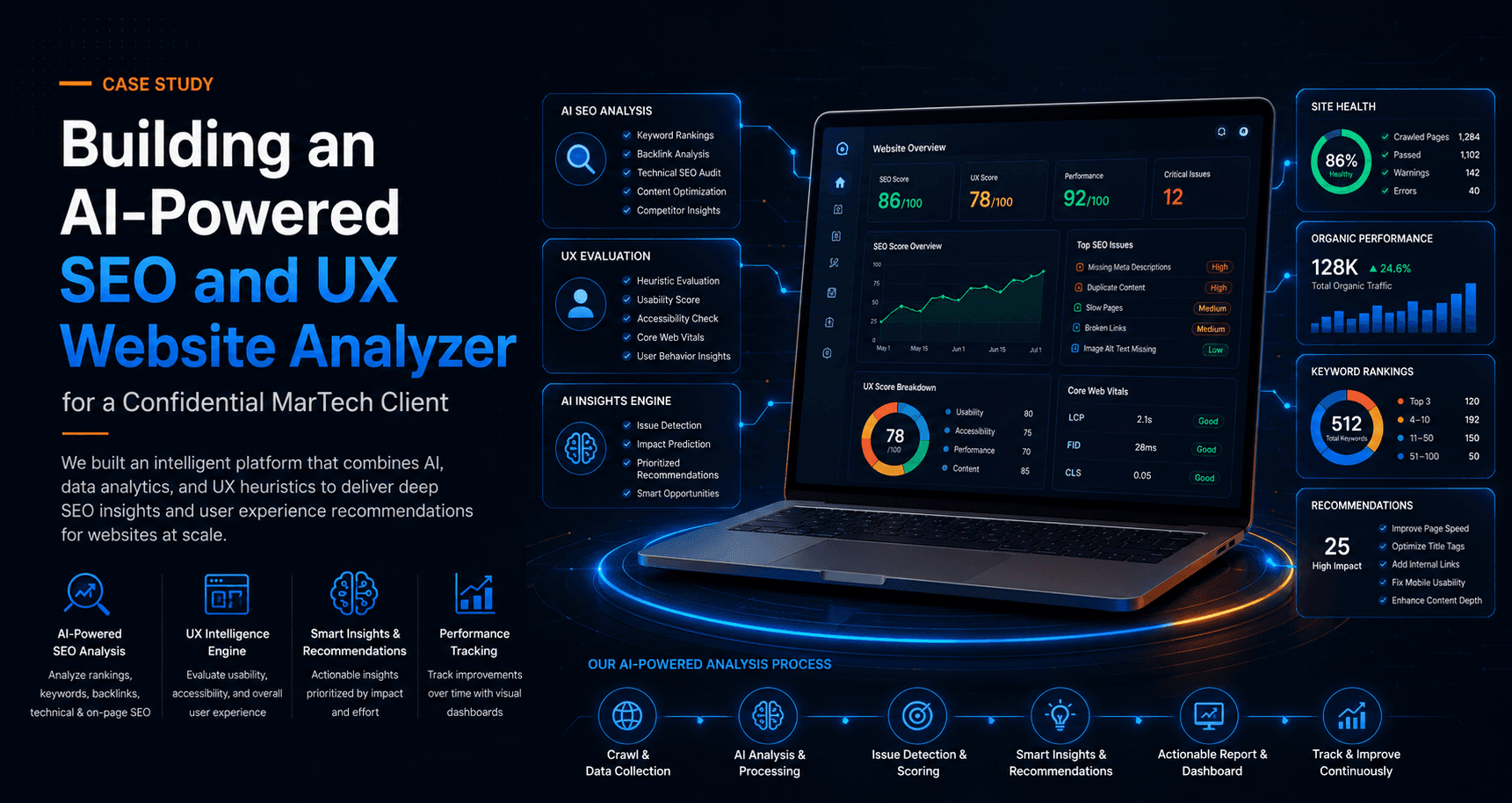
A confidential SaaS client in the digital marketing technology space partnered with Meritorious CodeCrafters to design and build an AI-powered website audit platform. The client needed a way for marketers, product owners, and digital teams to move beyond static SEO reports and get fast, explainable insight into both the SEO and user experience health of any website. Meritorious CodeCrafters delivered a full-stack SaaS application that combines automated SEO and UX scoring with a conversational AI assistant, letting users ask natural-language questions about their site's performance and receive contextual, LLM-generated answers grounded in their own analysis history. The result is a single platform where technical website diagnostics and AI-driven interpretation live side by side, reducing the gap between "here is your report" and "here is what you should actually do."
Client Overview
Confidential SaaS Client - Digital Marketing Technology Sector
The client operates in the digital marketing technology space, building tools for marketers, product owners, and digital teams who need to understand and improve website performance. Their target users are non-technical to semi-technical professionals who need clear, actionable answers rather than raw technical audit data. Due to a confidentiality agreement, the client's name and specific brand identity are withheld in this case study.
Business Challenge
Traditional website audit tools tend to produce dense, technical SEO reports that are accurate but hard to act on, especially for marketers and product owners without a deep technical background. At the same time, most tools evaluate SEO and user experience separately, forcing teams to stitch together insights from multiple platforms. The client needed a unified solution that could:
- Automatically evaluate both SEO and UX from a single URL submission
- Translate technical findings into clear strengths, weaknesses, and recommendations
- Let users interrogate their results conversationally instead of re-reading static reports
- Retain historical analysis data so users could track site health over time
- Operate securely as a multi-user SaaS platform with proper authentication and rate-limited API access
Project Objectives
- Build a registration and authentication system suitable for a secure, multi-tenant SaaS platform
- Develop a background-processed website analysis engine covering SEO and UX scoring
- Design a dashboard and historical reporting system so users can revisit past analyses
- Integrate a large language model (LLM)–powered chat assistant capable of answering questions using a user's own analysis data
- Combine relational and semantic (vector) data storage to give the AI assistant contextual memory of past reports
- Deliver a responsive, modern frontend suitable for both technical and non-technical users
Solution
Meritorious CodeCrafters designed and built the AI-powered Website Analyzer as a full-stack SaaS platform, connecting a FastAPI backend, a React frontend, and an AI layer that ties analysis data directly into a conversational assistant.
User Onboarding and Authentication
The team implemented a secure registration and login flow using JWT-based access tokens and an OAuth 2.0 login pattern, with backend authorization guards protecting all API endpoints. Rate limiting was applied to sensitive endpoints - including authentication, analysis submission, chat, and history retrieval - to protect the platform against abuse and ensure fair usage across users.
Website Analysis Engine
At the core of the platform is a background-processed analysis pipeline. When a user submits a URL, the system queues the request for asynchronous processing rather than blocking the user's session, then runs a multi-dimensional evaluation that produces:
- An SEO score with associated strengths and weaknesses
- A UX score with associated strengths and weaknesses
- Identification of missing on-page elements
- Actionable, itemized recommendations for improvement
Each completed analysis is persisted and made available in the user's history, with visual score bars and clearly separated sections for strengths, weaknesses, and recommendations in the detailed report view.
Dashboard and Reporting
The frontend dashboard surfaces recent analyses as status cards (processing or completed), so users can track multiple audits at once without needing to manually refresh or dig through logs. Completed analyses immediately display SEO and UX scores, and users can drill into a full detail view for a comprehensive breakdown of any individual report.
AI Chat Assistant
Meritorious CodeCrafters integrated a conversational AI layer powered by Google's Gemini LLM, connected directly to each user's analysis data. The chat assistant supports both analysis-specific sessions (tied to a particular website report) and general-purpose sessions, and maintains full session history so users can return to earlier conversations. Response streaming was implemented to give the interface a responsive, real-time chat feel rather than a slow request-response cycle. Sessions and messages support soft deletion, preserving data integrity while giving users control over their chat history.
Data and Search Architecture
To let the AI assistant answer questions with real context rather than generic LLM output, the team built a dual-storage architecture: structured analysis results are stored in a relational PostgreSQL database via async SQLAlchemy, while semantic representations of the same data are stored in a Chroma vector database. This allows the chat assistant to retrieve relevant historical context semantically - rather than through rigid keyword lookups - when answering a user's question about their site.
Frontend Experience
The client-facing application was built with React and Vite, styled with Tailwind CSS, and structured around dedicated pages for the landing page, login, registration, dashboard, analysis detail view, and chat interface. The frontend communicates with the backend through an Axios-based API client, handles authentication tokens client-side, and reflects real-time updates to chat sessions and messages as they occur.
Technology / Expertise
Backend: FastAPI, Async SQLAlchemy, Alembic (migrations), Python background task processing
Database: PostgreSQL (relational data), Chroma (vector database for semantic search)
AI / LLM: Google Gemini for conversational chat and semantic interpretation
Frontend: React, Vite, Tailwind CSS, Axios
Security: JWT-based authentication, OAuth2 login flow, backend authorization guards, endpoint-level rate limiting
Implementation Process
01. Discovery
Meritorious CodeCrafters worked with the client to define the core product vision: a unified SEO and UX analysis tool augmented by an AI assistant capable of contextual, conversational interpretation of results.
02. Architecture and Strategy
The team designed a backend architecture capable of handling asynchronous, potentially long-running website analysis jobs without blocking the user experience, alongside a dual-database strategy to support both structured reporting and semantic AI search.
03. Core Platform Development
The engineering team built the authentication system, the analysis engine, the dashboard, and the historical reporting views, establishing the relational data model in PostgreSQL with Alembic-managed migrations.
04. AI Integration
The team layered in the Gemini-powered chat assistant, connected it to both analysis-specific and general chat sessions, implemented response streaming, and built the semantic retrieval layer using Chroma so the assistant could reference a user's own analysis history.
05. Frontend Build
In parallel, the React and Vite frontend was developed with Tailwind CSS, covering the landing page, authentication flows, dashboard, analysis detail pages, and the chat interface, with attention to loading states and error handling throughout.
06. Testing and Refinement
The platform was tested across the core workflows - registration, analysis submission, background processing, report viewing, and AI chat - to validate reliability of the asynchronous pipeline and the accuracy of the AI assistant's contextual responses.
Key Features / Deliverables
- Secure, token-based user registration and login (JWT + OAuth2)
- URL submission and background-processed website analysis
- Automated SEO scoring with strengths, weaknesses, and recommendations
- Automated UX scoring with strengths, weaknesses, and recommendations
- Dashboard with real-time status cards for processing and completed analyses
- Detailed per-analysis report pages with visual score bars
- AI chat assistant supporting both analysis-specific and general sessions
- Streaming AI responses for a real-time conversational feel
- Session-based chat history with soft-delete support
- Dual data persistence: PostgreSQL for structured data, Chroma for semantic/vector search
- Rate-limited, guarded API endpoints for authentication, analysis, and chat
- Responsive React/Vite frontend styled with Tailwind CSS
Challenges & Solutions
Building a platform that blends traditional web analysis with AI-driven interpretation introduced several technical challenges the Meritorious CodeCrafters team had to design around:
Combining relational and semantic data models. Structured analysis results and AI-searchable context serve different purposes, so the team maintained two coordinated data stores - PostgreSQL for reliable, structured reporting and Chroma for semantic retrieval - keeping them in sync so the AI assistant's answers stay grounded in a user's actual analysis history rather than generic model output.
Delivering a responsive experience despite long-running analysis jobs. Website analysis cannot happen instantly, so the team moved this work to background processing, using dashboard status cards to keep users informed without blocking the interface or forcing users to wait on a loading screen.
Making AI chat feel real-time. Standard request-response chat patterns can feel sluggish for conversational interfaces. The team implemented response streaming so the AI assistant's replies appear incrementally, closer to the experience users expect from modern chat products.
Balancing security with usability in a multi-tenant SaaS environment. With JWT authentication, OAuth2 login, and rate limiting applied across sensitive endpoints, the team had to ensure the platform stayed secure against abuse while keeping the login and analysis submission flows fast and frictionless for legitimate users.
Results
Meritorious CodeCrafters delivered a fully functioning, end-to-end SaaS platform that unifies SEO analysis, UX evaluation, and AI-driven interpretation in a single product - a combination that is uncommon in most standalone audit tools. The platform gives the client's users:
- A single workflow to evaluate both SEO and UX for any submitted website
- Clear, structured, non-technical explanations of technical findings
- An AI assistant that answers follow-up questions using the user's own analysis history, rather than generic responses
- A persistent, searchable history of past analyses for tracking site health over time
- A secure, scalable foundation ready to support additional users and future feature growth
Business Impact
By combining SEO analysis, UX evaluation, and conversational AI into one platform, the client is positioned to offer their users faster, more accessible optimization guidance than traditional single-purpose SEO tools. Non-technical users gain the ability to ask direct questions about their website rather than interpreting a static report on their own, lowering the barrier between diagnostic data and action. The underlying architecture - asynchronous processing, dual relational/vector storage, and a modular AI layer - also gives the client a scalable foundation to build toward the platform's next phase, including scheduled monitoring, competitive benchmarking, and third-party integrations.
Why Meritorious CodeCrafters
Meritorious CodeCrafters brought together full-stack software engineering, AI integration expertise, and modern SaaS architecture to deliver a platform that goes beyond a typical audit tool. The team's ability to combine a async, production-grade FastAPI backend with a Gemini-powered AI assistant - grounded in real user data through a semantic vector store - reflects the kind of AI-first engineering approach Meritorious CodeCrafters applies across itscustom software andAI development projects.
Final Outcome
The AI Powered Website Analyzer stands as a working example of how traditional website diagnostics and modern AI interpretation can be merged into a single, coherent product. Meritorious CodeCrafters delivered a secure, scalable, and extensible SaaS platform that gives the client a strong foundation for future growth, including planned capabilities like automated monitoring, competitive benchmarking, third-party marketing tool integrations, team collaboration features, and bulk analysis workflows.
Call to Action
Looking to combine AI, automation, and modern software architecture into your own product?Contact Meritorious CodeCraftersto discuss your AI development or custom software project.
FAQs
What problem does the AI Powered Website Analyzer solve?
It gives marketers, product owners, and digital teams a single platform to evaluate both SEO and user experience for any website, then interpret those findings through an AI chat assistant instead of a static report.
Why did the client need both SEO and UX analysis in one tool?
Most website audit tools evaluate SEO and UX separately, forcing teams to piece together insights from multiple sources. Combining both into a unified scoring and reporting system gives users a more complete, faster picture of website health.
How does the AI chat assistant know about a specific website's results?
The platform stores each analysis in a relational database and also saves a semantic representation in a Chroma vector database, allowing the AI assistant to retrieve relevant context from a user's own analysis history when answering questions.
What technology stack was used to build the platform?
The backend was built with FastAPI, async SQLAlchemy, and PostgreSQL, with Chroma for vector search and Gemini for AI chat. The frontend was built with React, Vite, and Tailwind CSS.
Is the platform secure for multiple users?
Yes. The platform uses JWT-based authentication, an OAuth2 login flow, backend authorization guards on all endpoints, and rate limiting on sensitive actions like login, analysis submission, and chat.
What's next for the platform?
Planned future capabilities include scheduled automated monitoring, competitive benchmarking against other websites, integrations with tools like Google Analytics and Search Console, team collaboration features, and bulk URL analysis workflows.