
Executive Summary
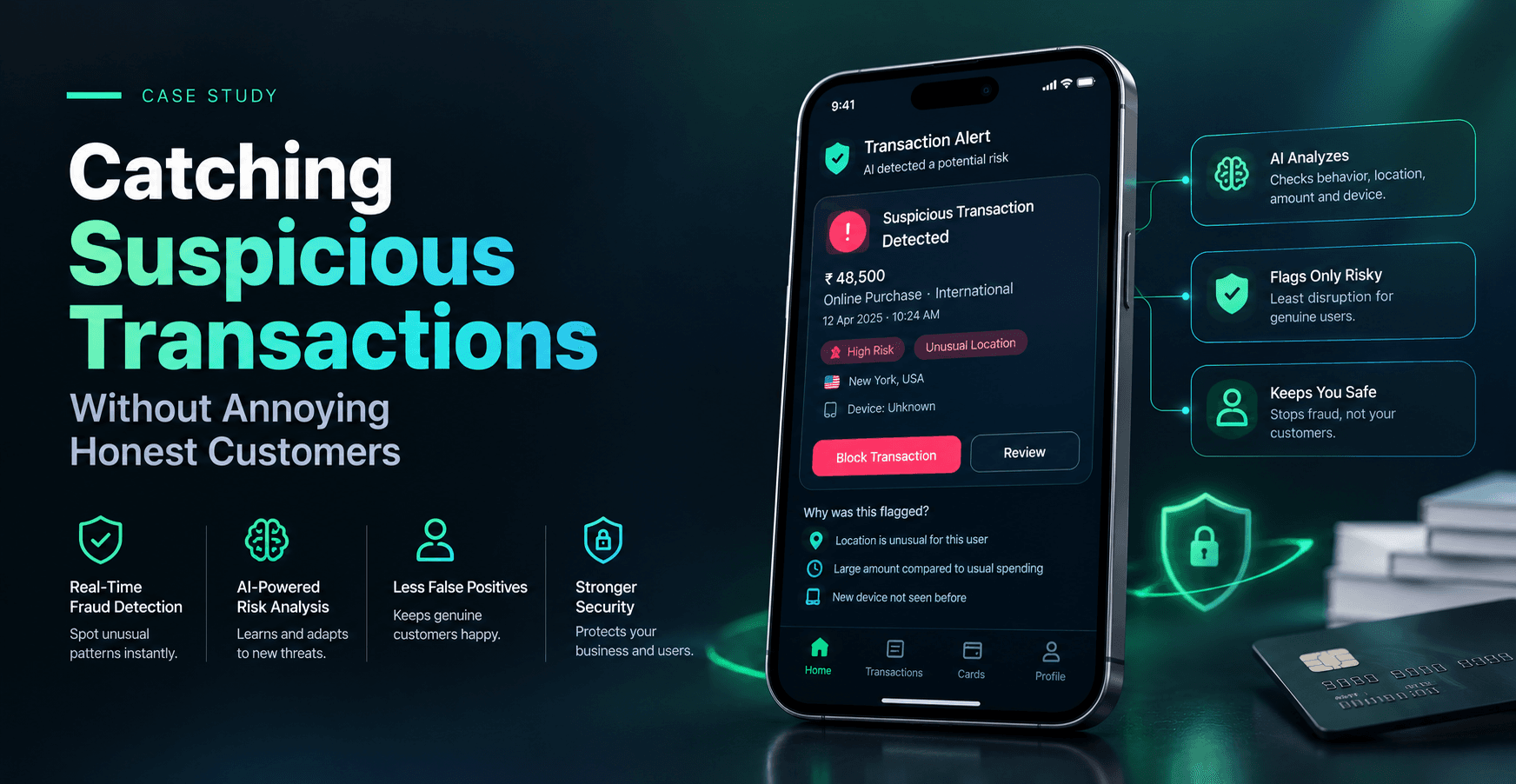
A growing digital payments company was stuck in a familiar squeeze. Tighten security and honest customers get blocked; loosen it and fraud slips through. Meritorious CodeCrafters designed and built a real-time fraud detection system that scores each transaction, explains in plain language why something looks risky, and gives analysts a clean screen to act from. Alerts became more useful, the analysts' workload became manageable, and the business gained control over its own risk thresholds. Below, our project lead answers the questions we hear most about this build, from what the client needed to how long it took.
The conversation
We sat down with the project lead for a candid Q&A about how the project went.
Q: First, what exactly did you build, and for whom?
A: The client is a digital payments company in the fintech space. We built an internal fraud monitoring platform with three parts: a scoring service that rates every transaction as it happens, an analyst dashboard where flagged payments are reviewed, and a rules panel where the business can adjust thresholds without waiting on engineers. It is a web-based tool for the risk team, not a consumer app. The people using it all day are analysts, so that is who we designed it for.
Q: What did the client actually ask for?
A: They did not say, "We need machine learning." They said, "Our customers keep getting their legitimate payments declined, and our analysts are drowning in alerts." We turned that into six requirements. Score transactions in real time. Reduce false alarms. Give a plain-language reason for every alert. Let analysts record outcomes so the system keeps learning. Let the business change thresholds itself. And keep complete audit trails with strong access control, because in finance you must always be able to show who did what.
Q: What was going wrong before you arrived?
A: Four things. First, alert overload: analysts were buried in flags, and real problems were hidden in the noise. Second, honest customers were being declined, which damaged trust and sent support tickets climbing. Third, the old rules were hard-coded, so even a small change meant a developer, a release, and a wait. Fourth, scores arrived with no explanation. An analyst staring at a number cannot make a confident decision, and a decision made without confidence is slow.
Q: So where did you start?
A: With the analysts, not the algorithm. We spent time watching how they review a flagged payment: what they look at first, what makes them certain, what makes them hesitate. A model that gives a score with no reason is useless to someone who has to make the call. So explainability became a core requirement from day one, not a nice extra we would add later.
Q: Which tools and technology did you use?
A: We stayed with proven choices. Python powered the scoring service, because it is excellent for data work and for machine learning. The models were built with TensorFlow and PyTorch, depending on what suited each task. PostgreSQL held transactions and decisions, while Redis gave us very fast lookups so scoring could happen in real time. The analyst dashboard was built in React.js for a quick, clean interface, and everything ran on AWS with encryption and role-based access. If you want to see how we approach this kind of work, ourfraud detection solutions page explains it in more detail, and ourPython developers are the people who build it.
Q: Walk me through the roadmap.
A: Five phases. In weeks 1 to 3, discovery: we shadowed analysts, audited the data, and agreed on what success meant. In weeks 4 to 7, a prototype: a first model trained on historical data, plus the format for explanations. In weeks 8 to 14, the real build: the real-time scoring service, the dashboard, the rules panel, and audit logging. In weeks 15 to 17, a pilot, where the new system ran alongside the old process so we could compare decisions without any risk. Then, from week 18 onward, rollout and tuning, where the system went live and began learning from analyst feedback.
Q: How long did it take?
A: About four and a half months from kickoff to going live. That sits inside the range we usually see for AI-powered platforms, roughly three to six months depending on data quality and integrations. The pilot phase added time, but nobody on the team regrets it. Running side by side is how the analysts came to trust the system.
Q: Were there moments you were worried?
A: Constantly, and that is healthy. A fraud model will sometimes get it wrong, so we never treated it as a verdict. Borderline cases always go to a human. We also made sure analysts could mark a decision as right or wrong, and that feedback flows straight back into improving the model. A fraud system is never "done." It is something you tend, like a garden.
Q: What does it look like for an analyst on a normal day?
A: They open the dashboard and see flagged payments sorted by how urgent they are. Click one, and the screen shows the payment, the customer's usual behavior, and a short reason in plain English, such as "unusual location for this customer" or "several rapid payments to a new recipient." They approve, decline, or ask for more information, and then they mark whether the system was right. That last click takes a second but matters enormously, because it is how the models improve. We kept the number of clicks as small as possible, because tired analysts make worse decisions.
Q: Finance is heavily regulated. How did you handle security?
A: We treated it as part of the design, not a final checklist. Data is encrypted, access is role-based so people only see what their job requires, and every decision is logged with who made it and when. That audit trail is what lets the company answer questions from auditors and regulators calmly. We always recommend that clients also have their own compliance specialists review a system like this, because rules differ by country and by product.
Q: Anything you would do differently?
A: We would involve the customer-support team earlier. They hear first about wrongly declined payments, and their stories would have helped us tune the early prototype even faster. On later projects we invite support to the first workshop, not the last.
Q: What did the client say afterward?
A: Here is what their head of risk shared with us:
"What changed for us is confidence. Our analysts used to see a number and guess. Now they see a reason and decide. We also stopped waiting on developers every time we wanted to adjust a threshold, which has made us far more responsive."
Head of Risk, digital payments company
Q: What would you tell another fintech thinking about this?
A: Start with your analysts' daily frustration, not with the algorithm. Insist that every alert comes with a reason. Plan for security and audit trails from the first sprint, not the last. And be honest that this is an ongoing practice rather than a one-time install. If you are early in the process, our IT consulting team can help you map the options before you commit.
Conclusion
The result is a system that helps people make faster, calmer, better-informed decisions. Honest customers face fewer unnecessary blocks, analysts spend their time on the cases that matter, and the business can adjust its own rules without a development cycle. Technology did not replace the risk team. It gave the risk team better tools.
If fraud, risk, or any other data-heavy challenge is slowing your business down, we would be glad to help. Meritorious CodeCrafters is a custom software and AI development company, and you can book a conversation with our team whenever you are ready.