
Executive Summary
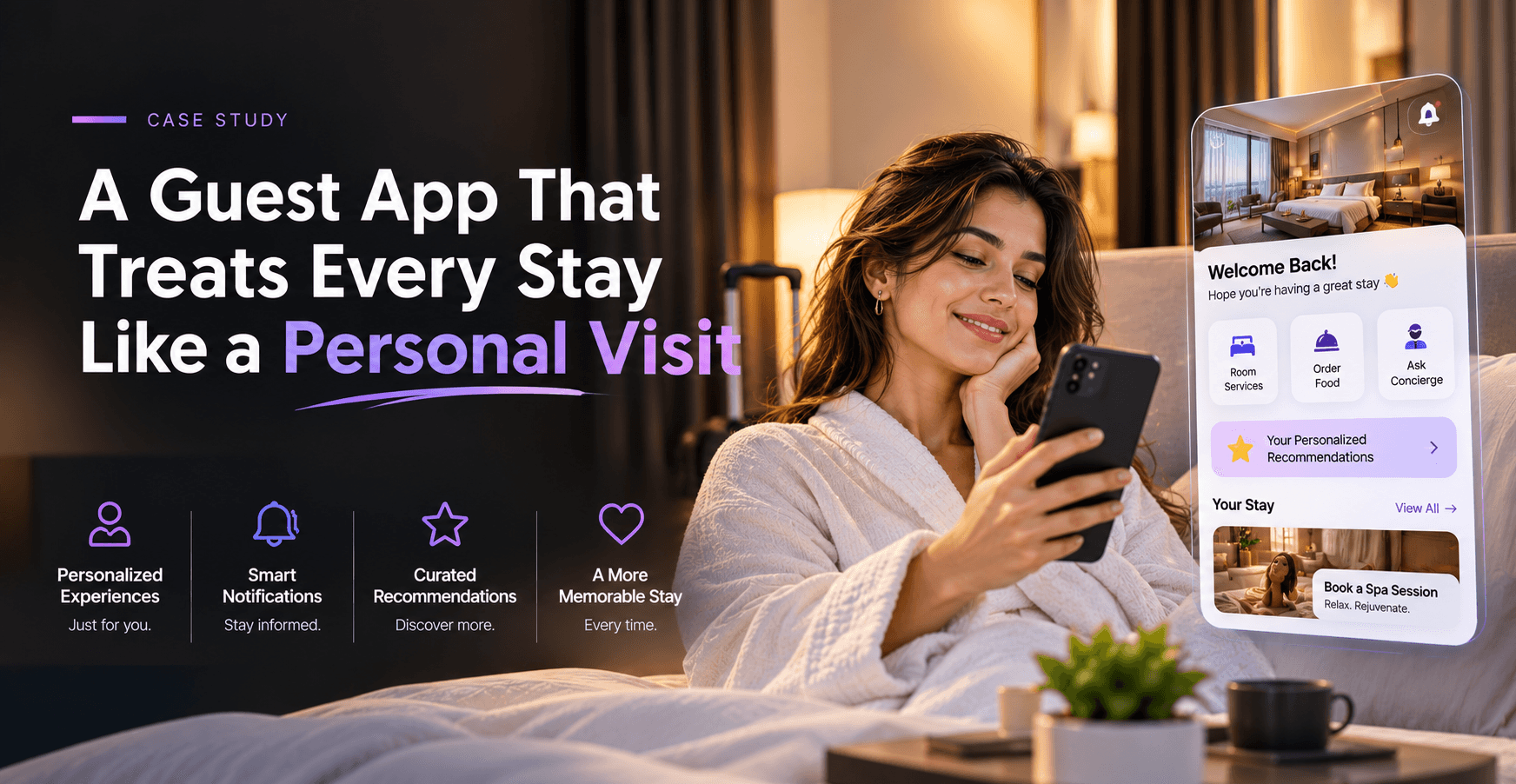
A boutique hotel group with five properties prided itself on warm service, but its small teams were stretched thin. Guests called the front desk for towels, restaurant tips, late checkout, and directions, often all at once. Meritorious CodeCrafters built a guest mobile app with an AI concierge and a staff request board, so guests could ask for what they need in their own words and staff could respond in order of importance. Service stayed personal while the desk got breathing room. The story below is told as the challenges and fixes we met along the way, followed by the details of tools, roadmap, duration, and feedback.
Challenge and fix: seven moments from the project
1. Challenge: "The desk phone never stops."
During busy check-in hours, one receptionist might be greeting arrivals, answering the phone, and handling a room-service query at the same time. Guests with simple questions waited just as long as guests with urgent ones.
Fix: a guest app where requests are typed, tapped, or spoken, then routed to the right team. Towels go to housekeeping, a broken air conditioner goes to maintenance, and a dinner booking goes to the restaurant. The front desk only sees what truly needs a human voice.
2. Challenge: "Our guests speak many languages."
The hotels welcome travellers from all over the world. Staff were friendly and resourceful, but language gaps still caused small misunderstandings, such as a dietary need misheard or a request missed.
Fix: the AI concierge understands and replies in the guest's own language, while staff see the request in theirs. Guests feel looked after, and staff avoid guessing. For sensitive matters such as allergies, the system asks the guest to confirm their request before passing it on.
3. Challenge: "We know our city, but guests can't ask us at midnight."
The team knows excellent local restaurants, quiet walks, and hidden galleries. But that knowledge lived in people's heads, and people go home at night.
Fix: we gathered the staff's favourite local tips into a curated guide that the concierge draws on. Ask for "a quiet breakfast spot with outdoor seating" and you get the team's actual recommendations, with opening hours and walking directions, not a generic search result. The assistant stays inside this approved guide, so guests are never sent somewhere the hotel would not stand behind.
4. Challenge: "Guests don't know what we offer."
The spa, the rooftop dinner, and the airport pick-up were all popular when guests found them. Many never did, because they were buried in a printed folder in the room.
Fix: gentle, well-timed suggestions inside the app. A guest arriving on a rainy afternoon might see a spa offer. Someone staying a third night might be reminded of the rooftop tasting menu. We designed these to be occasional and relevant, never pushy, and guests can switch them off.
5. Challenge: "Check-in is slow when everyone arrives at 3 p.m."
Paper forms, passport copies, and payment confirmations created queues at exactly the wrong time.
Fix: pre-arrival check-in in the app. Guests complete their details beforehand, receive a digital key where the hotel's door system supports it, and walk straight to their room. Where a hotel's lock system could not support a digital key, the app simply shows a short pickup code at a self-service point.
6. Challenge: "Staff need to see what matters."
A flood of requests is no help if everything looks equally urgent.
Fix: the staff request board. It groups tasks by team, flags anything overdue, and highlights guests who have waited longest. Supervisors see the whole property at a glance, and any request can be reassigned in a tap.
7. Challenge: "We can't lose the human touch."
This was the most important concern. The owners feared an app might make the hotel feel like a machine.
Fix: clear hand-off rules. Complaints, anything emotional, and anything involving health or safety go straight to a person, with a short summary so the guest never repeats themselves. The concierge speaks in the hotel's own warm voice, which staff helped us write.
What kind of project this was
Industry: travel and hospitality, specifically boutique hotels.
What we built: a cross-platform guest mobile app, an AI concierge, a staff request board, and a simple content area where managers update local tips and offers without calling a developer.
What the hotel group asked for
- Faster, simpler guest requests without more front-desk staff
- Multilingual support
- Pre-arrival check-in to cut queues
- Gentle promotion of spa, dining, and experiences
- A staff view that organises work by team and urgency
- A personal tone that matches each property's character
The tools
- Flutter for the guest app, so one codebase serves iPhone and Android; our Flutter developersbuilt it
- Node.js and PostgreSQL for requests, bookings, and guest data
- An AI language model, such as OpenAI GPT or Gemini, with LangChain and a curated knowledge base for the concierge, in line with our AI chatbot development work
- React.js for the staff request board
- Firebase for real-time notifications
- AWS for secure hosting
The roadmap
Weeks 1 to 2: Stayed overnight at a pilot property, interviewed staff, and mapped common requests.
Weeks 3 to 4: Designed guest flows and the staff board.
Weeks 5 to 10: Built the app, concierge, and request routing.
Weeks 11 to 12: Language and tone testing with staff reading sample chats.
Week 13: Pilot at one property.
Weeks 14 to 16: Refinement, then rollout to the remaining four hotels.
How long it took
About sixteen weeks from kickoff to full rollout, with the pilot teaching us more than any planning document could.
What the pilot taught us
We piloted at the smallest property first, and it paid off. In the first fortnight, guests used the app far more for tiny requests than we expected: an extra pillow, a phone charger, a late breakfast. Housekeeping loved this, because requests arrived with a room number and an exact item instead of a rushed phone message.
We also discovered that older guests were enthusiastic once the first step was easy. Instead of asking everyone to download an app before arrival, the hotel now sends a simple link that opens the same experience in a browser, with the option to install the app if they like. Staff also learned to mention the app at check-in in one friendly sentence, which doubled early adoption at the pilot hotel.
One mistake was instructive. In the first version, the concierge offered restaurant bookings without checking that the restaurant had tables free. Guests were disappointed, and the restaurant manager rightly pointed it out. We connected the concierge to the restaurant's real availability and added a rule that it never promises anything it cannot confirm. That principle, never overpromise, now guides every new feature.
Lastly, the managers' content area became a quiet favourite. When a nearby gallery closed for renovation, a duty manager removed it from the guide in thirty seconds, and the concierge stopped recommending it immediately. The team feels ownership of the assistant's voice, which is exactly what we hoped for.
Conclusion
Good hospitality is about attention. The app does not replace the staff's attention; it protects it, by handling routine requests quickly so people can focus on the moments that need a human. Guests feel known, and teams feel supported.
What the hotel group said
"We were afraid technology would make us feel less like ourselves. The opposite happened. Our team has more time for real conversations, and guests tell us the app feels like it was written by us."
Operations Director, boutique hotel group
If you run a hotel, resort, or travel business and want to deliver more personal service without adding pressure to your team, Meritorious CodeCrafterswould be glad to help. You can also see our AI solutionsor schedule a meeting.