
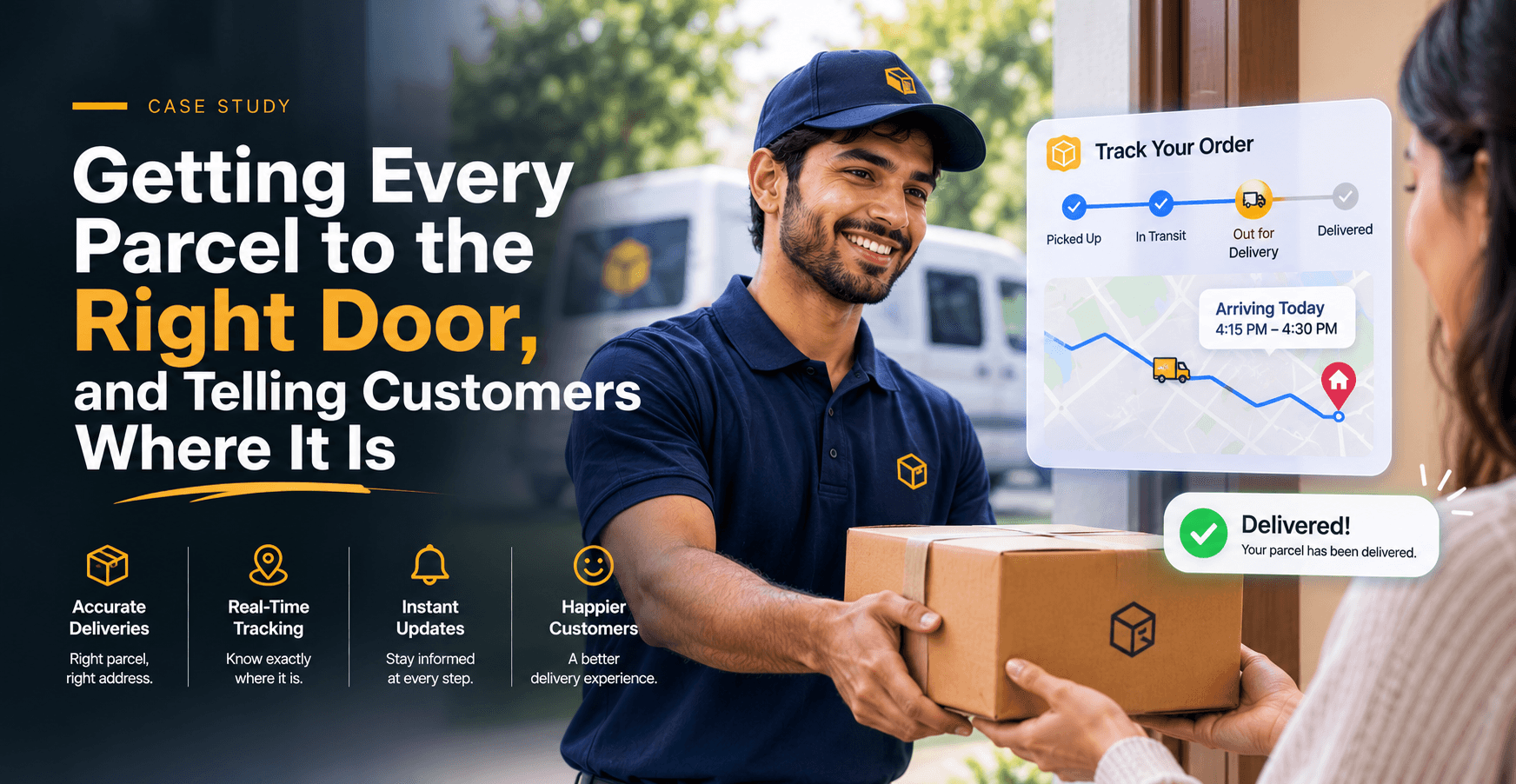
Executive Summary
A regional delivery company moved thousands of parcels a week using spreadsheets, phone calls, and drivers' own judgement. Routes were uneven, customers kept calling to ask "where is my parcel?", and missed deliveries meant costly second attempts. Meritorious CodeCrafters built a logistics platform with route planning, a driver mobile app, live tracking, and a dispatcher dashboard. Drivers got clearer routes, customers got reliable updates, and the dispatch office got a calm overview of the day. This case study is written as a frequently asked questions page, answering what operations leaders usually ask us before starting a project like this.
Frequently asked questions
What kind of company was this, and what did you build?
The client is a regional courier and delivery company working in the logistics and last-mile delivery industry. We built a connected platform with four parts: a route planning engine, an Android and iOS driver app, a live tracking page and notifications for customers, and a web dashboard for dispatchers. Together they replace a patchwork of spreadsheets and phone calls with one system.
What did the company actually ask for?
The operations director listed their needs in plain terms:
- Plan daily routes that balance workload and reduce wasted kilometres
- Give drivers a simple app with their stops, in order, with navigation
- Capture proof of delivery with a photo or signature
- Update customers automatically with live status and estimated arrival times
- Show dispatchers where every vehicle is and which deliveries are at risk
- Keep working when a driver is in a poor-signal area
What was going wrong before?
Four things, in order of pain.
Uneven routes. Dispatchers built routes by hand each morning, using local knowledge and a lot of coffee. Some drivers finished early while others were still on the road late in the evening.
Missed deliveries. Customers were not always home, and nobody could easily tell them when to expect the driver. Second attempts were expensive.
Constant phone calls. A large share of customer calls were simply "where is my parcel?" Staff spent their days giving the same answer.
Paper proof. Signed slips were collected at the end of the day, sometimes lost, and disputes were hard to settle.
Which tools and technology did you use?
We chose reliable, widely supported tools.
- React Native for the driver app, so one build serves Android and iOS, developed by ourmobile app development team
- Python for the route optimisation logic, along with open routing libraries and Google Maps Platform services for distances and navigation
- Node.js and PostgreSQL for orders, drivers, and status updates
- Redis and WebSockets for live tracking
- React.js for the dispatcher dashboard
- Twilio or a similar provider for SMS notifications
- AWS for hosting
How does the route planning work, in simple terms?
Each morning, the system takes the day's parcels, vehicle capacities, driver shifts, and delivery time windows. It then proposes routes that minimise total travel while keeping workloads fair. Dispatchers can accept the plan or adjust it by dragging stops between drivers. We deliberately kept the human in charge, because dispatchers know things no algorithm does, such as a road that is always blocked on market day.
What does a driver see?
A short, ordered list of stops with a single "navigate" button, the customer's delivery notes, and a large "delivered" action. If a customer is not home, the driver taps a reason, and the system immediately offers the customer a re-delivery slot by message. Photos and signatures are stored with the order, so there is no paper to lose. The app keeps working without signal and syncs when coverage returns.
What does the customer see?
A tracking link by SMS, showing the parcel's progress and a rolling arrival window. As the driver gets close, the customer receives a short alert. Customers can reschedule or leave delivery instructions in a couple of taps.
How long did the project take?
About twenty weeks from kickoff to the first live depot. We rolled out in stages, starting with one depot, learning from real days on the road, then expanding. Logistics projects with route logic and apps typically take four to six months, and the staged approach kept the risk low.
What was the roadmap?
Weeks 1 to 3: Discovery, ride-alongs with drivers, and process mapping
Weeks 4 to 6: Design of the driver app and dispatcher dashboard
Weeks 7 to 14: Build of route planning, driver app, tracking, and notifications
Weeks 15 to 17: Testing with a small group of drivers on real routes
Weeks 18 to 20: Pilot depot, then refinement
After week 20: Rollout to remaining depots
What was the hardest part?
Honestly, the people side. Experienced drivers had developed their own methods over years, and an app that tells them where to go can feel like criticism. We spent time riding along, listening, and adjusting the app to reflect their feedback. The dispatchers' ability to override suggested routes helped enormously. Once drivers saw that the tool saved them time instead of second-guessing them, adoption grew naturally.
What did the company say afterwards?
"The biggest difference is how quiet the phones have become. Customers know where their parcels are, our drivers know where they are going, and dispatch can see the whole day. We spend our energy solving real problems now, not answering the same question fifty times."
Operations Director, regional delivery company
How did you handle exceptions, like traffic, breakdowns, or failed deliveries?
Exceptions are normal in logistics, so we designed for them. If a vehicle breaks down, the dispatcher marks it, and the system suggests how to share its remaining stops among nearby drivers. If a road closes, the driver can report it, and the dispatcher sees which later deliveries are now at risk and can warn those customers early. If a parcel cannot be delivered, the driver chooses a reason from a short list, such as nobody home, wrong address, or refused. Each reason triggers the right follow-up, like offering a new time or contacting the sender.
How did you keep it reliable on busy days?
Peak days, such as the weeks before holidays, are when systems fail. We tested with several times the normal parcel volume, set up monitoring so the team is alerted before drivers notice a problem, and designed the app to keep working from its stored route even if the internet connection to our servers briefly drops. We also agreed a simple fallback with the company: a printable route sheet generated each morning, used only in emergencies.
How did customers respond?
Customers responded most strongly to the arrival window and the ability to reschedule. Many said they appreciated not having to stay home all day. The company also noticed that drivers received fewer unfriendly doorstep conversations, because customers knew when to expect them. Good information, it turns out, makes everyone more polite.
What would you advise another logistics business?
Start with a single depot. Ride along with drivers before you design anything. Keep dispatchers in control. And treat customer updates as a core feature, not an extra, because they reduce more calls than almost anything else.
Conclusion
Logistics runs on small things done reliably: the right parcel, the right route, the right message at the right time. By connecting planning, drivers, customers, and dispatch in one platform, we helped the company move from reacting to the day to running it.
If your business moves goods and your tools have not kept pace,Meritorious CodeCrafterswould be glad to talk it through. You can book a call orexplore our services.