
Executive Summary
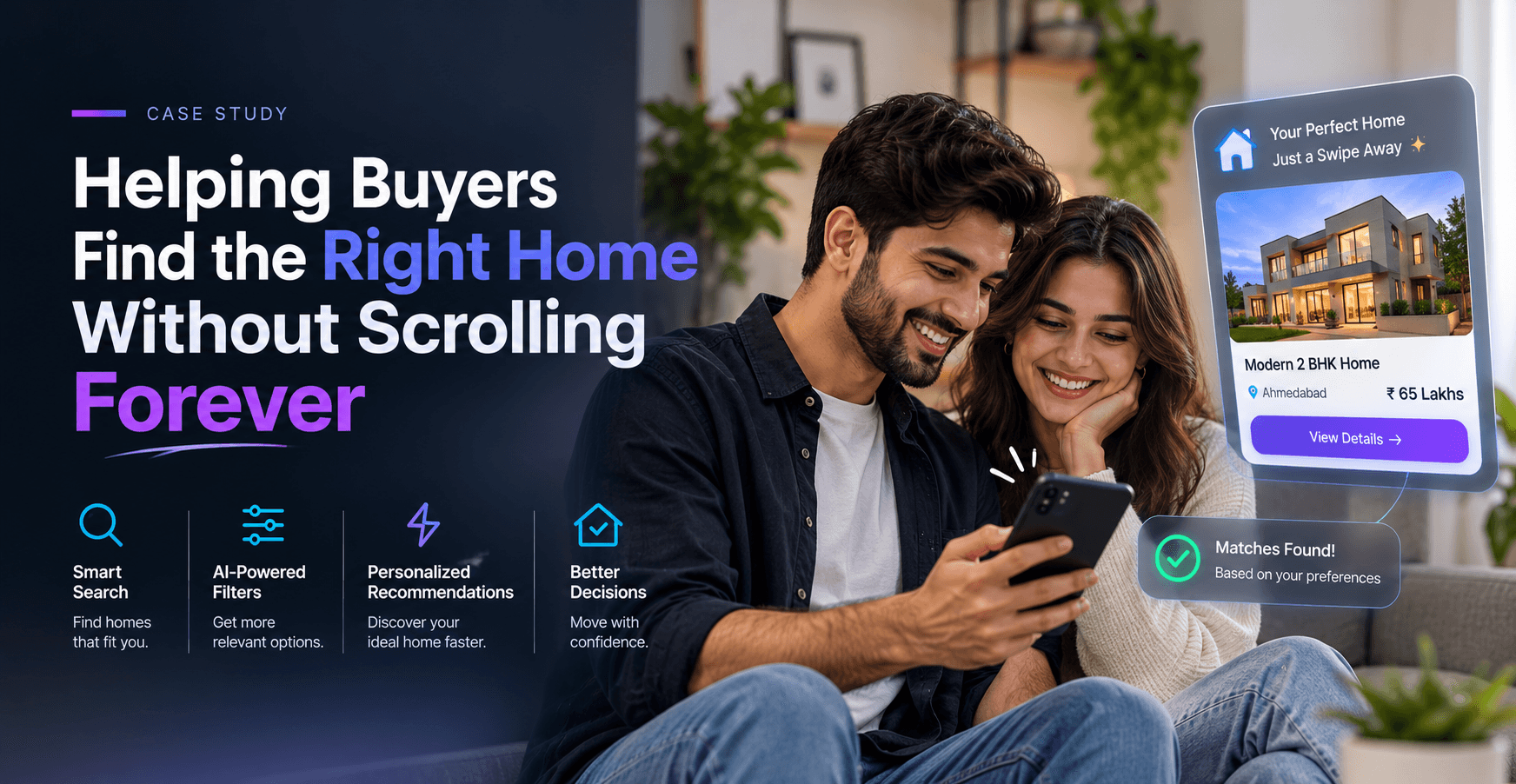
A regional real estate agency had hundreds of listings and a website that treated every visitor the same. Buyers scrolled through endless pages, agents spent evenings answering the same enquiries, and good leads went cold. Meritorious CodeCrafters built a property search platform with smart matching, saved searches, and a companion mobile app, plus a lead-management area for agents. Buyers now find relevant homes sooner, and agents spend their time on viewings rather than on repetitive messages. This case study follows two people, a buyer and an agent, through the platform, then covers requirements, obstacles, tools, roadmap, duration, and the client's own feedback.
Two people, one platform
Priya, the buyer
Priya and her partner are looking for a three-bedroom home near a good school, with a budget they will not stretch. On the old website she could filter by price and bedrooms, and that was about it. Every search ended in a long grid of photos, and she could not tell which homes actually suited a family.
On the new platform, she answers a few plain questions: how many bedrooms, how long a commute she can live with, whether a garden matters. The platform ranks listings by fit, shows a short "why this suits you" note on each, and lets her save the search. When a matching home appears overnight, she gets a notification on her phone before breakfast.
She books a viewing straight from the listing, picks a time from the agent's real calendar, and receives a reminder with directions. She never fills in a long contact form or waits for a callback.
Imran, the agent
Imran manages forty listings. On the old site, every enquiry landed in a shared inbox, and he spent his evenings sorting out who wanted what. Hot leads and curious browsers looked identical.
On the new platform, enquiries arrive in a simple board, sorted by how active and serious each person seems. He can see which homes a lead has saved, how often they have returned, and what they asked about. Booked viewings appear in his calendar automatically. Follow-up reminders pop up when a lead goes quiet. Imran says the biggest change is that he starts each morning knowing exactly who to call first.
What kind of project this was
Industry: real estate, specifically residential sales and lettings for a regional agency.
What we built: a responsive property website, a cross-platform mobile app for buyers and renters, and a web-based lead-management dashboard for agents. Together they are a marketplace-style product, with listings, search, notifications, and booking in one place.
What the agency asked for
The managing director summarised the brief in a sentence: "Show people homes they will actually like, and make it easy for them to talk to us." From the discovery workshops we listed six requirements:
- Smarter search that goes beyond price and bedrooms
- Saved searches with instant alerts when new listings match
- A mobile app so buyers can browse and book viewings from anywhere
- Online viewing bookings tied to agents' real calendars
- A lead dashboard that shows who is serious and what they care about
- Easy listing management, so agents can add or update a property in minutes
The obstacles
Messy listing data.
Photos, descriptions, and details came from several sources in different formats. Some listings had five photos, others had thirty. Some used "3 bed," others "three bedrooms." Smart matching only works on tidy data, so we spent real effort cleaning and standardising it.
Generic search.
The old filters could not capture lifestyle needs such as "quiet street" or "near parks." We had to translate those preferences into things the system could measure and compare.
Slow, heavy pages.
Photo-rich listing pages were slow on phones, and the agency knew visitors were leaving before images finished loading.
Lost leads.
With enquiries scattered across email, phone notes, and forms, there was no single view of a buyer's interest.
Trust.
Buyers dislike feeling tracked. We designed the interface to be helpful rather than pushy, with clear controls over notifications.
Tools we used
- React.js for the fast, app-like website and agent dashboard
- React Native for the iOS and Android buyer app, supported by our mobile app developmentteam
- Node.js for the backend that powers search, alerts, and bookings
- PostgreSQL for listings, users, and saved searches, with Redis for quick lookups
- Google Maps services for location search and travel-time features (subject to the client's licensing choices)
- AWS for hosting, image storage, and delivery
- Figma designs created by our UI/UX design team
For the smart matching, we began with transparent scoring rules rather than a black-box model, so agents could understand why a home ranked where it did. A learning model can be added later as data grows.
The roadmap
Weeks 1 to 2: Discovery. We interviewed agents and buyers, audited the listing data, and mapped the buyer journey.
Weeks 3 to 5: Design. Wireframes and a clickable prototype, tested with a handful of real buyers.
Weeks 6 to 9: Data and search. We cleaned and standardised listings, then built the matching and saved-search engine.
Weeks 10 to 15: Build. The website, buyer app, notifications, booking system, and agent dashboard.
Weeks 16 to 17: Testing. Speed tests on real phones, booking edge cases, and notification checks.
Week 18 onward: Launch and refinement, starting with one office, then the whole agency.
How long it took
The project ran about eighteen weeks from kickoff to launch, with refinement continuing afterwards. Products of this size usually fall between three and six months, and the clean, early involvement of the agents helped us stay near the lower end.
What we learned about property buyers
Watching real buyers use the prototype taught us things no brief could. Most people do not know exactly what they want until they see a few examples, so the platform lets them react with a simple "more like this" or "not for me" on any listing, and the results sharpen with each tap. Photos matter enormously, but so does the first line of the description, so we nudged agents to lead with the one detail a buyer would care about most instead of a generic opening.
We also learned that buyers rarely start on a laptop and finish on a laptop. Priya might browse on her phone during a lunch break, share a favourite with her partner by message, and book the viewing later from a tablet. Saved searches and favourites therefore follow the account across devices, and shared links open straight onto the right listing.
For agents, the surprise was how much they valued small reminders. A gentle prompt saying "this buyer viewed the same home three times this week" turned many quiet leads into warm conversations. None of this needed advanced technology; it needed attention to how people actually behave.
Finally, we agreed with the agency on a simple review rhythm after launch. Every month, we looked at which searches returned nothing, which listings attracted views but no enquiries, and where buyers dropped out of the booking flow. Those three lists drove most of the improvements in the first six months.
Conclusion
A property platform succeeds when it feels like a helpful local expert rather than a catalogue. By matching buyers to homes based on how they live, connecting bookings to real agent calendars, and giving agents a clear view of their leads, we helped the agency turn browsing into conversations. The data cleaning was the least glamorous part of the project and probably the most valuable.
What the agency said
"Our old site showed everything to everyone. Now buyers see homes that suit them, and our agents start each day knowing who to call. The viewing bookings alone have saved us a huge amount of back and forth."
Managing Director, regional real estate agency
If you run a property business and your website is not working as hard as your agents do, we would be glad to talk. Meritorious CodeCraftersis a custom software and AI development company serving clients worldwide, and you can get in touch here to start a conversation.