
Executive Summary
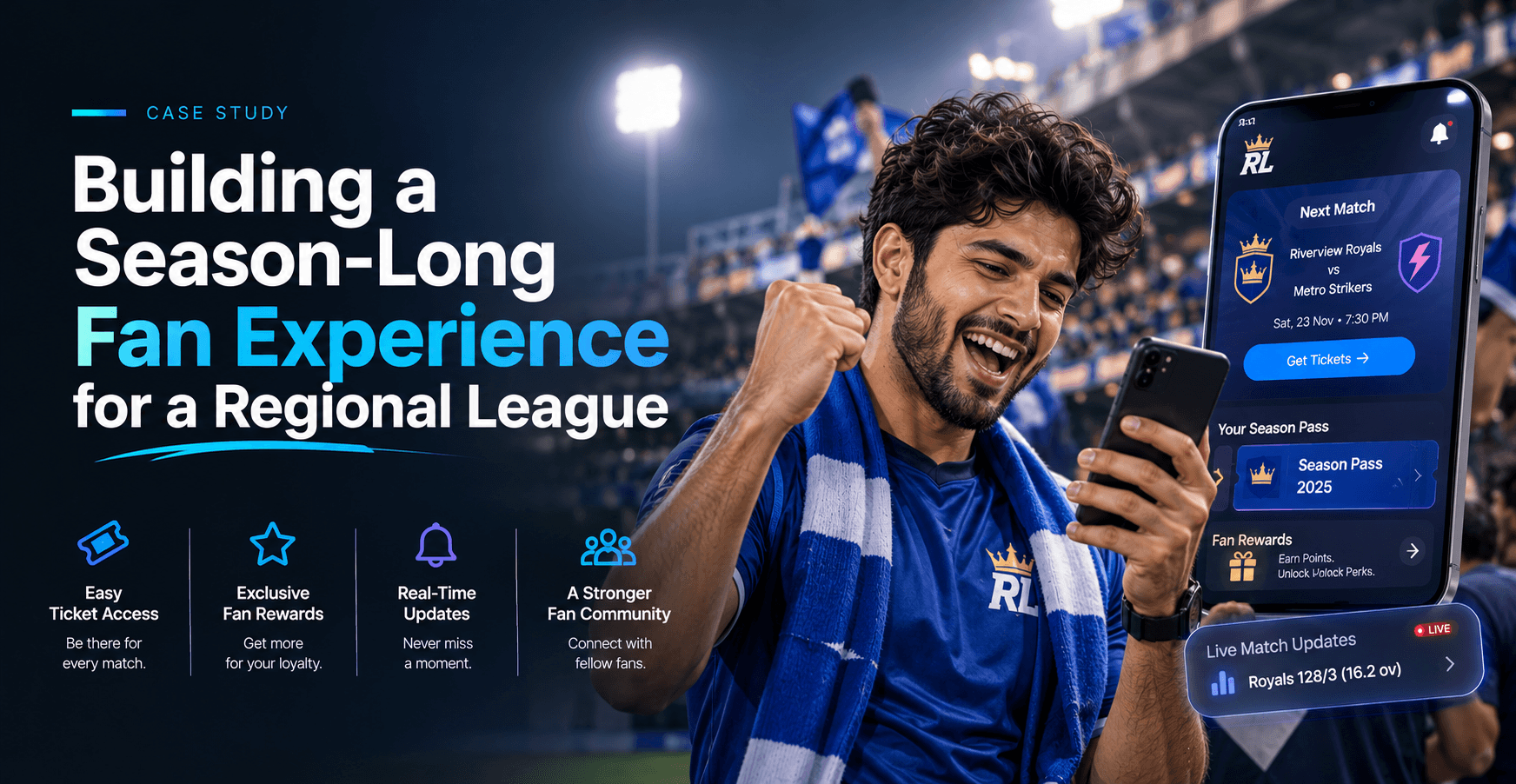
A regional sports league had passionate supporters but scattered ways to reach them: a basic website, social media posts, and printed fixtures. Fans missed games, tickets sold unevenly, and sponsors wanted better ways to be seen. Meritorious CodeCrafters built a fan mobile app with live scores, fixtures, ticketing, club news, and match-day features, along with an admin area for the league's small media team. We have written the story as a season calendar, because the product was designed around the rhythm of a sporting year: pre-season, match days, mid-season slumps, and the finals.
The season calendar
Pre-season: listening to the terraces (weeks 1 to 4 of the project)
Before drawing a single screen, we went to games. We stood with supporters, spoke to ticket-office volunteers, and watched how people used their phones during matches. The pattern was clear: fans wanted three things at once, which were the score, the news, and a way to share the moment with friends.
The league's requirements, written down, were these:
- Live scores and match updates that arrive quickly and reliably
- Fixtures, results, tables, and team pages that are easy to read on a phone
- Ticket purchase and digital entry
- Push notifications for goals, kick-off, and team news, with fans choosing what they receive
- Space for sponsors, without cluttering the experience
- A simple admin tool for a small media team with no developers
Industry: sports and fan engagement.
What we built: a cross-platform mobile app for fans, plus a web admin panel.:
Early season: the obstacles (weeks 5 to 10)
Once design began, a handful of real problems appeared.
Match data was messy. Results arrived by text message, email, and a shared spreadsheet. A fan app is only as good as its numbers, so we created a single entry screen where volunteers at each ground could submit scores, and we built a feed that accepts data from a professional provider for higher divisions.
Everyone checks at once. When a goal is scored, thousands of fans open the app within seconds. The system had to stay fast under that sudden spike, not just on a quiet Tuesday.
Weak mobile signal at grounds. Stadiums and small-town pitches often have poor coverage. We designed the app to keep working with limited connectivity, showing the last known score and syncing when the signal returns.
Notification fatigue. Too many alerts and fans switch them all off. We let supporters choose per team and per type of alert, and we kept messages short and meaningful.
Fair sponsor visibility. Sponsors wanted exposure but fans wanted a clean experience. We designed a few tasteful placements, such as a "match-day partner" banner, instead of pop-ups.
Match day: the toolbox (weeks 11 to 18)
During the main build, we chose tools to match the demands above.
- Flutter for one smooth app on iPhone and Android, built by our Flutter developers
- Node.js and WebSockets for fast live updates
- PostgreSQL for fixtures, results, and users, with Redis to handle the burst of traffic when a goal goes in
- Firebase for push notifications
- Stripe or a regional payment provider for ticketing, depending on the league's market
- React.js for the admin panel
- AWS for hosting that can scale on busy weekends
This is the kind of work covered by our mobile app development service, with the live-update engineering that sport demands.
Mid-season: testing under pressure (weeks 19 to 21)
We tested the way a fixture list tests a team. We simulated thousands of fans opening the app at the same moment, switched off signal on test phones, and ran through a full matchday with volunteers submitting scores from a muddy touchline. Several small problems appeared, such as a delay in notifications and a confusing ticket screen, and we fixed them before the real thing.
The opening weekend: launch (week 22)
The app launched at the start of a real round of fixtures. We watched the system closely, kept the team on call, and ran a quick feedback form inside the app. A few supporters suggested team-colour themes and a "my team first" home screen, which went into the next update.
The rest of the year: growing with the season
After launch, the league added features gradually: player profiles, match photo galleries, and fan polls. The admin tool let the media team post news and manage fixtures without us. We held monthly reviews to look at what fans actually used and what they ignored.
The finals: where it paid off
By the final weekend, the app had become the way fans followed their teams. Kick-off reminders, live updates, and digital tickets worked together smoothly, and the league's small team was able to run a big occasion without drowning in messages.
Behind the scenes: the volunteers
The most important people in the whole system never appear on a fan's screen. They are the match-day volunteers who enter scores. We designed their screen to be almost impossible to get wrong: big buttons, one action per tap, an undo button, and a clear confirmation before anything goes public. We trained them in ten minutes at a pre-season meeting, handed out a one-page guide, and kept a phone number for emergencies.
A small incident shows why this mattered. In the second round, a volunteer accidentally recorded a goal for the wrong team. Because the screen allowed a quick correction and the app showed a short "score updated" note, the mistake was fixed within a minute, and supporters barely noticed. In the old world of social media posts, that error could have circulated for hours.
What fans asked for next
Supporters are generous with ideas. Within weeks we heard requests for team-colour themes, a "my team first" home screen, a pre-match line-up view, and a way to share a result as an image. We ranked requests by how many fans asked and how much effort each needed, and shipped the quick wins first. This simple habit of listening, ranking, and shipping built goodwill with the community.
Sponsors and the commercial side
For the league's partners, we added a straightforward report showing how often each sponsor's placement was seen and tapped. This gave the commercial team a fair, evidence-based way to talk to sponsors at renewal time, without turning the app into an advertising wall.
How long it took
The project took about twenty-two weeks from first terrace visit to launch, followed by seasonal updates. Apps with live data and payments commonly take four to six months, and ours landed at the shorter end because the league was clear about priorities and ready to simplify.
Advice for clubs and leagues
If you are thinking about a fan app, a few points from this project are worth keeping in mind. Start with the moments that matter most to supporters, which are usually the score and the ticket, and add the extras later. Make the data entry process for volunteers as simple as you possibly can, because your whole product depends on it. Test for the busiest second of your busiest day, not the average hour. And give supporters control over notifications, because trust is easy to lose with a single unwanted buzz.
Conclusion
Sports fans want to feel close to the game. A good app removes friction between a supporter and the moment they care about: the score, the ticket, the news, the shared cheer. By building around match-day reality, including poor signal, traffic spikes, and volunteers entering results from a touchline, we gave the league something fans actually use.
What the league said
"Our supporters used to rely on whoever posted first on social media. Now there is one place for scores, tickets, and news, and our volunteers can update it from the sideline. It has made the league feel bigger than it is."
Chief Executive, regional sports league
If you run a league, club, or sports business and want to bring supporters closer to the action, Meritorious CodeCrafters would love to hear your plans. You can also browse our portfolio or get a quote.