Key Takeaways
- DevOps enables deployment frequency measured in days or hours through CI/CD pipelines, while traditional deployment models typically release in weeks- or months-long cycles.
- Traditional deployment concentrates risk into large, infrequent releases, while DevOps spreads risk across smaller, incremental changes that are easier to test, roll back, and troubleshoot individually.
- Containerization tools like Docker and orchestration platforms like Kubernetes are core to why DevOps deployments are more consistent across environments than traditional server-based releases.
- DevOps generally lowers long-term operational cost through automation, but requires upfront investment in tooling and process change that traditional deployment doesn't demand.
- Enterprise software with strict compliance requirements can still favor structured, traditional deployment phases for certain release types, even while adopting DevOps practices elsewhere in the pipeline.
DevOps vs Traditional Deployment: Which Is Better in 2026?
DevOps is better suited to most modern software development in 2026 because it enables faster, more frequent, and lower-risk releases through automation and continuous integration, while traditional deployment remains viable for projects with rigid compliance requirements or infrequent release cycles. The right choice depends on how often your software needs to change and how much risk your organization can absorb per release.
This isn't a purely technical decision. It affects how quickly a business can respond to customer feedback, fix bugs, and ship new features, all of which have direct commercial consequences. Organizations planning a broader technology shift often start by reviewingIT consulting for cloud and automation to understand how deployment strategy fits into their larger infrastructure decisions.
What's the Core Difference Between DevOps and Traditional Deployment?
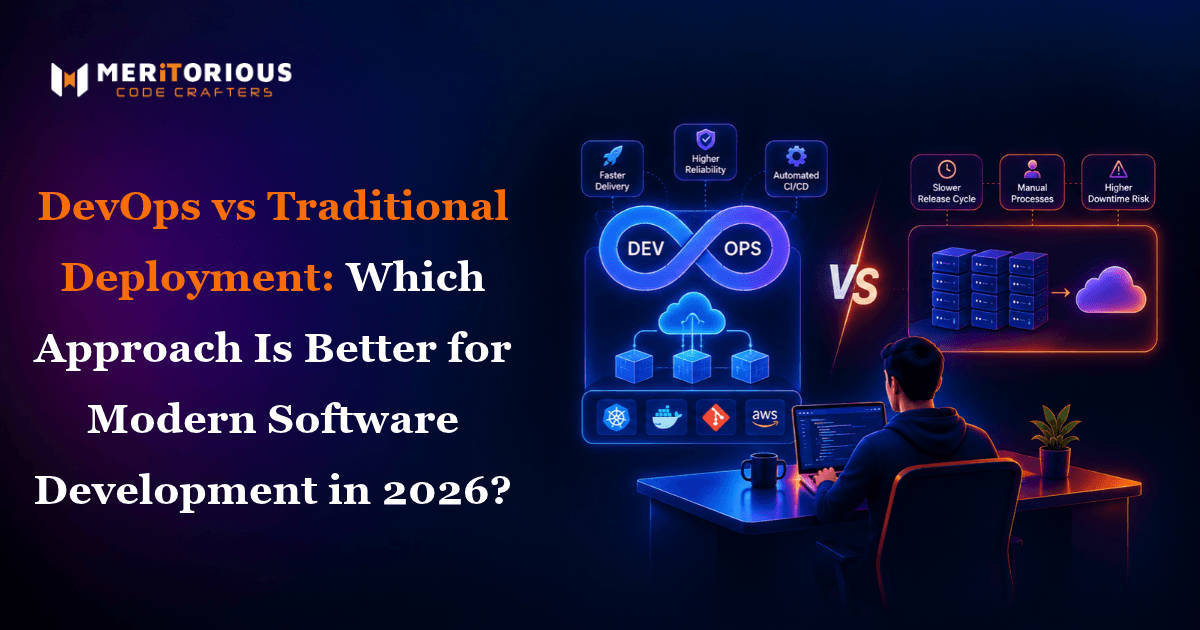
DevOps integrates development and operations into a continuous, automated pipeline where code moves from commit to production in small, frequent releases, while traditional deployment, often following a Waterfall model, separates development and operations into distinct phases with larger, less frequent releases. This structural difference drives nearly every other distinction between the two approaches.
| Factor | DevOps | Traditional Deployment |
|---|---|---|
| Release frequency | Days to hours | Weeks to months |
| Risk per release | Low (small changes) | High (large batches) |
| Team structure | Integrated dev + ops | Separate dev and ops teams |
| Automation | Central to the process | Minimal to moderate |
| Rollback speed | Fast, often automated | Slower, manual |
| Core tools | CI/CD, Docker, Kubernetes | Manual scripts, staged servers |
DevOps vs Waterfall Deployment: How Do the Models Actually Compare?
DevOps replaces the sequential, phase-gated structure of the Waterfall model with continuous, overlapping cycles of development, testing, and deployment. Waterfall requires each phase to complete before the next begins, which creates long lead times between writing code and getting it into production; DevOps compresses that gap significantly.
Waterfall deployment isn't inherently wrong for every project. It suits work with fixed, well-understood requirements and minimal expected change after launch. But most modern software, especially products still evolving based on user feedback, doesn't fit that profile, which is where the mismatch between Waterfall and continuous delivery becomes a real business problem.
Why Does DevOps Improve Deployment Speed and Reliability?
DevOps improves deployment speed and reliability by automating testing, integration, and release processes through CI/CD pipelines, removing the manual handoffs and delays that slow down traditional deployment. Automated pipelines also catch integration issues early, before they compound into larger production problems.
CI/CD Versus Traditional Release Cycles
Continuous integration and continuous deployment (CI/CD) pipelines run automated tests every time code changes, catching bugs before they reach production. Traditional deployment cycles typically batch weeks or months of changes together, which means when something breaks, it's harder to isolate which specific change caused the failure among dozens of simultaneous updates.
The Role of Containerization
Docker packages an application and its dependencies into a consistent, portable unit, while Kubernetes orchestrates how those containers run and scale across environments. Together, they solve one of traditional deployment's most persistent problems: an application working in one environment and failing in another due to configuration differences. This consistency is a major reason DevOps deployments are more predictable than traditional, server-specific releases.
DevOps vs Traditional Deployment: Comparing Risk and Rollback
DevOps reduces risk per release by deploying small, incremental changes that are easier to test and roll back individually, while traditional deployment concentrates risk into large, infrequent releases where a single failure can affect many features at once. When something does go wrong, DevOps pipelines typically support faster, often automated rollback, while traditional deployments often require manual intervention.
This difference matters most during incidents. A DevOps team can usually identify and revert a problematic change within minutes because the change set is small and recent. A team using traditional deployment, discovering an issue after a large batched release, often has to investigate a much larger set of changes to isolate the cause, extending downtime.
DevOps vs Traditional Deployment Cost: Which Is Actually Cheaper?
DevOps generally lowers long-term operational costs through automation and reduced downtime, but requires upfront investment in tooling, infrastructure, and process changes that traditional deployment doesn't demand. Organizations evaluating cost should look at total cost over a release cycle, not just initial setup expense.
Traditional deployment can appear cheaper initially since it doesn't require CI/CD tooling investment or process redesign. But the ongoing cost of slower releases, longer downtime during failures, and more manual QA effort tends to outweigh that initial savings for any product releasing updates regularly. Teams weighing this trade-off often bring inhire DevOps programmer in India support specifically to build the automation layer without needing to hire and train an entire internal team from scratch.
Building something along these lines?
Tell us what you have in mind. We will come back with scope, stack and a realistic timeline.
Is DevOps Better Than Traditional Deployment for Startups?
Yes, in most cases. Startups benefit from DevOps because it allows fast iteration based on user feedback without the delays and risk concentration of large, infrequent releases, which matters most when a product's direction is still being validated. Traditional deployment's structured, slower cadence rarely matches the pace startups need to compete.
A startup shipping weekly feature updates based on early user feedback would struggle under a Waterfall-style release cycle designed for stable, well-defined requirements. DevOps lets small teams ship changes continuously without waiting for a large, coordinated release window, which is often the difference between responding to the market in days versus months.
DevOps vs Traditional Deployment for Enterprise Software
Enterprise software often adopts a hybrid approach, using DevOps practices for most development while retaining structured, traditional deployment phases for releases with strict compliance, audit, or regulatory requirements. Full DevOps adoption isn't always practical when certain releases legally require documented approval stages before going live.
This hybrid model lets enterprises benefit from DevOps speed and reliability for the majority of their software while maintaining the control traditional deployment offers for high-stakes, regulated releases. Building and maintaining this kind of pipeline typically requires bothexpert JavaScript developers for application-layer work andhire top QA developers in India to maintain the automated testing coverage that makes frequent releases safe.
When Should You Choose Traditional Deployment Over DevOps?
Traditional deployment remains a reasonable choice for projects with fixed, well-defined requirements, infrequent release schedules, or regulatory environments where every change requires formal review before deployment. It also suits teams without the infrastructure or budget to support CI/CD tooling and automated testing pipelines yet.
Not every project benefits from DevOps immediately. A small internal tool updated once a quarter, or a system in a heavily regulated industry with mandatory audit trails per release, may not justify the investment DevOps automation requires. The decision should follow the software's actual release cadence and risk profile, not industry trends.
How to Decide Between DevOps and Traditional Deployment
Base the decision on three factors: how often your software needs to change, how much risk a large release can absorb, and whether your team has the resources to build and maintain automated pipelines. If your product needs frequent updates and rapid feedback loops, DevOps is almost always the better fit. If you're building something structurally stable that changes rarely, traditional deployment may still be sufficient. Teams building the surrounding application layer alongside their deployment strategy can review web application development services explained to understand how deployment approach fits into the broader development cost and process.
Conclusion: Match the Approach to Your Release Needs
DevOps outperforms traditional deployment for most modern software development in 2026, offering faster releases, lower risk per deployment, and better long-term cost efficiency through automation. Traditional deployment still has a place for stable, low-change systems or releases with strict compliance requirements, but it's increasingly the exception rather than the default.
Meritorious CodeCrafters deliverstailored software development built around the deployment approach that fits your product, whether that's a full DevOps pipeline or a hybrid model. Teams scaling their engineering capacity for either approach can alsohire experienced full stack professionals India to support both application development and deployment needs.Let's build together to plan the right deployment strategy for your software.
Frequently Asked Questions
1. Is DevOps better than traditional deployment?
For most modern software, yes. DevOps enables faster, lower-risk releases through automation and CI/CD pipelines. Traditional deployment still suits projects with infrequent changes or strict regulatory requirements where structured, phase-gated releases are necessary.
2. What's the main difference between DevOps and Waterfall deployment?
DevOps uses continuous, overlapping cycles of development and deployment, while Waterfall follows sequential phases where each must complete before the next begins. This makes DevOps significantly faster at getting code from commit to production.
3. Is DevOps more expensive than traditional deployment?
DevOps requires more upfront investment in tooling and process changes, but generally lowers long-term costs through automation, reduced downtime, and fewer manual QA cycles. Traditional deployment can seem cheaper initially but often costs more over time for frequently updated products.
4. Can enterprises use both DevOps and traditional deployment together?
Yes. Many enterprises use a hybrid approach, applying DevOps practices for most development while keeping structured, traditional deployment stages for releases with compliance or regulatory requirements that require documented approval before going live.
5. Why is DevOps recommended for startups over traditional deployment?
Startups typically need to iterate quickly based on user feedback, which DevOps supports through frequent, low-risk releases. Traditional deployment's slower, larger release cycles are usually too rigid for a startup still validating its product direction.