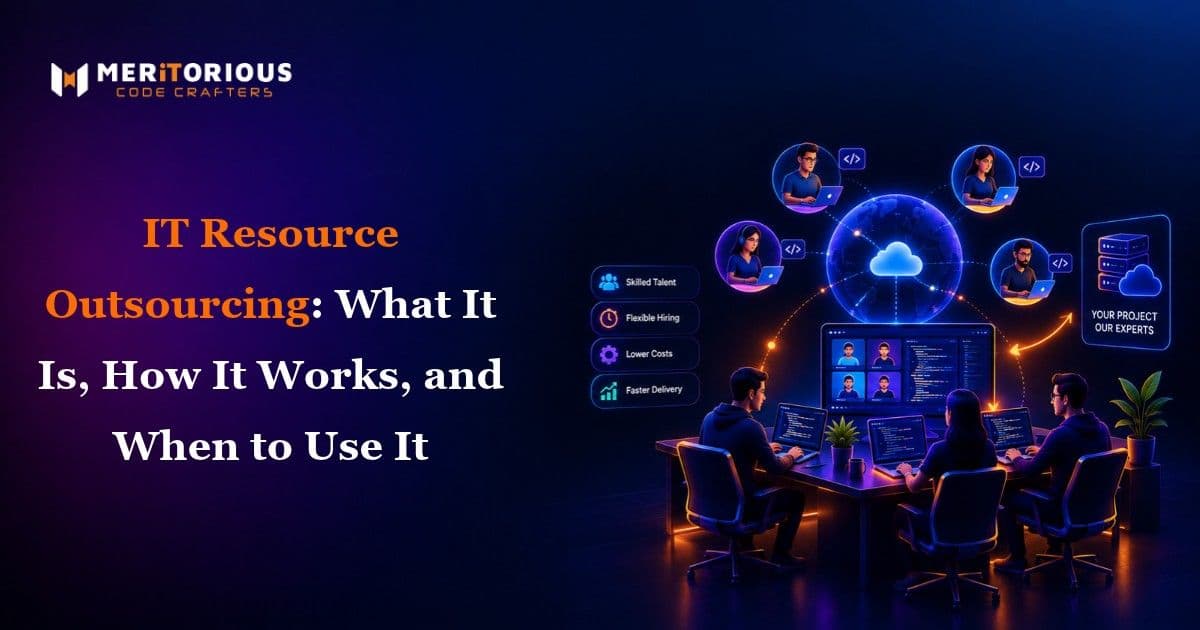
IT resource outsourcing means hiring skilled technology professionals-such as software developers, QA testers, cloud engineers, or AI specialists-from an external provider instead of recruiting them as permanent employees. You get the specific people and skills you need, while the provider handles sourcing, vetting, payroll, and administration.
Unlike outsourcing a whole project (where a vendor takes total control of the deliverable), IT resource outsourcing focuses on adding human capacity to your existing organization. Depending on the exact arrangement, these resources either work directly inside your team under your management, or as a dedicated pod managed jointly with the provider.
Companies choose this model to access specialized technical skills quickly, launch products faster than traditional hiring allows, and elastically adjust their team size as quarterly workloads change.
How IT Resource Outsourcing Works
- Define what you need: Specify the exact roles, technical skills (e.g., Python, React Native, DevOps), seniority, engagement duration, and required working-hour overlap.
- Brief your provider: Share your product vision, tech stack, internal workflows (Agile/Scrum), and project goals.
- Review candidates: The provider shortlists pre-vetted professionals. You interview the candidates directly and approve the best fit for your team culture and technical bar.
- Onboard: The chosen resources get secure access to your communication tools (Slack/Teams), repositories (GitHub/GitLab), and project management boards (Jira).
- Manage and scale: You manage their daily output and easily scale the number of resources up or down as your roadmap shifts.
IT Resource Outsourcing Models
| Model | How It Works | Best For |
|---|---|---|
| Staff Augmentation | Outsourced resources join your existing team, and you manage their day-to-day tickets and priorities. | Immediate skill gaps, fast capacity scaling, and maintaining total control over code. |
| Dedicated Team | A self-contained team works exclusively on your product, typically led by a Scrum Master or Tech Lead under joint management. | Long-term product development or building standalone new platforms. |
| Managed Services | The provider owns a specific IT function end-to-end, managing their own SLAs and processes. | Ongoing operations like cloud infrastructure maintenance or IT support. |
| Project-Based Outsourcing | The provider delivers a defined scope for a fixed outcome and fixed price. | One-off builds, fixed-scope MVPs, or isolated migrations. |
Which IT Resources Can You Outsource?
- Software Developers: Frontend, backend, full-stack, and mobile (iOS/Android/Cross-platform).
- AI & Machine Learning Engineers: LLM integration, custom AI agents, and data model training.
- QA and Test Engineers: Manual testing and automated QA frameworks.
- Cloud and DevOps Engineers: Infrastructure setup, CI/CD pipelines, and cloud migrations (AWS/Azure).
- Database & Data Engineers: Architecture structuring (PostgreSQL, MongoDB) and vector database management.
- UI/UX Designers: Product design, user research, and prototyping.
Many enterprise and mid-market companies outsource a combination of these roles while keeping their core architectural decisions in-house.
Benefits of IT Resource Outsourcing
- Faster hiring: Deploy engineers in weeks (or days) instead of waiting months for local recruitment pipelines to yield results.
- Access to specialist skills: Reach high-demand talent-like generative AI experts or specific SaaS framework specialists-that may be scarce or prohibitively expensive in your local market.
- Lower operational overhead: Completely bypass recruitment agency fees, employee benefits, hardware provisioning, and severance liabilities.
- Flexible scaling: Add or remove seats dynamically as feature demands fluctuate.
- Focus on core work: Free your internal engineering leadership from administrative burdens so they can focus on product strategy and architecture.
Risks and How to Manage Them
- Communication gaps across time zones: Establish required overlap hours (e.g., 4+ hours of daily overlap), standard communication tools, and strict daily standup routines before day one.
- Data security and IP exposure: Enforce NDAs, mandate strict IP assignment clauses in your contracts, and ensure all code is committed to company-owned repositories via role-based access control.
- Knowledge loss: Require asynchronous documentation, regular code reviews, and formal handover practices so institutional knowledge remains when the contract ends.
- Inconsistent quality: Set clear sprint expectations, run short paid trial periods, and establish 30/60/90-day review intervals.
IT Resource Outsourcing vs. In-House Hiring
| Feature | In-House Hiring | IT Resource Outsourcing |
|---|---|---|
| Time to Start | Often 2 to 3 months | 3 to 10 business days |
| Cost Structure | High fixed costs (Salary, benefits, HR overhead) | Predictable hourly or monthly engagement rate |
| Flexibility | Low; difficult and costly to scale down | High; easy to scale up or ramp down at contract end |
| Talent Access | Limited by local geography and budget | Global pool of pre-vetted specialists |
| Best Used For | Core product leadership, permanent strategic roles | Project-based scaling, specialized skills, or fluctuating workloads |
Building something along these lines?
Tell us what you have in mind. We will come back with scope, stack and a realistic timeline.
When IT Resource Outsourcing Is the Right Choice
- You need niche technical skills (like LangChain, Flutter, or advanced Node.js) that your current team doesn't possess.
- A critical product deadline cannot wait for a standard 90-day hiring cycle.
- Your engineering workload rises and falls drastically across different quarters.
- You want to implement new technologies (e.g., adding AI features to your SaaS) without committing to permanent, specialized headcount.
- You need extra development capacity but refuse to hand over architectural control to a traditional outsourcing agency.
IT Resource Outsourcing With Meritorious Global
Meritorious CodeCrafters provides elite technical resources-including AI/ML specialists, cross-platform mobile developers, full-stack engineers, and QA automation experts-on flexible engagement terms.
With a proven track record of 47+ successful app deployments and an average client engagement spanning over 5 years, we match you with pre-vetted professionals highly skilled in React.js, Python, Laravel, Node.js, and advanced AI frameworks (OpenAI, LangChain, Pinecone). We ensure strict IP protection, direct integration into your Agile workflows, and developers who can be onboarded and actively committing code within 3 to 10 business days.
Ready to scale your technical capacity? Schedule a meeting with Meritorious Global to build the right extended team for your roadmap.
Frequently Asked Questions (FAQs)
What is IT resource outsourcing?
IT resource outsourcing is the practice of hiring skilled technology professionals from an external provider to add capacity or missing skills to your internal projects, without recruiting them as permanent, salaried employees.
How is IT resource outsourcing different from project outsourcing?
Resource outsourcing adds people to your existing management capacity (you direct the work). Project outsourcing hands over an entire scope of work, budget, and timeline for the external provider to deliver autonomously.
Is IT resource outsourcing the same as staff augmentation?
Staff augmentation is the most common and direct form of IT resource outsourcing. However, the wider term also covers sourcing "Dedicated Teams" where a small external pod works on your product under joint management.
How much does IT resource outsourcing cost?
Costs vary based on the role, technical stack, seniority, and contract length. For senior augmented engineers from global talent pools, fully-loaded rates typically range from $35 to $55 per hour-delivering significant savings over local in-house hiring overhead.
How quickly can outsourced resources start?
Usually much faster than traditional hiring. At Meritorious Global, candidate shortlists are typically provided within 24 to 48 hours, and fully vetted engineers can begin onboarding into your workflows within 3 to 10 business days.