Key Takeaways
- An AI agent perceives its environment, reasons over goals, and takes multi-step action without a human approving every move - unlike a chatbot, which only responds turn by turn.
- Enterprise adoption is shifting from single-task automation toward agent systems that plan, call tools, and adjust their own approach mid-task.
- The four core components of any AI agent are perception, reasoning/planning, memory, and action (tool use or execution).
- Businesses evaluating AI Agent development should map the decision first, not the technology - agents earn their value on multi-step, rules-plus-judgment work, not simple lookups.
- Governance and oversight (approval checkpoints, audit logs, scoped permissions) determine whether an agent deployment succeeds in production, more than the underlying model does.
What Is an AI Agent?
An AI agent is a software system that perceives information from its environment, reasons about a goal, and takes autonomous action to achieve that goal - often across multiple steps and tools - with minimal human intervention at each stage. This is the foundation AI Agent Development is built on, and it’s what separates an agent from simpler automation.
That last part is the distinction that matters for business planning. A rules-based script executes a fixed sequence. A chatbot answers one prompt at a time and waits. An AI agent holds a goal in mind, decides which steps are needed to reach it, executes those steps using available tools or systems, checks the outcome, and adjusts course if the first attempt doesn’t work - the difference between looking something up and actually solving a problem.
How AI Agents Work
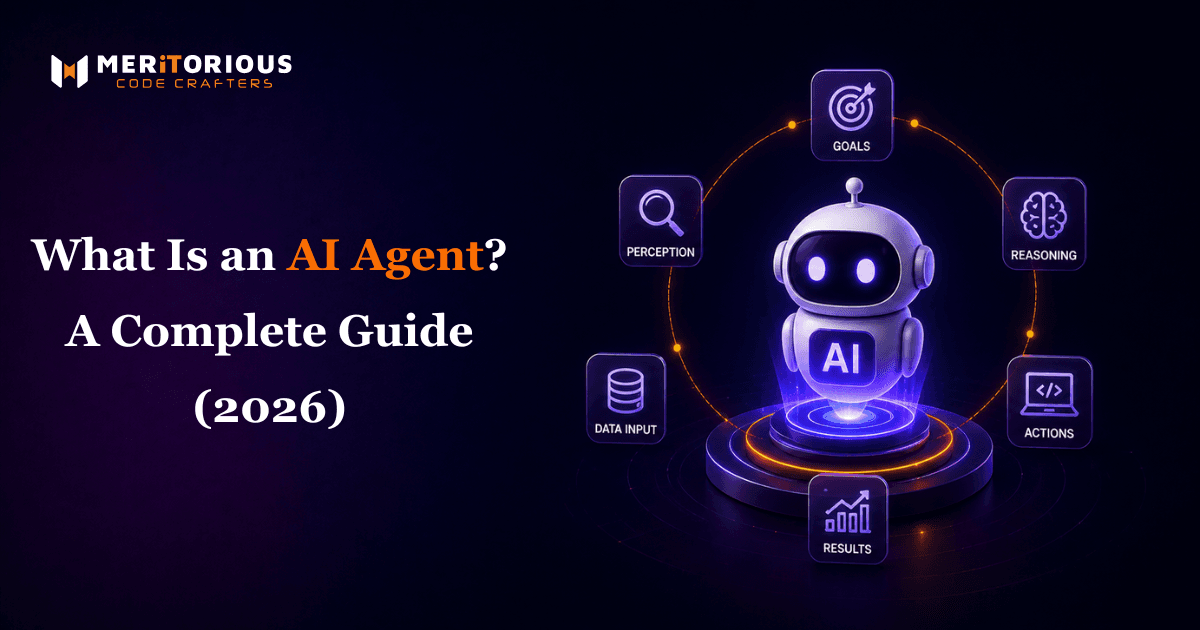
An AI agent works through a repeating cycle: it observes the current state, reasons about what action moves it closer to the goal, executes that action through a tool or system, then evaluates the result before deciding on the next step.
This sense-plan-act-reflect loop is what lets an agent handle tasks that weren’t fully specified in advance. A language model typically provides the reasoning layer, while surrounding infrastructure supplies memory, tool access, and guardrails.
The Core Components of AI Agent Architecture
Every functional agent is built from four recurring components:
- Perception - ingesting structured or unstructured input: documents, emails, database records, API responses, or user queries.
- Reasoning and planning - breaking a goal into an ordered sequence of sub-tasks, often using a language model to weigh options.
- Memory - retaining context across steps or sessions, so the agent doesn’t restart from zero on every action.
- Action - executing steps through tool calls, API requests, or system integrations, then reporting or logging the outcome.
Weakness in any one component undermines the system. Strong reasoning without memory repeats mistakes; memory without a reliable action layer plans well and executes poorly.
AI Agent vs. AI Chatbot: What’s the Real Difference?
The core difference is autonomy over multiple steps. A chatbot responds to one input at a time and depends on the user to direct the next move. An AI agent pursues a goal independently, deciding its own action sequence until the task is complete.
A chatbot deployed for customer support answers questions as they come in. An agent deployed for the same function might receive a support ticket, check order history, issue a refund within policy, and send a confirmation - all without a human routing each step. The chatbot assists a conversation; the agent completes a workflow.
This changes what you’re buying. A chatbot project is mostly a conversation-design problem. AI Agent development is a systems-integration problem - connecting the agent to the tools, data, and permissions it needs to finish work, not just discuss it.
Types of AI Agents
Not every business problem needs the same agent design. Four types cover most current enterprise use cases:
Reactive Agents
Reactive agents respond directly to current input without retaining memory of past interactions. They’re fast and predictable, suited to narrow, repetitive tasks like routing inbound requests against fixed criteria.
Deliberative (Planning) Agents
These agents build an internal plan before acting, weighing multiple paths to a goal. They suit tasks with several valid routes to completion - scheduling or resource allocation - where the “best” path depends on shifting constraints.
Learning Agents
Learning agents adjust their behavior based on outcomes over time, improving accuracy as they accumulate experience. They fit high-volume, repeatable processes where marginal gains compound, such as fraud-pattern detection.
Multi-Agent Systems
Multiple specialized agents coordinate on a shared goal, each handling a distinct sub-task - one researching, another drafting, a third reviewing. Multi-agent systems suit workflows too complex for a single agent to reason through reliably.
Benefits of AI Agents for Business
The measurable benefits cluster around three areas: reduced cycle time, fewer manual handoffs, and consistent rule execution at a volume no team could sustain manually.
Cycle time drops because the agent doesn’t wait in a queue between steps. Handoffs shrink because one agent, connected to multiple systems, replaces a chain of manual data entry. Consistency improves because it applies the same decision logic every time - harder for a rotating team to guarantee under volume.
None of this replaces human judgment on ambiguous or high-stakes decisions. It removes the repetitive coordination work around those decisions, freeing people for the parts that genuinely need a person.
Building something along these lines?
Tell us what you have in mind. We will come back with scope, stack and a realistic timeline.
AI Agent Use Cases and Examples
Across industries, the highest-value agent deployments share a pattern: clear rules, several steps, and access to more than one system.
- Finance - reconciling transactions across ledgers, flagging anomalies, routing exceptions to a reviewer.
- Customer operations - resolving tier-one support tickets end-to-end, escalating only genuine exceptions.
- Sales operations - qualifying inbound leads against CRM data and auto-scheduling meetings.
- Internal operations - managing recurring approvals, document routing, or compliance checks.
Businesses exploring AI Solutions typically start with one high-friction process rather than an “automate everything” mandate - narrower scope makes early wins easier to measure.
How to Approach AI Agent Implementation
Successful AI Agent Development implementation starts with mapping a process’s decision logic before selecting any technology - teams that reverse this order tend to automate the wrong steps or lack the system access needed to finish the job.
A practical implementation sequence:
1. Map the process - document every decision point, including who makes exceptions and why.
2. Define authority - decide which actions run unsupervised versus which need human sign-off.
3. Connect the systems - give the agent scoped access to the data and tools the task requires.
4. Build in oversight - audit logs, approval checkpoints, rollback paths for errors.
5. Pilot narrow, then expand - prove the agent on one workflow first.
Organizations building this internally often underestimate the integration and governance work - the reasoning layer is frequently the easiest part.
Enterprise AI Agents vs. Off-the-Shelf Tools
Off-the-shelf agent tools solve generic tasks quickly but rarely map onto a company’s systems and approval chains. Enterprise AI agents, configured around actual workflows, take longer to deploy but perform reliably against real operational rules.
For standardized, low-stakes tasks, packaged tools can be enough. Where the process touches proprietary systems, sensitive data, or compliance requirements, custom-configured enterprise agents - and the governance around them - are usually the better long-term investment. A well-scoped AI Chatbot Development layer often complements an agent, handling the conversational front end while the agent executes the underlying task.
The Future of AI Agents
The near-term trajectory points toward greater autonomy paired with stronger governance. Expect wider adoption of multi-agent systems, tighter integration with enterprise software, and maturing standards for auditing agent decisions.
Businesses that treat oversight as a first-class design requirement, not an afterthought, will scale these systems faster than those chasing autonomy alone.
If your team is ready to move from exploration to execution, working with a partner experienced in AI Agent development - and complementary systems like Virtual Assistant Services - can shorten the path to a working, governed agent in production. Start Your Project when you’re ready to scope it.
FAQs
1. What is an AI agent in simple terms?
An AI agent is a software system that can understand a goal, decide on its own sequence of steps, and carry out actions across tools or systems to complete that goal with minimal ongoing human input.
2. How is an AI agent different from a chatbot?
A chatbot responds to individual messages and waits for the next instruction. An AI agent pursues a multi-step goal independently, deciding and executing its own sequence of actions until the task is finished.
3. What industries benefit most from AI agents?
Finance, customer operations, sales operations, and internal compliance functions see the fastest returns, since these areas combine clear rules, multiple systems, and high repetitive volume.
4. Is AI Agent development expensive for small and mid-sized businesses?
Cost scales with process complexity and system integration needs, not company size. A narrowly scoped agent on one well-defined workflow is often more affordable and faster to deploy than businesses expect.
5. How long does it take to implement an AI agent in a business workflow?
Timelines vary by integration complexity, but a well-scoped pilot on a single process typically moves from mapping to a working deployment in a matter of weeks, with expansion phased afterward.