KEY TAKEAWAYS
- The right Python developer team size is determined by project scope and sprint capacity requirements - not by budget alone. Undersizing creates delivery bottlenecks; oversizing creates coordination overhead that slows the team it was supposed to accelerate.
- A single senior Python developer is the correct team size for an MVP or proof of concept - adding developers before the product direction is validated adds cost and coordination complexity without proportional output.
- Three developers is the most common and most effective structure for an early-to-mid-stage SaaS product: enough to parallelise frontend/backend/testing without the sprint management overhead that comes with larger teams.
- Five developers marks the threshold where structured sprint processes - defined ownership, async documentation standards, and a technical lead function - become necessary rather than optional.
- Team size decisions are reversible - but scaling up mid-sprint costs more in coordination disruption than scaling up at a sprint boundary. Plan team size changes at natural delivery milestones, not reactively.
Most product teams default to the team size they can afford - not the team size their project actually requires. The result is one of two failure modes: an understaffed project where a solo developer becomes a bottleneck and delivery slips by months, or an overstaffed project where five developers spend 30% of their time in coordination meetings and produce less combined output than three focused ones would have.
This guide answers the question directly: given your project type, stage, and delivery timeline, how many Python developers do you actually need? Not how many you can afford, and not how many a competitor claims to use - how many will produce the optimal ratio of delivery velocity to coordination cost for your specific situation.
The Right Question: Not 'How Many?' But 'How Much Scope?'
Team size is an output of scope, not an input to it. The correct sequencing is: define what needs to be built in the next 12 weeks, estimate the sprint capacity required to build it, and then determine how many developers of what seniority are needed to deliver that capacity. Working in the opposite direction - picking a team size and then fitting scope to it - produces teams that are consistently either over- or under-resourced.
Three variables determine the right number:
- Scope breadth: How many parallel workstreams does the product require? A single Django API backend can be owned by one developer. A product with a backend, a data pipeline, an admin dashboard, and a public API benefits from parallel ownership across at least three profiles.
- Delivery timeline: A 10-week MVP has a different capacity requirement than a 12-month SaaS build. The shorter the timeline for a given scope, the more developers needed to meet it - up to the point where coordination overhead erodes the benefit.
- Seniority mix: One senior Python developer typically produces 2–2.5× the net output of one junior developer on a production codebase, because seniors spend less time debugging fundamentals, write less code that requires rework, and make architectural decisions that do not need to be reversed. Team size calculations that treat all developer profiles as equivalent are consistently wrong.
Python Developer Team Size by Project Type
The table below maps common Python project types to the team size that produces the best delivery-to-cost ratio:
| Project Type | Ideal Team | Duration | Core Roles | When to Add More |
|---|---|---|---|---|
| MVP / Proof of Concept | 1 developer | 6–14 weeks | Senior Python engineer | When scope confirmed post-validation |
| Early SaaS (single feature set) | 2–3 developers | 3–6 months | 2 Python engineers + QA | When second product area opens |
| Growth SaaS (multi-module) | 3–5 developers | 6–12 months | Lead + 2 engineers + data engineer + QA | When API load and data complexity increase |
| Internal tooling / automation | 1–2 developers | 4–10 weeks | Python engineer (+ part-time QA) | Rarely - scope is typically bounded |
| Data platform / ML pipeline | 3–5 developers | 4–9 months | Data engineer + ML engineer + DevOps | When model count and pipeline breadth grow |
| Enterprise web app | 5+ developers | 9–18 months | Lead + backend team + QA + DevOps | At each major module addition |
The 'When to Add More' column is as important as the team size recommendation itself. Teams that expand before they reach the trigger condition listed consistently report coordination overhead rising faster than delivery velocity - a sign of premature scaling.
1 Python Developer: When It's Right and When It Isn't
A solo Python developer is the correct structure for a focused, well-scoped MVP or proof of concept where the primary goal is validation, not scale. One developer eliminates coordination overhead entirely, produces the fastest time-to-first-delivery, and keeps the cost structure minimal during the highest-uncertainty phase of any product.
When 1 Developer Works
- The product is a single bounded application - one API, one set of core features, one deployment target
- The developer is senior enough to make architectural decisions without a second opinion being required on every sprint
- The goal is a working demonstration or minimum viable product - not a scalable production system
- You have 10–16 weeks and a clear, stable specification that will not expand mid-build
When 1 Developer Becomes a Problem
A solo developer is a single point of failure: illness, personal circumstances, or attrition halts all development. They also have a fixed capacity ceiling - a senior Python developer produces approximately 20 story points per week. If your scope requires 30+ story points per week to hit a hard deadline, one developer cannot deliver it regardless of seniority or effort.
The most common mistake with solo Python developers is keeping the team at one when the scope expands beyond what one person can maintain without accruing technical debt. When the Django codebase reaches a point where one developer is spending more than 30% of their time on maintenance, bug fixes, and review of their own code, it is time to add a second developer - not after that threshold is crossed, but at the sprint boundary before it.
3 Python Developers: The Most Effective Early-SaaS Structure
Three developers is the structure that most consistently produces high delivery velocity with manageable coordination overhead for early-to-mid-stage SaaS products. It is small enough to run on a daily standup without a formal project manager, large enough to parallelise backend, data/integration, and QA workstreams, and resilient enough that any single developer's absence does not halt all development.
The Effective 3-Person Python Team Structure
- Lead Python engineer: owns architecture decisions, the core backend API, and code review for the whole team
- Mid-level Python engineer: owns integrations, secondary features, and database work under the lead's review
- QA engineer or Python engineer with testing focus: owns test coverage, CI pipeline, and regression prevention - the role most commonly absent from Python teams that ship bugs
This structure produces approximately 55–65 story points per week of quality-assured output - roughly 3× the solo developer baseline. The coordination overhead at this team size is low: a 15-minute daily standup, a sprint planning session, and a PR review culture are sufficient to keep the team aligned without a formal project management function.
For teams building full-stack products where Python is the backend and the frontend requires separate engineering, Hire Full Stack Developers india covers how to extend the Python team with frontend capability without increasing coordination complexity proportionally.
Building something along these lines?
Tell us what you have in mind. We will come back with scope, stack and a realistic timeline.
5 Python Developers: The Growth-Stage Structure
Five developers is the threshold where informal coordination breaks down and structured sprint processes become necessary. At this team size, daily standups are no longer sufficient to keep everyone aligned - you need defined ownership boundaries, documented architectural decisions, async documentation standards, and a clear technical lead function that resolves conflicting approaches before they become technical debt.
What Changes at 5 Developers
- Ownership boundaries matter: with five engineers touching the same codebase, undefined ownership produces conflicts, duplicated work, and integration failures at merge time. Each developer or pair should own a specific domain or module.
- Sprint capacity is genuinely high: 100–120 story points per week enables parallel major feature development - but this only materialises if the work is decomposed into independently-deliverable chunks from the planning stage
- Code review bottlenecks: with five developers generating PRs, the technical lead becomes a review bottleneck without a distributed review culture where mid-level engineers review each other's work within defined scope boundaries
- Architectural coherence requires investment: five engineers making individual architectural decisions without a governing framework produce divergent codebases that are expensive to refactor at month six
The Effective 5-Person Python Team Structure
- Technical lead / senior architect: owns architectural decisions, resolves design conflicts, reviews critical PRs
- 2 × mid-to-senior Python engineers: own primary product modules - one each, with clear boundary documentation
- Data or DevOps engineer: owns the data pipeline, infrastructure, or deployment complexity that the product layer engineers should not be distracted by
- QA engineer: owns test strategy, automation framework, and release gates - without this role, five developers produce five times the bugs that one developer would
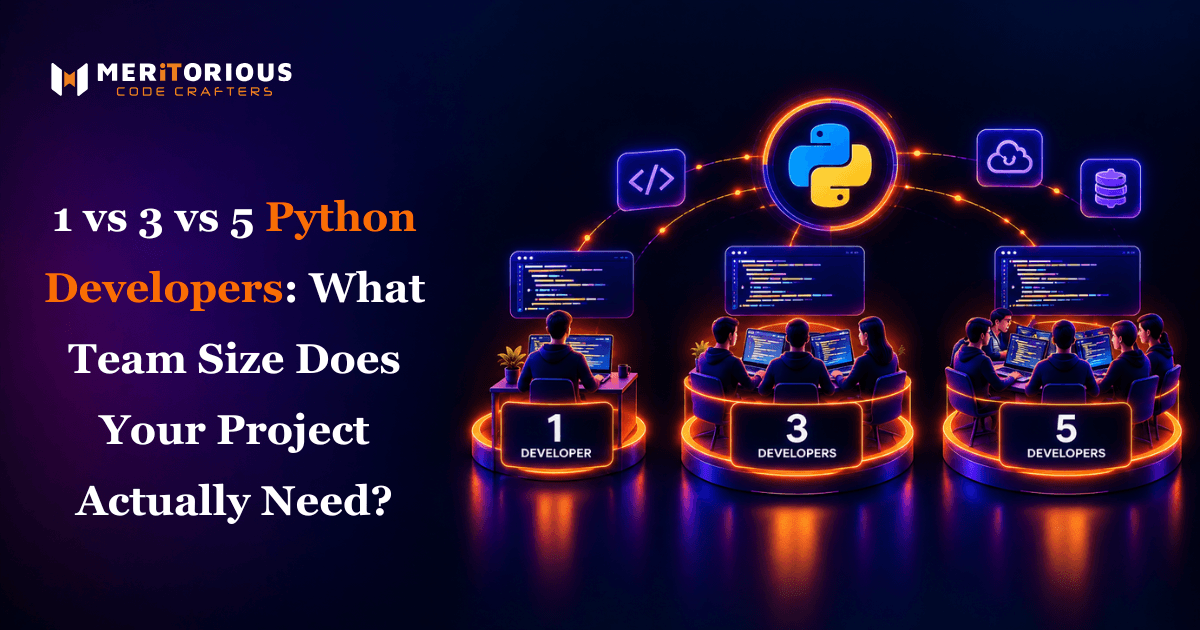
1 vs 3 vs 5 Python Developers: Side-by-Side
| Dimension | 1 Developer | 3 Developers | 5 Developers |
|---|---|---|---|
| Best project fit | MVP, focused feature build | Early SaaS, multi-module product | Growth SaaS, data platform, enterprise |
| Sprint capacity | ~20 story points/week | ~55–65 story points/week | ~100–120 story points/week |
| Single point of failure risk | High - no backup | Low - knowledge distributed | Very low - redundant coverage |
| Coordination overhead | None | Low (daily standup sufficient) | Moderate (structured sprint process needed) |
| Monthly cost (India) | $3,000–$9,000 | $9,000–$22,000 | $18,000–$45,000 |
| Time to first delivery | Fastest - no coordination | Moderate - some sync needed | Longer setup - but higher parallel output |
| Best for | Validation, cost control | Core product build | Scaling, parallel workstreams |
The cost figures reflect dedicated offshore India rates - the structure that most growth-stage product teams use to achieve the sprint capacity of a 3–5 person team at a cost that domestic hiring cannot match. For a detailed breakdown of engagement models and how to structure a 3 or 5-person dedicated Python team, the Python Developer Hiring Checklist covers team composition alongside the hiring process.
When Should You Scale Your Python Team?
Scale your Python team when the current structure is the bottleneck - not before. The three signals that indicate it is time to add a developer:
- Sustained sprint overcommitment: the team consistently carries stories from one sprint to the next because capacity is genuinely insufficient - not because stories were poorly estimated or scope crept mid-sprint
- Maintenance consuming >30% of capacity: when existing developers are spending more than 30% of their sprint time on bug fixes, technical debt, and infrastructure maintenance, a new developer's time is being absorbed before they start - an architectural or process problem, not a team size problem
- New workstream with no natural owner: adding a second product area (a data pipeline alongside an API, a mobile backend alongside the web backend) with no one available to own it end-to-end is the correct trigger for a team size increase
Scale at a sprint boundary, with a defined onboarding plan ready before the new developer joins. The coordination cost of adding a developer mid-sprint is higher than the cost of waiting one week for a clean start.
For a structure that allows you to adjust team size cleanly at sprint boundaries, Choose a Python Hiring Model for Your Budget covers the engagement models that enable scaling without the friction of a new hire cycle each time your requirements change.
Frequently Asked Questions
1. How many Python developers do I need for an MVP?
One senior Python developer is the right team size for a focused MVP with a clear specification and a 10–16 week timeline. A second developer becomes justified when the scope includes both a backend API and a separate data layer or integration-heavy workstream that one developer cannot own without context-switching overhead. Do not add developers to an MVP to go faster - define a smaller scope instead.
2. Is a team of 3 Python developers enough for a SaaS product?
Yes, for an early-to-mid-stage SaaS product with a single primary product surface. A lead engineer, a mid-level engineer, and a QA engineer produces approximately 55–65 story points per week of quality-assured output - sufficient to ship major feature sets every 2–3 sprints. The three-person structure starts to constrain when the product has two distinct product areas with separate data models and user experiences, or when the team's maintenance overhead exceeds 25% of total capacity.
3. When does adding a 4th or 5th Python developer actually increase output?
A 4th or 5th developer increases output when: there are parallel workstreams that cannot be combined (a mobile API and a web API, a data pipeline and a core product backend), the codebase is mature enough for new developers to be productive within 1–2 sprints, and ownership boundaries are clearly defined before the new developer joins. Adding developers to an already-chaotic team increases chaos proportionally.
4. What is the cost difference between a 1, 3, and 5-person Python team in India?
Using dedicated offshore India rates: a single mid-level Python developer costs $2,500–$5,000/month. A 3-person team (lead + engineer + QA) costs approximately $9,000–$22,000/month. A 5-person team costs approximately $18,000–$45,000/month depending on seniority mix. These figures are 60–70% lower than equivalent US team structures, making them the dominant model for growth-stage product companies with multi-developer requirements.
5. Should the QA engineer on a Python team be a Python developer?
Not necessarily. A QA engineer with Python proficiency is valuable - they can write automated test scripts, integrate pytest into the CI pipeline, and review Python code for testability. But a strong QA engineer who tests systematically, writes detailed bug reports, and maintains test coverage standards is more valuable than a Python developer who reluctantly does QA. For teams under five people, a Python engineer with strong testing discipline often covers both roles effectively.
Conclusion: Right-Size First, Then Optimise
The most expensive Python team is the wrong-sized one. One developer on a scope that needs three produces delays, burnout, and compounding technical debt. Five developers on a scope that needs two produces meeting overhead, integration conflicts, and a sprint velocity that does not scale linearly with headcount.
The right number is the one that matches your sprint capacity requirement to your team's output capacity - at the current scope, at the current stage. Plan team size changes at milestone boundaries, not mid-sprint. Define ownership before you add developers, not after.
To build the right-sized Python team with pre-vetted developers matched to your specific scope and structure, Hire Dedicated Python Developers india - or talk to Web & Mobile App Development company to get a team size recommendation matched to your project before committing to any structure.
Ready to define your team structure? Let's Talk and get a tailored recommendation for your specific product stage, timeline, and delivery goals.