KEY TAKEAWAYS
- Most Python hiring failures are not caused by technical skill gaps - they are caused by skipping the pre-hiring clarity phase: undefined role scope, unclear success criteria, and no agreed engagement model before the first candidate is contacted.
- A GitHub portfolio review is a mandatory first filter, not a nice-to-have: candidates who cannot show production code, real project history, or a meaningful take-home assessment should not advance to technical interviews.
- The NDA and IP assignment agreement must be signed before any code is written or any proprietary information is shared - not after the developer has already started work.
- The first 30 days of onboarding determine whether a new Python developer becomes a high-performing long-term contributor - teams that invest in structured onboarding recover the time cost within the first sprint.
- Hiring red flags during the interview process are more predictive of future performance than technical scores: how a candidate explains their reasoning, handles uncertainty, and responds to code feedback reveals more than algorithm test results.
A bad Python hire costs more than a good one. It costs the salary paid during the engagement, the time your team spent onboarding someone who did not deliver, the technical debt left in the codebase, and the delay on the features that were supposed to ship. The Python hiring market in 2026 is crowded with developers who look strong on paper and underdeliver in practice - and the companies that hire well are the ones with a structured, repeatable process that filters for real capability, not polished CVs.
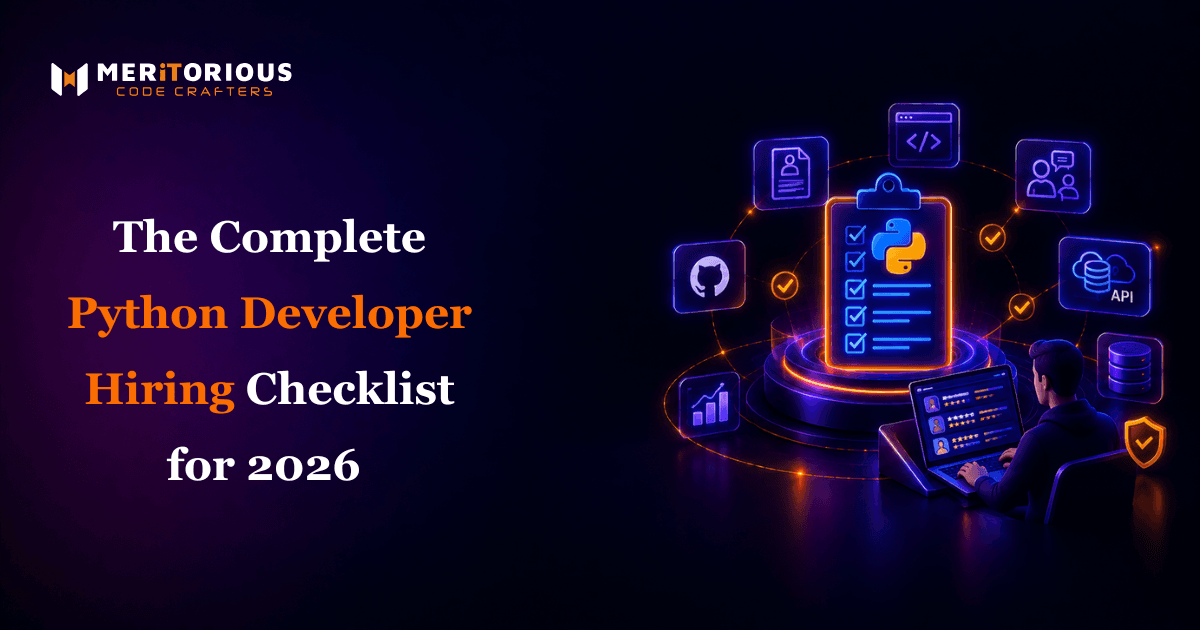
This is that process: a complete Python developer hiring checklist that covers every stage from defining the role to completing the first month of onboarding. Use it as a reference for every Python hire - full-time, part-time, or dedicated offshore - and treat each unchecked item as a risk you are consciously accepting.
PHASE 1: PRE-HIRING CLARITY Week 1
Phase 1: Pre-Hiring Clarity - Define Before You Search
The most expensive Python hiring mistake happens before a single candidate is contacted. Hiring without a clear role definition produces a job description that attracts the wrong profiles, technical interviews with no consistent evaluation framework, and a developer who does not match the actual workload once they start.
Role Definition Checklist
☐ Define the primary Python use case: web backend (Django/FastAPI), data engineering, ML/AI, automation, or full-stack. Each requires a different skill profile - do not hire a data engineer for a FastAPI backend role.
☐ Specify the required framework depth: list the specific frameworks (Django ORM, FastAPI dependency injection, SQLAlchemy, Celery) and the depth required - not just 'Python experience'
☐ Define the database requirements: PostgreSQL, MongoDB, Redis, DynamoDB - and whether the developer needs to design schemas or only query existing ones
☐ Confirm cloud and DevOps expectations: does the developer need to deploy their own work? Docker, AWS/GCP/Azure familiarity - specify what is required versus what is a bonus
☐ Set the seniority level honestly: junior developers need management overhead your team may not have; senior developers cost more but operate autonomously - match seniority to your team's management capacity, not your budget preference
☐ Define the engagement model: full-time dedicated, part-time dedicated, or hourly freelance - each has different cost, continuity, and management implications that should be decided before sourcing begins
For a structured comparison of engagement model options, compare full-time, part-time, and hourly hiring to confirm the right model for your workload before posting a role.
Engagement Model Selection
| Criteria | Full-Time Dedicated | Part-Time Dedicated | Hourly Freelance |
|---|---|---|---|
| Best for | Ongoing product development (6+ months) | Early MVP or maintenance phase | Isolated, scoped tasks (<40 hours) |
| Continuity | High - full context retention | Good - stable but limited hours | Low - resets per engagement |
| Management overhead | Low - embedded in your sprint | Medium - bounded to scope | High - brief, review, re-hire cycle |
| IP risk | Low - formal agreements standard | Low with agency | Higher - platform terms vary |
| Cost (India) | $2,500–$9,000/month | $1,500–$5,000/month | $15–$55/hour |
| Time to start | 5–15 business days | 5–15 business days | 2–7 days |
PHASE 2: SOURCING AND INITIAL SCREENING Week 1–2
Phase 2: Sourcing and Initial Screening
The sourcing channel determines the quality distribution of your candidate pipeline before a single interview happens. Job boards produce high volume and inconsistent quality. Vetted agency partners produce lower volume and pre-screened quality. The right channel depends on how much screening capacity your team has internally.
Sourcing Checklist
☐ Define your sourcing channel: vetted agency partner, direct job board (LinkedIn, Wellfound), or referral from existing team
☐ For offshore hiring (India): use a specialist dedicated developer partner rather than general freelance platforms - vetting quality and IP protection are structurally stronger
☐ Write a job description that specifies frameworks, not just 'Python' - vague JDs attract vague candidates
☐ Set a clear application deadline and define the screening criteria before applications arrive
CV and Portfolio Screening Checklist
☐ GitHub profile review: look for active commit history, real projects (not just tutorial repos), README quality, and evidence of code review participation
☐ Verify that described experience matches the portfolio - CVs that list 'Django expert' should show Django projects with meaningful complexity
☐ Check for Python-specific contributions: open-source PRs, Stack Overflow activity, technical blog posts - optional but strong positive signals
☐ Filter out immediately: portfolios with only tutorial projects, no Git version control history, or no evidence of collaborative work
☐ For senior roles: look for architectural decision documentation - READMEs that explain why, not just what
For a detailed guide on what to evaluate technically at the portfolio stage, what to test before hiring covers the full evaluation framework for Python developers at every seniority level.
PHASE 3: TECHNICAL EVALUATION Week 2–3
Phase 3: Technical Evaluation - What to Test and How
A well-designed technical evaluation tests the skills the job actually requires - not algorithm puzzles that measure interview preparation. The evaluation should mirror the work the developer will do in their first sprint.
Round 1: Technical Screening Call (30–45 Minutes)
☐ Test Python fundamentals: OOP principles, decorators, generators, async/await - ask for explanations, not just definitions
☐ Framework-specific questions: For Django - ORM query optimisation, custom middleware, signal trade-offs. For FastAPI - dependency injection, background tasks, Pydantic model design
☐ Database design question: 'Walk me through how you would design a schema for [your actual use case]'
☐ API design judgment: REST resource naming, idempotency, versioning strategy, authentication approach
☐ Testing discipline: 'How do you decide what to test?' - candidates with genuine testing habits describe their approach without prompting; those without it cannot
Round 2: Technical Assessment (Practical Task)
☐ Assign a paid take-home task: mirror your actual work - a small FastAPI endpoint with a database integration, or a data transformation script with a test suite
☐ Provide realistic constraints: time limit (4–6 hours), a real-ish dataset or API spec, and clear acceptance criteria
☐ Evaluate the submission on: code structure, test coverage, error handling, documentation, and whether the acceptance criteria were actually met
☐ Code review round: present the candidate with intentionally flawed Python code and ask them to review it - this reveals architectural judgment, communication style, and how they give feedback
Round 3: System Design Discussion (45 Minutes - Senior Roles)
☐ Use a realistic scenario: 'Design a background job processing system that handles 50,000 tasks per day with retry logic and monitoring'
☐ Evaluate: does the candidate ask clarifying questions first? Do they propose a simple solution before scaling it? Do they acknowledge trade-offs?
☐ Strong signal: candidates who say 'I would start with X because Y, and scale to Z when the data justifies it'
☐ Weak signal: candidates who jump to complex architectures without understanding the constraints, or who cannot explain why they would choose one tool over another
PHASE 4: SOFT SKILLS AND COMMUNICATION EVALUATION Week 2–3
Building something along these lines?
Tell us what you have in mind. We will come back with scope, stack and a realistic timeline.
Phase 4: Soft Skills and Communication Evaluation
For remote and offshore Python developers, communication quality is as operationally critical as technical proficiency. A developer who writes excellent code but cannot document decisions, communicate blockers proactively, or participate effectively in async sprint workflows creates more friction than their technical output resolves.
☐ Evaluate English proficiency in real conversation - not just written responses in the application
☐ Ownership language: listen for 'I built', 'I decided', 'I debugged' - versus 'the team did' for everything. Ownership language correlates with accountability
☐ Proactive clarification: does the candidate ask questions before diving into answers, or do they make assumptions and proceed?
☐ Honest uncertainty: candidates who say 'I don't know, but here is how I would find out' are more trustworthy than candidates who confabulate answers to every question
☐ Async communication test: send a technical question via email or Slack and evaluate response quality, clarity, and turnaround time
☐ Documentation discipline: ask 'What does your typical PR description look like?' - developers who cannot describe their own code changes clearly create review and maintenance problems
PHASE 5: PRE-OFFER LEGAL AND CONTRACTUAL CHECKLIST Week 3
Phase 5: Pre-Offer Legal and Contractual Checklist
Contractual protections must be in place before any proprietary information is shared or any code is written. This is the most consistently skipped phase in startup hiring - and the most expensive to fix retroactively.
☐ NDA: signed before any product details, architecture information, or proprietary data is shared with the candidate
☐ IP assignment agreement: all code, models, and derived work products are assigned to your company - not retained by the developer or their agency
☐ Non-compete clause: prevents the developer from simultaneously working on a competing product during the engagement
☐ Data handling agreement: if the developer will access customer data, production databases, or sensitive business information - define access scope, storage restrictions, and deletion obligations
☐ Engagement terms: clear notice period (30 days standard), replacement guarantee clause if hired through an agency, and scope of work definition that prevents scope creep disputes
☐ Payment terms: monthly invoicing cycle, currency, payment method, and late payment provisions - agreed in writing before day one
For companies hiring dedicated offshore Python developers, the dedicated development model guide covers the specific contractual and operational structures that protect IP and ensure continuity in dedicated offshore engagements.
PHASE 6: ONBOARDING CHECKLIST Week 4–8
Phase 6: Onboarding Checklist - The First 30 Days
The first 30 days determine whether a new Python developer becomes a high-performing long-term contributor or a recurring management overhead. Onboarding failures are almost always documentation failures - the developer did not have what they needed to understand the codebase, standards, or priorities independently.
Day 1: Access and Orientation
☐ Provision all access before the developer's first day: GitHub repo, project management tools (Jira, Linear, Notion), communication channels (Slack, Teams), cloud console access with appropriate permission scoping
☐ Provide a written architecture overview - even a 500-word document explaining how the system is structured is more valuable than three hours of verbal explanation
☐ Introduce to the team and clarify the communication rhythms: standup time, sprint cadence, async vs sync expectations
☐ Assign a named internal point of contact for questions - not 'ask anyone'
Week 1: Codebase Immersion
☐ Assign a small, bounded first task that requires reading existing code - not writing new code from scratch
☐ Schedule a pair programming session with a senior team member to walk through the most complex module
☐ Share the coding standards document: naming conventions, PR template, branch naming, commit message format
☐ Run a review of their first PR with detailed, constructive feedback - this sets the quality standard for all future work
Week 2–4: Ramp to Full Contribution
☐ Assign the first independent feature with clear acceptance criteria - a task they own end-to-end
☐ Include them in sprint planning - let them estimate their own tasks and participate in trade-off discussions
☐ 30-day check-in: structured conversation covering what is going well, what is unclear, and what they need to be more effective - not a performance review
☐ Confirm IP agreement is countersigned now that they have access to production systems
Python Hiring Red Flags: Complete Reference Table
The following red flags - encountered at any stage of the hiring process - are statistically predictive of poor hire outcomes. Treat them as disqualifying signals unless there is a compelling, specific explanation:
| Red Flag | What It Signals | What to Do |
|---|---|---|
| GitHub portfolio with only tutorial projects | No production experience; has only followed guides | Ask for private repo access or a paid test task on real data |
| Cannot explain why a design choice was made | Surface-level knowledge; memorised answers not reasoned ones | Follow up with 'walk me through your reasoning' |
| No testing experience or skips QA entirely | Will deliver code that breaks in production | Require pytest examples or a test-writing exercise |
| Vague answers about production deployments | Has not shipped to real users or managed real traffic | Ask for a specific incident they debugged in production |
| Requests unusually high rates for junior output | Misrepresented seniority; CV does not match capability | Always run a paid technical task before rate negotiation |
| Refuses to sign NDA or IP assignment | Intends to reuse your code or has conflicting obligations | Non-negotiable requirement - walk away if refused |
| Communication delays of 24+ hours during hiring | Will be unreliable in remote async collaboration | Treat response speed during hiring as a proxy for working habits |
| No questions about your product or codebase | Treating it as a transactional gig, not a long-term role | The best candidates always ask about the problem they are solving |
Applying This Checklist to Offshore Python Hiring
The checklist above applies identically to offshore Python developer hiring - with three additional considerations specific to remote and cross-border engagements.
- Time zone overlap: confirm the developer's working hours and the daily overlap window before the offer is made - a minimum 3–4 hours of synchronous coverage per day is the baseline for effective sprint participation
- Communication infrastructure: before day one, agree on async documentation standards - ticket descriptions, PR descriptions, and architecture decision records - because information that travels verbally in an office must travel in writing in a distributed team
- Agency-backed legal protection: offshore hiring through a specialist partner provides structured IP assignment, compliance with local labour law, and talent continuity guarantees (replacement if the developer exits early) that direct freelance hiring does not
To engage a vetted India-based Python developer through a structured dedicated engagement, Hire Python Developers india covers pre-screened profiles across all seniority levels and Python specialisations.
Frequently Asked Questions
1. What should I check first when hiring a Python developer?
Start with role clarity before looking at any candidates. Define the specific frameworks required (Django, FastAPI, SQLAlchemy), the database stack, the seniority level matched to your management capacity, and the engagement model. Teams that skip this step attract mismatched candidates and make expensive hires. The GitHub portfolio review is the first candidate-facing filter - treat it as mandatory, not optional.
2. What is the most common Python hiring mistake?
Treating the technical interview as the complete evaluation. Technical interviews test coding ability - they do not test communication quality, documentation discipline, ownership mindset, or how a developer behaves when they are stuck or wrong. All of these are more predictive of remote developer success than technical scores. Run the full checklist: technical assessment, code review round, soft skills evaluation, and a structured reference or trial period.
3. How do I evaluate a Python developer's GitHub portfolio?
Look for: active commit history across real projects (not only tutorial clones), README quality that explains the why of architectural decisions, evidence of Git version control discipline (meaningful commit messages, feature branches), test files in the repository, and any evidence of code review participation. A portfolio of five real projects is more valuable than twenty tutorial completions. Ask for private repository access if the developer's best work is not public.
4. Should I hire a Python developer full-time or use a dedicated offshore model?
For ongoing product development with a 6-month+ horizon, a full-time dedicated developer - whether local or offshore - delivers better ROI than hourly freelancers due to continuity, context accumulation, and lower management overhead. For early-stage exploration or tasks under 40 hours, hourly engagement is appropriate. The dedicated offshore model captures full-time continuity at 60–70% lower cost than local hiring for US and UK companies - making it the dominant model for growth-stage product teams.
5. What legal documents must I have before a Python developer starts?
At minimum: a signed NDA before any proprietary information is shared, an IP assignment agreement transferring all code ownership to your company, a data handling agreement if the developer will access production data, and a formal services agreement with scope, payment terms, and notice period. For agency-mediated offshore hires, confirm the agency's standard agreements cover these points and have your legal counsel review IP clauses before signing. These documents are not optional - they are the minimum viable legal structure for any commercial software engagement.
Conclusion: Use the Checklist Every Time, Without Exception
Hiring Python developers in 2026 is not difficult - hiring the right Python developer requires discipline. The checklist in this guide is not a formality - it is the difference between a hire that ships product and one that ships problems. Every phase matters: pre-hiring clarity sets the foundation, technical evaluation filters for real capability, legal protections secure your IP, and structured onboarding activates what the hire is worth.
The companies that hire Python developers consistently and well do not have better luck - they have better processes. Use this checklist as a living document: update it after every hire based on what the evaluation revealed, and it will compound in value across every hiring cycle that follows.
If you are ready to hire a vetted, production-experienced Python developer without running a full search and vetting process yourself, Start Your Project to connect with pre-screened Python developers matched to your specific framework requirements, seniority level, and engagement model - ready to contribute within two weeks.