KEY TAKEAWAYS
- AI chatbot development is the process of designing, building, and deploying conversational AI systems that interact with users via text or voice - ranging from simple rule-based bots to sophisticated generative AI chatbots powered by large language models.
- In 2026, the dominant AI chatbot architecture is LLM-powered: chatbots built on GPT-4, Claude, or Gemini handle open-ended conversations, understand context across multiple turns, and generate human-quality responses without rigid scripting.
- The most impactful business use case for AI chatbots is customer support automation - well-built enterprise chatbots resolve 60-70% of support tickets without human escalation, directly reducing support cost while improving response time.
- Custom AI chatbot development costs range from $2,000 for a basic rule-based bot to $120,000+ for an enterprise LLM chatbot - with India-based teams delivering 60-70% cost savings versus US rates for equivalent quality.
- The difference between an AI chatbot and an AI agent is scope: chatbots handle conversational interaction; agents take autonomous multi-step actions. Choosing the wrong architecture for your use case is the most expensive mistake in conversational AI planning.
Customer expectations for instant, accurate, 24/7 responses have permanently outpaced what human support teams can economically deliver. AI chatbot development is the engineering discipline that bridges that gap - building conversational AI systems that handle queries, guide users, qualify leads, and resolve issues at scale, without proportional headcount growth.
In 2026, the technology behind AI chatbots has advanced significantly. The generation of scripted, keyword-triggered bots that frustrated users with "I didn't understand that" responses has been replaced by generative AI chatbots that understand natural language, maintain conversational context, and respond with human-quality answers. This guide explains what AI chatbot development is, how it works, what it costs, and how to choose the right approach for your business.
What Is AI Chatbot Development?
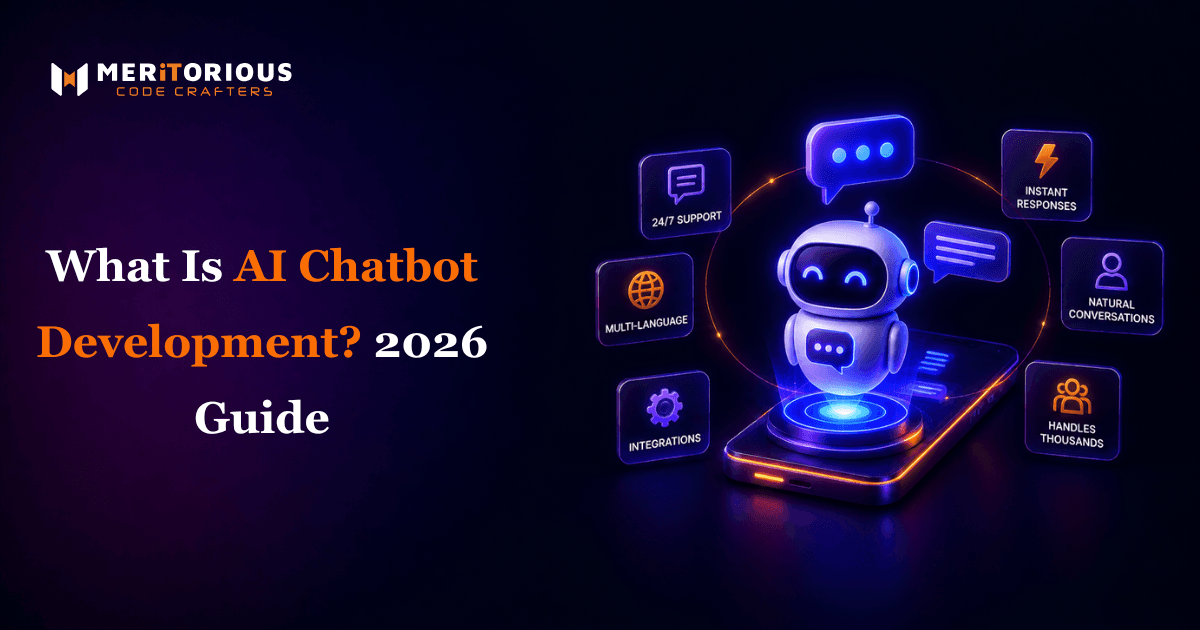
AI chatbot development is the process of designing, building, integrating, and deploying conversational AI systems that understand user inputs and respond intelligently through text or voice interfaces. It encompasses natural language processing, dialogue management, system integration, and the deployment and monitoring infrastructure required to keep the chatbot reliable in production.
A complete AI chatbot development engagement covers:
- Conversation design: Defining the chatbot's scope, user flows, tone, and escalation logic before any code is written
- NLP and intent architecture: Configuring how the chatbot understands what users mean - not just what they type
- LLM integration: Connecting the chatbot to a large language model (GPT-4, Claude, Gemini) for generative response capability
- Backend and system integrations: Connecting the chatbot to CRM, helpdesk, database, booking system, or any other platform it needs to access
- Testing and quality assurance: Evaluating performance across hundreds of input variations, including edge cases and adversarial inputs
- Deployment and monitoring: Launching on the right channels (web widget, WhatsApp, Slack, mobile app) with performance tracking from day one
For businesses evaluating the full landscape of conversational AI options, AI Solutions covers the range from chatbots through to autonomous AI agents, helping you identify the right capability for your specific workflow.
Types of AI Chatbots: Rule-Based vs NLP vs Generative AI
Not all AI chatbots are the same. Three distinct architectures serve different business needs, at different cost points and capability levels. Choosing the wrong type for your use case produces either an overpowered (and overpriced) system or an underperforming one that frustrates users.
| Dimension | Rule-Based Chatbot | NLP / ML Chatbot | Generative AI / LLM Chatbot |
|---|---|---|---|
| How it works | Fixed decision trees and keyword matching | Intent classification using trained ML models | Reasoning and generation via large language models |
| Response quality | Scripted, predictable | Good within trained intents | Human-like, contextual, open-ended |
| Handles unknown inputs | Fails or escalates | Partially - outside trained intents | Yes - generates best-effort responses |
| Training required | No ML - logic only | Yes - intent and entity training data | Minimal - prompt engineering |
| Personalisation | None | Limited | High - adapts per conversation |
| Integration complexity | Low | Moderate | Moderate to high |
| Cost to build | $3,000-$15,000 | $15,000-$60,000 | $20,000-$150,000+ |
| Best for | Simple FAQs, menu flows | Defined-domain support, lead qualification | Complex support, enterprise assistants, copilots |
The practical decision rule: if your chatbot needs to handle open-ended questions, complex queries, or conversations that evolve unpredictably, a generative AI chatbot powered by an LLM is the right architecture. If your use case is a defined, bounded set of interactions - appointment booking, order status, standard FAQs - an NLP chatbot may deliver adequate results at lower cost.
How Does AI Chatbot Development Work? The Process
A well-executed AI chatbot development process follows six stages, each building on the previous. Skipping or compressing early stages - particularly discovery and conversation design - produces chatbots that are technically functional but commercially ineffective.
Stage 1: Discovery and Scope Definition (1-2 Weeks)
Define the chatbot's primary use cases, target users, channels (web, WhatsApp, Slack, mobile), language requirements, and integration touchpoints. Critically, define what success looks like - resolution rate, escalation rate, response accuracy - before development begins. Teams that skip this stage build chatbots that work technically but do not measurably improve the business metric they were deployed to address.
Stage 2: Conversation Design (1-3 Weeks)
Map the conversation flows: how users will arrive at the chatbot, the range of queries they will raise, how the chatbot handles unknown inputs, and when and how it escalates to a human. For LLM chatbots, this stage includes system prompt architecture - the foundational instructions that define the chatbot's persona, boundaries, and response style. Well-designed conversation architecture is the primary driver of user satisfaction scores.
Stage 3: Development and Integration (4-12 Weeks)
The core engineering phase covers: LLM API integration or NLP model configuration, backend system integrations (CRM, helpdesk, database, booking), authentication and session management, and the web or messaging platform widget. Integration engineering typically consumes 40-60% of total development time - the chatbot's intelligence is only as useful as the data it can access and the actions it can take.
Stage 4: Training and Testing (2-4 Weeks)
For NLP chatbots: intent training with real user utterance examples, entity recognition tuning, and confidence threshold calibration. For LLM chatbots: system prompt testing across hundreds of input variations, including edge cases, adversarial inputs, and out-of-scope queries. This stage also validates integration behaviour - does the chatbot correctly retrieve order data, update CRM records, and trigger the right workflows under test conditions?
Stage 5: Deployment and Channel Integration (1-2 Weeks)
Deploy the chatbot to its target channels - a web widget, WhatsApp Business API, Slack, Microsoft Teams, or a mobile SDK integration. Each channel has specific technical requirements: WhatsApp requires Meta Business verification, enterprise Slack bots require workspace admin approval, and web widgets require performance optimisation for page load impact. Multi-channel deployment multiplies scope proportionally.
Stage 6: Monitoring, Optimisation, and Iteration (Ongoing)
A chatbot's value compounds over time - but only if it is monitored and improved. Track: resolution rate (queries handled without escalation), escalation rate (queries passed to humans), satisfaction score (user ratings or implicit signals), and topic distribution (what users are actually asking). Monthly optimisation cycles - updating prompts, adding intent coverage, refining escalation triggers - consistently improve resolution rates by 5-15% in the first six months post-launch.
AI Chatbot Use Cases by Industry
The highest-ROI AI chatbot deployments share a common pattern: high query volume, repetitive question categories, and a clear resolution action the chatbot can take or initiate.
| Industry | Primary Use Case | What It Replaces / Augments | Measurable Outcome |
|---|---|---|---|
| E-Commerce | Product discovery, order tracking, returns | Email/phone support + manual search | 30-40% reduction in support tickets |
| Healthcare | Symptom triage, appointment booking, FAQs | Front-desk calls + manual scheduling | 60% reduction in admin call volume |
| Finance / Banking | Account queries, fraud alerts, loan guidance | Call centre Level 1 support | 70%+ query resolution without agent |
| SaaS / Tech | Onboarding guidance, feature FAQs, bug triage | Support team + documentation search | 50% faster time-to-resolution |
| HR / Internal | Policy queries, leave requests, onboarding | HR email + manual handbook lookups | HR team capacity freed by 40%+ |
| Real Estate | Property search, lead qualification, booking | Manual agent follow-up | 3× more leads qualified per day |
| Education | Course guidance, enrollment, student support | Admin staff + email responses | 24/7 student support without headcount |
The common thread across all high-performing AI chatbot deployments is integration depth: chatbots that can access real data - order status, account balance, appointment availability - resolve queries completely. Chatbots that can only provide information from a knowledge base resolve a much smaller proportion of queries and require more frequent human escalation.
Building something along these lines?
Tell us what you have in mind. We will come back with scope, stack and a realistic timeline.
Key Benefits of AI Chatbot Development for Businesses
24/7 Availability Without Proportional Staffing Cost
A well-built AI chatbot handles queries at 2 AM on a public holiday identically to 9 AM on a weekday. For businesses with global customer bases or high after-hours query volume, this availability unlocks revenue and satisfaction improvements that extended staffing cannot achieve cost-effectively.
Scalable Query Handling
A single AI chatbot handles 1,000 simultaneous conversations as easily as it handles 10. During product launches, seasonal peaks, or marketing campaign traffic spikes, chatbot capacity scales automatically - without a proportional increase in support cost or response time degradation.
Consistent, Accurate Responses
Human agents give different answers to the same question, misremember policy details, and have off days. An AI chatbot with a well-maintained knowledge base and system prompt gives the same accurate answer every time - reducing error rate, improving compliance adherence, and delivering a more consistent brand experience across every interaction.
Data and Insight Generation
Every chatbot conversation is structured data: what users asked, how the chatbot responded, which queries escalated, and what users said after escalation. This dataset - unavailable from traditional support channels - reveals product gaps, FAQ opportunities, UX friction points, and customer intent signals that marketing and product teams can act on directly.
AI Chatbot vs AI Agent: Which Does Your Business Need?
The most common misalignment in conversational AI planning is deploying a chatbot for a task that requires an agent, or specifying an agent for a task that a chatbot handles adequately. The distinction is straightforward:
- AI chatbot: Handles conversational interaction - answering questions, guiding users through flows, capturing inputs, retrieving information from integrated systems. The chatbot responds.
- AI agent: Takes autonomous multi-step actions toward a goal - researching, deciding, executing, and adapting without step-by-step human instruction. The agent acts.
A chatbot can tell a customer their order is delayed. An AI Agent Development system can identify the delay, contact the courier, arrange a redelivery, issue a partial refund, and send a confirmation - without human involvement. The right choice depends on whether your workflow ends with a response or requires a sequence of downstream actions.
For businesses that need a conversational interface with a personal productivity focus - managing calendars, drafting communications, coordinating tasks - Virtual Assistant Services covers the specific architecture and capabilities that distinguish AI virtual assistants from general-purpose chatbots.
AI Chatbot Development Cost in 2026
AI chatbot development cost varies by chatbot type, integration complexity, and team geography. The table below gives realistic ranges across all four complexity tiers:
| Chatbot Type | US Cost | India Cost | Timeline | Monthly Ops |
|---|---|---|---|---|
| Rule-Based Chatbot | $5,000-$20,000 | $2,000-$8,000 | 2-4 weeks | $200-$500 |
| NLP / ML Chatbot | $20,000-$80,000 | $8,000-$30,000 | 6-12 weeks | $500-$1,500 |
| Generative AI Chatbot (LLM) | $40,000-$150,000 | $15,000-$60,000 | 8-16 weeks | $1,000-$5,000 |
| Enterprise AI Chatbot | $100,000-$300,000+ | $40,000-$120,000 | 16-28 weeks | $2,000-$8,000 |
India-based AI chatbot development teams deliver 60-70% cost savings versus US equivalents - the same generative AI chatbot that costs $80,000 with a US development team costs $25,000-$35,000 with a vetted India-based team. The saving reflects labour market economics, not engineering quality.
Key cost drivers within each tier:
- Number of system integrations: Each CRM, helpdesk, database, or API connection adds 20-40 hours of integration engineering
- Number of deployment channels: Web widget + WhatsApp + mobile SDK is a 3× channel scope versus web-only
- Conversation complexity: Multi-turn, context-dependent conversations require more sophisticated prompt architecture and more testing coverage
- Ongoing LLM API costs: GPT-4 at medium volume costs $1,000-$3,000/month; lighter models reduce this by 70-80% at some quality trade-off
How to Choose the Right AI Chatbot Development Company
The AI chatbot development market in 2026 includes generalist agencies, specialist conversational AI companies, and no-code platform vendors. The right choice depends on your use case complexity, budget, and how much customisation your workflow requires.
Evaluate any AI chatbot development partner on these criteria:
- Production deployments, not demos: Ask to speak with clients who have chatbots live in production - not prospects evaluating the platform
- Integration experience with your specific stack: A partner who has integrated with Salesforce, Zendesk, or your CRM previously will move faster and make fewer errors than one doing it for the first time
- Conversation design capability: Technical teams without conversation design experience build chatbots that function but frustrate - evaluate sample conversation flows, not just demo videos
- Monitoring and optimisation process: Ask how they measure resolution rate and what their optimisation cycle looks like post-launch - a partner without a clear answer is treating deployment as the finish line
- Transparent pricing: Flat project pricing with clear scope boundaries is easier to manage than hourly billing with undefined scope - ensure the contract specifies what is and is not included
For a specialist AI Chatbot Development partner with production deployment experience across multiple industries and integration types, review the full service scope and case examples before committing to a development partner.
Frequently Asked Questions
1. What is AI chatbot development?
AI chatbot development is the end-to-end process of designing, building, integrating, deploying, and maintaining conversational AI systems that interact with users through text or voice. It spans conversation design, NLP or LLM configuration, backend system integration, testing, and ongoing monitoring - producing a chatbot that understands natural language, retrieves relevant information, and resolves user queries without requiring scripted keyword matching.
2. What is the difference between a rule-based chatbot and an AI chatbot?
A rule-based chatbot follows fixed decision trees - it can only respond to inputs that match its pre-programmed keywords or button selections, and it fails or escalates anything outside that map. An AI chatbot uses NLP or an LLM to understand the intent behind user inputs, handles open-ended and unexpected queries, maintains conversational context across multiple turns, and generates responses that adapt to what the user actually said - not just what the script anticipated.
3. How much does custom AI chatbot development cost?
Custom AI chatbot development costs $2,000-$8,000 for a basic rule-based bot (India), $8,000-$30,000 for an NLP chatbot, and $15,000-$60,000 for a generative AI chatbot - all with an India-based team. US-based development costs 2.5-3× more for equivalent scope. Ongoing operating costs (LLM API, hosting, monitoring) run $200-$5,000/month depending on chatbot type and query volume.
4. How long does it take to build and deploy an AI chatbot?
A basic rule-based chatbot takes 2-4 weeks. An NLP chatbot with multiple intents and system integrations takes 6-12 weeks. A generative AI chatbot with LLM integration and CRM/helpdesk connectivity takes 8-16 weeks. Enterprise chatbots with multi-channel deployment, custom knowledge bases, and complex escalation workflows take 16-28 weeks. Timelines extend when requirements change during development or when integration documentation from third-party systems is delayed.
5. When should a business use an AI chatbot instead of an AI agent?
Use an AI chatbot when your goal is conversational interaction - answering questions, guiding users, capturing information, and providing responses based on integrated data. Use an AI agent when the task requires autonomous multi-step action - researching, deciding, executing across multiple systems, and adapting based on results without human input at each step. If your workflow ends with giving the user an answer, use a chatbot. If it requires the system to take action on the user's behalf across multiple downstream systems, you need an agent.
Conclusion: Build the Chatbot Your Customers Will Actually Use
AI chatbot development in 2026 is not about deploying any chatbot - it is about deploying the right chatbot: the right architecture for your use case, integrated deeply enough to resolve queries completely, designed conversationally enough that users choose it over alternatives, and monitored closely enough to improve continuously after launch.
The businesses getting the most value from AI chatbots are not necessarily those who spent the most. They defined scope clearly, chose the right chatbot type, invested in integration depth, and built optimisation into the engagement from day one.
If you are ready to build an AI chatbot that creates measurable business value - not just a demo that impresses in a meeting - Contact Us to discuss your use case, get an accurate cost estimate, and scope a development engagement matched to your timeline and budget.