KEY TAKEAWAYS
- AI agent development cost in 2026 ranges from $5,000 for a basic single-tool agent built in India to $500,000+ for an enterprise multi-agent system - the spread is determined by tool count, integration complexity, and team location, not the LLM choice.
- The largest single cost factor is talent: AI engineers consume 45–55% of total project budget, making geography the highest-leverage cost optimisation decision - India-based teams deliver 65–75% savings versus US rates for equivalent output quality.
- Ongoing AI agent maintenance costs 10–20% of the original build cost annually - this recurring expense is the most consistently underbudgeted line item in AI project planning.
- LLM API costs are the most volatile ongoing expense: a mid-volume agent making 50,000 calls per month to GPT-4 costs $1,500–$4,000/month in API fees alone - caching and model routing can reduce this by 30–50%.
- AI agents cost significantly more to build than AI chatbots because they require tool integration engineering, planning loop architecture, memory systems, and production observability infrastructure that chatbots do not.
Budgeting for AI agent development is harder than budgeting for standard software because the cost variables are less familiar and the range is wider. A basic AI agent that automates a single workflow can cost $5,000. An enterprise multi-agent orchestration system costs $500,000+. That tenfold spread is not arbitrary - it is determined by specific, identifiable factors that you can control before the first line of code is written.
This guide gives you a complete, accurate picture of AI agent development cost in 2026: what drives it, what the realistic price ranges look like by project type, how geography affects the total, what ongoing maintenance costs, and where the money is most commonly wasted. Whether you are scoping your first AI agent or evaluating proposals from development partners, this pricing guide gives you the numbers and the framework to make an informed decision.
What Is an AI Agent - and Why Does It Cost More Than a Chatbot?
An AI agent is an autonomous software system that pursues a goal across multiple steps, using tools, reasoning, and memory to adapt its approach based on results. This is architecturally different from an AI chatbot, which generates text responses to single inputs.
The cost difference between agents and chatbots is structural:
- Tool integration engineering: Each tool the agent can use - web search, CRM API, calendar, database - requires a defined interface, error handling, and output parsing. A 6-tool agent has 6 separate integration engineering scopes.
- Planning and reasoning loop: The ReAct, Plan-Execute, or LangGraph architecture that orchestrates the agent's decision-making requires custom engineering - it is not a built-in feature of any LLM.
- Memory architecture: Short-term context management and long-term vector database retrieval must be engineered and maintained.
- Observability and guardrails: Agents take real actions with real consequences. Trace logging, error alerting, and human-in-the-loop checkpoints for high-stakes actions are production requirements, not optional additions.
A basicAI Chatbot Developmentproject costs $3,000–$20,000. An AI agent that does what no chatbot can - plan, act, evaluate, and adapt autonomously - costs more because it is a fundamentally different system. The ROI typically justifies the difference, but the cost comparison must start with an architectural understanding of what each is.
AI Agent Development Cost by Complexity Level
AI agent projects fall into four complexity tiers. The primary cost driver within each tier is the number of tools the agent integrates, the sophistication of its planning logic, and the production infrastructure required:
| Agent Type | US Cost | India Cost | Timeline | Best For |
|---|---|---|---|---|
| Basic AI Agent (1–2 tools) | $15,000–$40,000 | $5,000–$15,000 | 4–8 weeks | FAQ automation, lead capture |
| Mid-Level Agent (3–6 tools) | $40,000–$100,000 | $15,000–$40,000 | 8–16 weeks | Research, scheduling, support |
| Advanced Agent (6+ tools) | $100,000–$250,000 | $40,000–$100,000 | 16–28 weeks | Sales pipeline, complex workflows |
| Enterprise Multi-Agent System | $250,000–$500,000+ | $100,000–$250,000 | 6–12 months | Full workflow orchestration |
Important note on the US vs India gap: these are not quality tiers - they are geography tiers. An India-based dedicated team staffed through a vetted partner delivers equivalent technical output to a US team, because AI engineering is a skill-based discipline where output quality is determined by expertise, not location. The cost difference reflects labour market economics, not engineering capability.
For full technical capability across all agent complexity tiers, see the range ofAI Agent Development services available in 2026.
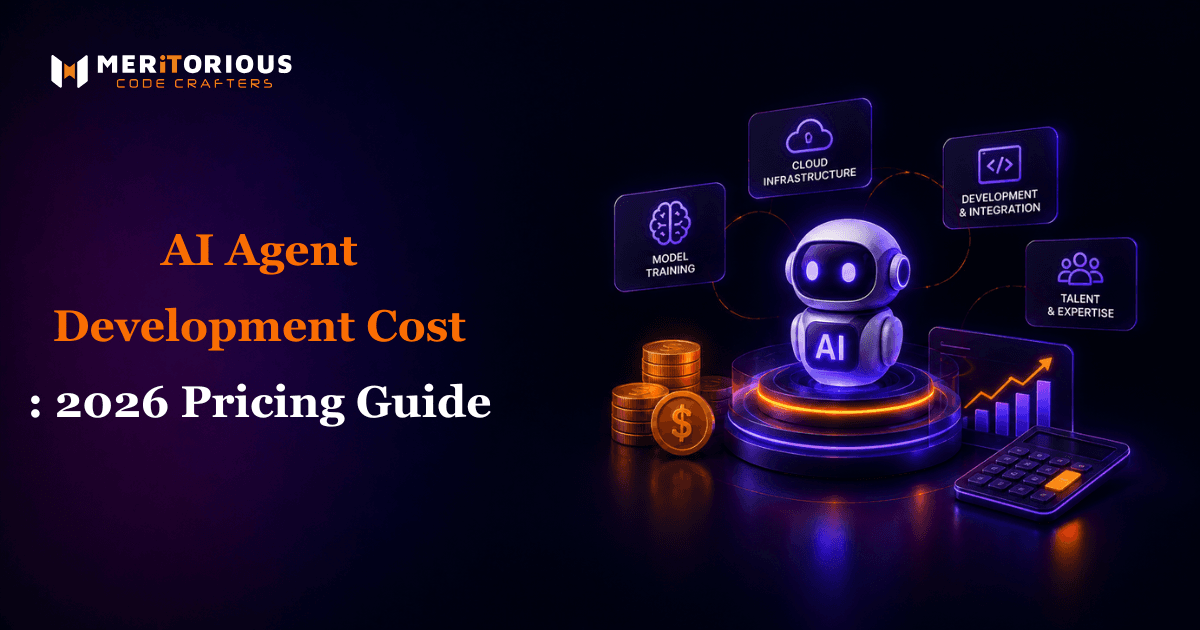
AI Agent Development Cost Breakdown: Where the Budget Goes
Understanding how budget is allocated across components prevents the most common AI agent cost surprise - discovering mid-project that integrations, compute, or observability were not in scope:
| Cost Component | % of Budget | India Range | Key Driver |
|---|---|---|---|
| AI Development (talent) | 45–55% | $5,000–$80,000+ | Team size, seniority, engagement model |
| LLM & API Integration | 10–15% | $500–$5,000/month | Model tier, call volume, caching |
| Tool & System Integration | 15–20% | $2,000–$20,000 | Number of integrations, API complexity |
| MLOps & Infrastructure | 10–15% | $1,000–$10,000 | Deployment complexity, monitoring scope |
| Testing & QA | 5–10% | $1,000–$8,000 | Agent complexity, failure scenario depth |
| Ongoing Maintenance | 10–20%/yr of build | $500–$5,000/month | Retraining, updates, monitoring |
The talent category dominates because AI agent development is an engineering-intensive discipline - the LLM is a commodity; the system built around it is not. Teams that underinvest in tool integration engineering and observability consistently produce agents that work in demos and fail in production.
Key Factors That Drive AI Agent Development Cost
Five variables determine where your project lands within any complexity tier's price range.
1. Number and Complexity of Tool Integrations
Each tool the agent uses requires engineering: API authentication, input/output schema definition, error handling, rate limit management, and output parsing. A single well-integrated tool takes 20–40 hours of engineering time. An agent with 8 complex integrations - CRM, calendar, email, document parser, web search, database, payment API, notification service - carries 160–320 hours of integration engineering before the agent logic itself is written.
2. LLM Model Selection and API Costs
The LLM backbone choice has a direct and ongoing cost impact. GPT-4 costs $0.03 per 1,000 input tokens and $0.06 per 1,000 output tokens. An agent making 50,000 tool-assisted calls per month generates $1,500–$4,000/month in API fees at GPT-4 pricing. Lighter models (GPT-4o-mini, Claude Haiku) cost 80–90% less per token but have lower reasoning quality - the right choice depends on your task complexity and acceptable quality threshold.
Cost optimisation levers: response caching (saves 20–40% for repeated queries), model routing (use cheap models for simple steps, expensive models for complex reasoning), and prompt compression (reduces token count by 15–30% without quality loss).
3. Memory Architecture Complexity
Simple agents with session-only memory cost less to build and operate. Agents requiring long-term memory - persistent user preferences, historical decision retrieval, multi-session context - need a vector database (Pinecone, Weaviate, pgvector), embedding pipeline engineering, and retrieval logic that adds $3,000–$15,000 to the build cost and $200–$1,500/month in ongoing infrastructure.
4. Multi-Agent vs Single-Agent Architecture
Single-agent systems are architecturally simpler and proportionally cheaper. Multi-agent systems - where a planner agent orchestrates specialised sub-agents - cost 2–3× more because each agent in the system requires its own tool set, memory configuration, and failure handling, plus orchestration logic that coordinates between agents, handles inter-agent communication, and manages partial failures.
Multi-agent systems are worth the premium when: the workflow is too complex for one agent to handle reliably, tasks can be parallelised across specialists, or different workflow segments have different accuracy and latency requirements.
5. Production Observability and Guardrails
This is the component most frequently excluded from initial scope and most frequently added as emergency spend after the first production incident. Full agent observability - trace logging of every reasoning step and tool call, latency monitoring, error alerting, human review queue for high-stakes actions - adds $5,000–$20,000 to the build cost and $500–$2,000/month in tooling. Budget for it upfront; it is cheaper than retrofitting after an agent takes a wrong action on live data.
Building something along these lines?
Tell us what you have in mind. We will come back with scope, stack and a realistic timeline.
AI Agent Development Cost by Region
Geography is the single highest-leverage cost variable in AI agent development. The same project scope produces dramatically different invoices depending on where the team sits:
| Region | Mid-Level AI Agent | Senior AI Engineer/mo | Cost Advantage |
|---|---|---|---|
| United States | $80,000–$200,000 | $14,000–$22,000/mo | Baseline |
| United Kingdom | $60,000–$160,000 | $10,000–$18,000/mo | 20–30% lower than US |
| Eastern Europe | $35,000–$90,000 | $5,000–$10,000/mo | 50–60% lower than US |
| India | $15,000–$50,000 | $3,000–$8,000/mo | 65–75% lower than US |
India's advantage is structural, not cyclical - lower cost of living, currency differential, and a deep AI engineering talent pool combine to make Indian teams consistently 65–75% less expensive than US equivalents. For a $120,000 US AI agent project, an equivalent India-based dedicated team delivers the same system for $35,000–$50,000.
To build with a vetted, production-experienced AI engineering team in India, Hire AI Developers in india covers dedicated engagement options across all specialisations required for agent development.
AI Agent Maintenance Cost: The Ongoing Budget
AI agent maintenance is not optional - it is the cost of keeping the agent reliable, accurate, and secure as the world around it changes. Budget 10–20% of the original build cost annually for:
- LLM model updates: When the underlying model is deprecated or upgraded, prompts and tool call formats frequently require revision
- Tool API changes: Every third-party integration your agent uses may update its API schema, authentication method, or rate limits - breaking the tool without notice
- Prompt drift correction: Agent prompts that worked reliably in month one can produce degraded output by month six as edge cases accumulate and the model's default behaviour shifts
- Performance monitoring response: When monitoring detects latency spikes, error rate increases, or quality degradation, investigation and remediation require engineering time
- Feature expansion: Adding new tools or capabilities to an existing agent - the most common maintenance request - requires integration engineering and testing proportional to the new tool's complexity
A mid-complexity AI agent with 5 tool integrations typically costs $1,000–$3,000/month to maintain properly - less than one day of a US engineer's time, but the difference between a reliable production system and an agent that silently fails three months after launch.
Custom Build vs Platform: How Does the Cost Compare?
Platform-based AI agents - Microsoft Copilot Studio, Salesforce Agentforce, Google Vertex AI Agent Builder - offer faster deployment at lower upfront cost, with ongoing platform licensing that scales with usage.
- Platform agent setup: $5,000–$30,000 for configuration and integration, plus $500–$5,000+/month in platform licensing
- Custom agent build: $15,000–$250,000 upfront, with infrastructure costs of $500–$3,000/month - no per-seat or per-agent licensing overhead
Platform agents win on: speed (2–4 week deployment vs 8–28 weeks for custom), lower upfront cost, and native ecosystem integration for standard workflows. Custom agents win on: flexibility, proprietary workflow support, no licensing ceiling as usage scales, and the ability to integrate with any system regardless of vendor ecosystem.
The break-even point where custom build costs less than platform licensing typically falls at 12–18 months of operation for mid-complexity use cases. For an overview of the full AI Solutions landscape - including where platform and custom approaches best apply - the decision framework depends on your workflow specificity and expected scale.
How to Reduce AI Agent Development Cost Without Reducing Quality
Five cost optimisation levers consistently deliver the most impact without compromising agent reliability:
- Hire from India: 65–75% talent cost reduction on the largest budget category - the single highest-leverage decision
- Start with MVP scope: Build with 2–3 core tools first, validate business value, then expand - avoids paying for integrations that turn out to be unnecessary
- Use model routing: Route simple agent steps to cheaper models (GPT-4o-mini, Haiku) and complex reasoning steps to premium models - reduces API cost by 40–60%
- Implement response caching: Cache frequent tool call results and LLM responses - particularly effective for knowledge retrieval and FAQ-adjacent agent tasks, saving 20–40% of API spend
- Choose open-source MLOps tooling: MLflow, LangSmith's open tier, and self-hosted monitoring reduce tooling cost by 30–50% versus fully-managed platforms at early production scale
Frequently Asked Questions
1. What is the average cost to build an AI agent in 2026?
A basic AI agent with 1–2 tool integrations built by an India-based team costs $5,000–$15,000. A mid-level agent with 3–6 tools costs $15,000–$40,000 in India or $40,000–$100,000 in the US. An advanced multi-agent system costs $100,000–$250,000 (India) or $250,000–$500,000+ (US). The right number for your project depends on tool count, integration complexity, and memory architecture requirements.
2. Why does AI agent development cost more than chatbot development?
AI agents require tool integration engineering, planning loop architecture, memory systems, and production observability that chatbots do not. Each tool integration takes 20–40 hours of engineering. The planning loop, memory architecture, and guardrails add significant engineering scope that a simple chatbot project does not carry. The capability difference - agents act autonomously across multiple steps; chatbots respond to single inputs - reflects directly in the build cost.
3. How much does it cost to maintain an AI agent after launch?
Budget 10–20% of your original build cost annually. For a $40,000 agent, that is $4,000–$8,000/year in maintenance - covering model updates, tool API changes, prompt optimisation, and performance monitoring response. LLM API costs run separately at $500–$4,000+/month depending on call volume and model tier. Maintenance is not optional - unmonitored AI agents degrade in reliability within 3–6 months as their dependencies evolve.
4. How long does AI agent development take?
A basic agent with 1–2 integrations takes 4–8 weeks. A mid-level agent with 3–6 tools takes 8–16 weeks. An advanced or multi-agent system takes 16–28 weeks. Enterprise orchestration systems take 6–12 months. These timelines assume clear requirements and a dedicated team - vague scope, frequent requirement changes, or part-time development extend all estimates significantly.
5. Is it cheaper to use a no-code AI agent platform or build a custom agent?
No-code and low-code platforms cost less upfront ($5,000–$30,000 setup vs $15,000–$250,000 for custom builds) but carry ongoing licensing fees that scale with usage. For standard workflows within the platform's native capability, this is often the right economic choice. For proprietary, complex, or high-volume use cases, custom builds become cheaper than platform licensing at the 12–18 month mark and offer unlimited flexibility beyond the platform's feature set.
Conclusion: Budget for the Agent, Not Just the Demo
AI agent development cost in 2026 is real, variable, and controllable - if you understand the drivers. Tool count determines integration engineering scope. Geography determines talent cost. LLM choice determines ongoing API spend. Observability investment determines whether your agent stays reliable after launch.
The companies that get the most value from AI agents are not necessarily the ones who spent the most. They are the ones who defined scope clearly, matched team geography to budget, optimised API and tooling costs systematically, and budgeted for maintenance before the first line of code was written.
If you are ready to scope an AI agent project with accurate cost estimates and the right team, Start Your Project to get a tailored cost assessment based on your specific workflow, integration requirements, and target timeline - before committing to any architecture or budget.