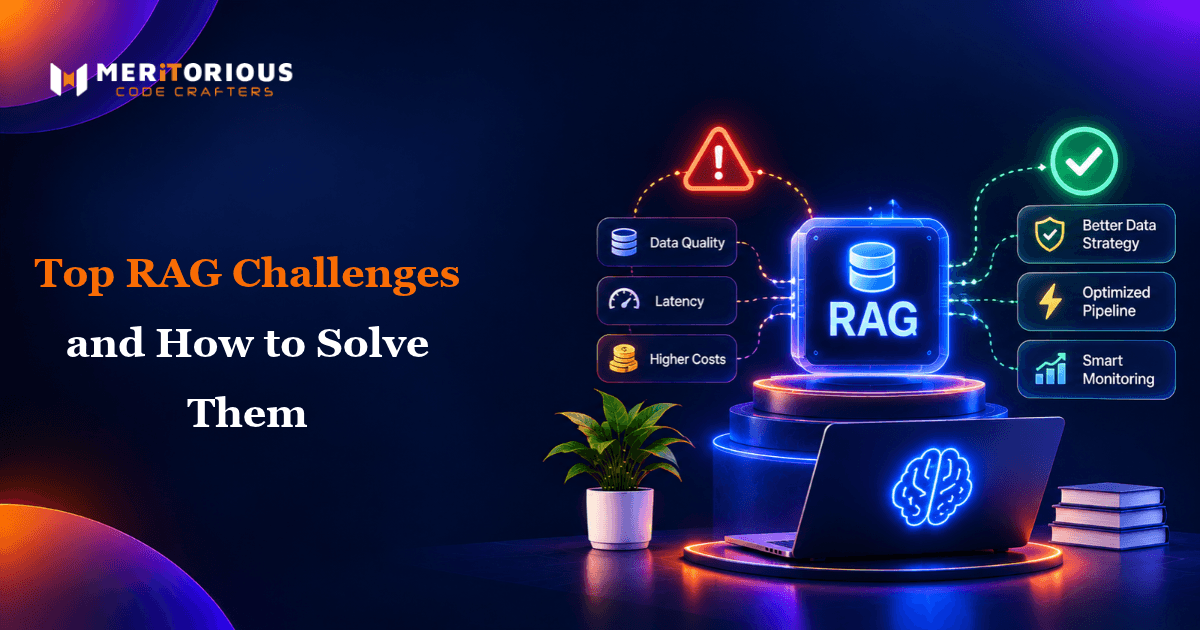
Quick Answer: The main issues are poor retrieval, messy data, chunking issues, out of date knowledge bases, hallucinations even with retrieval, context window issues, slow performance, leakage of permissions and scaling from prototype to production. Most can be resolved with better data, improved retrieval, ensuring regular reindexing, setting access rules and regular testing.
While it’s easy to create a ‘pretty’ prototype in one week, getting the RAG to deliver accurate, fast and secure answers can be quite tricky.
The main issues will not be due to the language model but the messy data, poor retrieval, slow performance and lack of security. These issues will be consistent for anyone trying to build Enterprise RAG Development Solutions and AI Software Solutions.
Below are the most common RAG issues and how to resolve them.
1. Poor Retrieval
Why am I getting irrelevant answers?
If the retrieval is poor then everything will fail. Common causes for poor retrieval are:
Large or small chunks of text. Chunks breaking sentences.
- Queries differ from what is in the documents.
- Exact search terms aren’t being used. E.g. Product codes. Vector search won’t find them.
- Too many loose answers.
How to improve retrieval performance.
- Use hybrid searches (Vector + Keywords).
- Use a re-ranking model. E.g. Cohere Rerank.
- Rewrite or expand the queries.
- Add metadata filters. E.g. Department, date, product.
2. Chunking Issues
One of the most common RAG issues. Chunks cutting through tables or separating headings will make the data meaningless.
How to improve chunking.
- Chunk based on document structure. Not character count.
- Keep tables and lists together.
- Use overlap.
3. Data Quality
How to handle messy enterprise documents.
Enterprise data is rarely perfect. Parsing PDFs can cause errors. Columns, tables and data will be missing. Scanned documents will need OCR.
How to improve data quality.
- Use layout aware parsers.
- OCR scanned documents. Check some of the output.
- Clean up and remove duplicates, drafts and out of date documents.
4. Poor Embeddings
Generic embedding models won’t understand industry specific terminology, acronyms or multi-language content. This leads to poor embeddings.
How to improve embeddings.
- Test multiple models against your data.
- Use domain specific or multi-language models.
- Re-embed your content.
5. Out Of Date Data
How to ensure your knowledge base isn’t out of date.
Having out of date data will cause your answers to be inaccurate and confident. This is a common issue with RAG and often occurs months after deployment.
How to fix.
- Schedule regular reindexing or trigger reindexing on changes to source data.
- Remove deleted/expired documents from vector database.
- Add metadata to show last updated and prioritise new data.
6. Hallucinations
Why are there still hallucinations and how to fix.
While hallucinations are reduced, they still occur. This is because the model isn’t using the context or combining information from multiple sources. If the retrieval is poor then the model may try to make up the answer.
How to improve.
- Ensure the model only uses the given context.
- Allow ‘I don’t know’ answers.
- Enforce citations to ensure all claims can be tracked down.
- Use tools to check faithfulness of answers. E.g. RAGAS.
7. Context Window Issues
Too many chunks may cause the model to exceed its context window or the correct answer may be lost.
The ‘Middle of the Prompt’ issue.
Studies have shown that LLMs will tend to use the start and end better than the middle of long prompts. This means if important facts are in the middle of your prompt they may be missed.
How to improve.
- Reduce the number of chunks and ensure they are high quality.
- Prioritise the most relevant information.
- Summarise long context.
Building something along these lines?
Tell us what you have in mind. We will come back with scope, stack and a realistic timeline.
8. Latency Issues
Why is RAG taking too long?
Retrieval, re-ranking and generation all cause latency.
How to reduce.
- Use caching to store answers to common questions.
- Reduce chunks retrieved. Reduce prompt size.
- Use fast models for simple queries.
- Stream answers.
9. Security & Compliance
Risk of leakage.
If there are no access rules in place then users may see information they shouldn’t. E.g. Salary information, confidential contracts.
How to improve security.
- Enforce access rules based on roles during retrieval.
- Add metadata to show what access each chunk has.
- Mask or remove sensitive fields before indexing.
- Log queries and documents retrieved.
10. Enterprise Data
Enterprise data will come from various sources. Wikis, file shares, CRM, ticketing systems and databases. All with different formats and access rules.
How to improve.
- Use connectors from frameworks like LangChain or LlamaIndex.
- Standardise documents.
- Sync access rules.
11. Scaling
How to scale your RAG.
A prototype with 100 documents will behave differently to a system with millions of chunks. Common issues when deploying RAG are slower searches, increased infrastructure requirements and inconsistent quality between departments.
How to improve.
- Use load testing with realistic data volumes.
- Split indexes by department/data type.
- Monitor retrieval, latency & errors.
By planning these early you’ll be ahead of the game with your roadmap to AI success. This will help you avoid the hidden costs of AI development.
Debugging Retrieval Issues
When you’re getting incorrect answers follow this process:
- Check your data : Has the correct document been indexed and is it up to date?
- Check retrieval : Has the correct chunk been returned?
- Check ranking : Is the chunk ranked highly?
- Check prompt : Has the context been passed through without issues?
- Check generation : Has the model used the context correctly?
By logging each step it will be much easier to identify any issues with your RAG system. As most RAG tools use Python, if you hire top python experts in india your team will be able to quickly debug and optimise.
FAQs
What are the most common RAG issues?
Poor retrieval, messy data, chunking, out of date data, hallucinations, latency, leakage and scaling.
Why am I getting irrelevant answers?
Usually due to poor chunking, poor embeddings, queries don’t match and no keywords.
How can I improve latency?
Use caching, less chunks and fast models for simple queries. Stream answers.
Why are there still hallucinations?
Poor retrieval, no context and unrestrictive prompts.
How can I avoid leakage?
Enforce access rules based on roles during retrieval. Add metadata to show each chunk’s access.
Conclusion
All RAG issues can be predicted. By having good quality data, well structured chunks, good retrieval, up to date data and access aware search, you’ll be able to transform your fragile prototype into a reliable production system.
If you’re struggling with any RAG issues in your project, partner with an experienced AI & Software Development Company and Talk to Our Experts.