KEY TAKEAWAYS
- AI chatbots increase revenue through four measurable mechanisms: faster conversion, better lead qualification, relevant upselling, and recovery of abandoned carts.
- Customer satisfaction improves mainly through speed, consistency, and personalisation, and only when the chatbot hands complex cases to a human with full context.
- CRM integration separates chatbots that move revenue from generic widgets, because answers built on real order and account data convert better than scripted replies.
- ROI should be calculated from gross profit on influenced sales plus support cost saved, measured against a pre-launch baseline rather than assumed.
- Start with one narrow, high-volume use case, prove the return, and expand, since low-volume or highly consultative sales see slower payback.
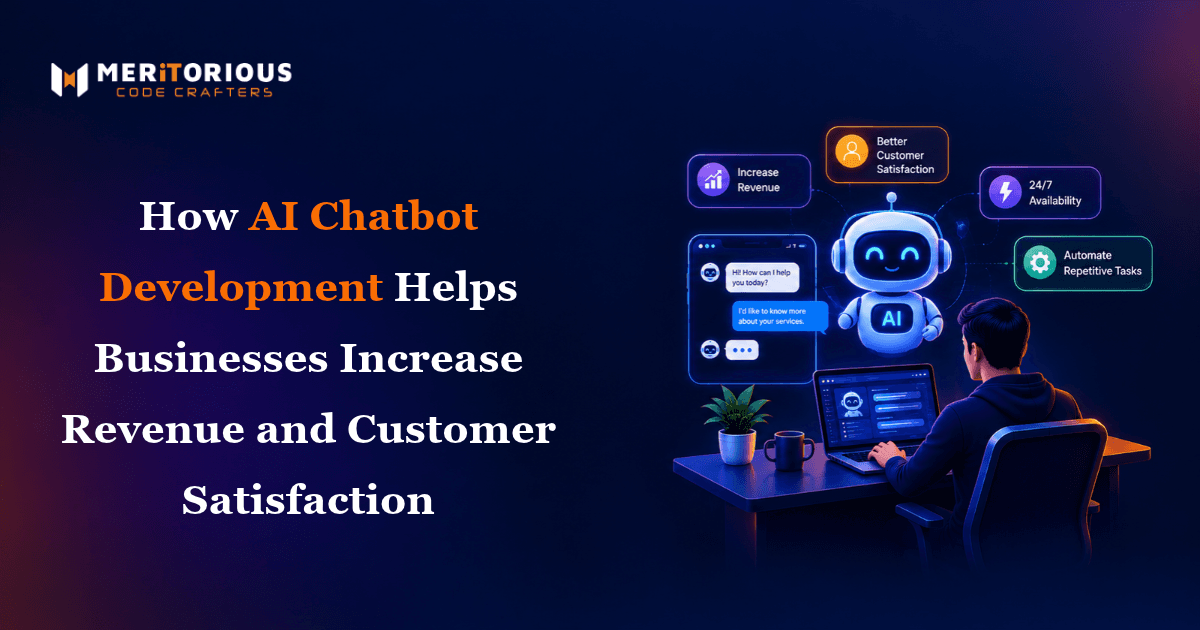
Most businesses buy a chatbot to cut support costs. The companies seeing real returns treatCustom AI Chatbot Development as a revenue investment. A well-built AI chatbot answers buyers at the moment of intent, qualifies leads while your sales team is offline, and recovers customers who were about to leave.
Powered by large language models and connected to your CRM, conversational AI now influences conversion, order value, and retention, not just ticket volume. This guide explains how AI chatbots increase revenue and customer satisfaction, where the gains actually come from, and how to measure them without inflating the numbers.
How Do AI Chatbots Increase Revenue?
AI chatbots increase revenue in four ways: converting more visitors by answering questions instantly, qualifying leads faster, raising order value through relevant recommendations, and retaining customers with proactive, personalised follow-up. Each mechanism maps to a metric you can track.
Higher Conversion Through Instant Answers
Most abandoned sessions come from unanswered questions about sizing, delivery, pricing, or compatibility. A chatbot resolves these in seconds, at any hour, with no queue. Published conversion lifts vary widely by industry, so treat them as directional, but the pattern is consistent: the biggest gains appear on high-consideration purchases, where hesitation is highest.
Lead Qualification and Shorter Sales Cycles
An AI chatbot for lead generation asks the questions a sales rep would: budget, timeline, use case, company size. It scores the answers, writes the lead into your CRM, and books a meeting when the lead is ready. Sales teams stop chasing cold enquiries and focus on qualified buyers. Instant replies matter too, because response speed strongly influences whether an enquiry converts.
Upselling and Cross-Selling
Chatbots with access to browsing and order history can suggest complementary products at the right moment, such as accessories for a device or a refill for a past purchase. Generative AI adds the explanation, telling the customer why the add-on fits, which feels like advice rather than a pitch.
Reducing Cart Abandonment
Triggered chat at checkout can answer last-minute concerns about shipping costs, returns, or payment options. When a customer still leaves, the chatbot can follow up on WhatsApp or email with the exact item and an answer to the question that stalled them.
Why Does Generative AI Change the Equation?
Rule-based bots follow scripts and fail when customers phrase questions unexpectedly. Chatbots built on large language models understand paraphrased questions, handle follow-ups, and adapt tone. The risk is inaccurate answers, which is why revenue-focused chatbots ground responses in your approved knowledge base and refuse to guess on pricing, policy, or stock.
How Do AI Chatbots Improve Customer Satisfaction?
AI chatbots improve customer satisfaction by removing waiting, giving consistent answers, and personalising responses with account data. Customers rate speed and accuracy above almost everything else, and both are strengths of a well-configured chatbot. Key CSAT drivers include:
- Instant response: no hold music and no ticket queue.
- 24/7 availability: help arrives at midnight and on public holidays.
- Consistency: every customer hears the same accurate policy answer.
- Personalisation: with CRM integration, the bot knows order status and history.
- Smart escalation: complex cases reach a human with the full conversation attached.
The last point is critical. A chatbot that traps customers in loops damages satisfaction faster than having no chatbot at all. Satisfied customers also return, so CSAT gains feed customer retention and repeat revenue.
AI Chatbot Impact by Business Goal
The table below links each business goal to the chatbot capability that drives it and the metric that proves it:
| Business Goal | Chatbot Capability | Metric to Track |
|---|---|---|
| Increase sales | Product guidance and recommendations | Conversion rate, average order value |
| Generate leads | Qualification and meeting booking | Qualified leads, cost per lead |
| Recover revenue | Checkout help and follow-up messages | Cart recovery rate |
| Improve CSAT | Instant, accurate, personalised answers | CSAT score, first-response time |
| Cut support cost | Automated resolution of repeat queries | Containment rate, cost per resolution |
How Do You Measure AI Chatbot ROI?
Measure AI chatbot ROI by comparing gross profit from influenced sales and support cost saved against total cost of ownership, using a baseline captured before launch. Without a baseline, any improvement claim is guesswork.
Formula: ROI = (gross profit from influenced sales + support cost saved − total chatbot cost) ÷ total chatbot cost.
Illustrative example: a chatbot costing $2,500 a month resolves 2,000 conversations that would cost $3 each to handle manually, saving $6,000. It also influences $10,000 in extra sales at a 40% margin, adding 4,000.ROI=(6,000 + $4,000 − $2,500) ÷ $2,500 = 300%.
Track these metrics:
- Conversion rate for chat users versus non-chat users
- Average order value and upsell acceptance rate
- Qualified leads generated and lead-to-meeting rate
- Containment rate: conversations resolved without a human
- CSAT and first-response time
Where possible, run the chatbot against a control group for 30 to 60 days. Be cautious with attribution: chat users often have higher purchase intent already, so compare similar segments rather than crediting every chat-assisted sale to the bot.
Building something along these lines?
Tell us what you have in mind. We will come back with scope, stack and a realistic timeline.
What Separates Revenue-Driving Chatbots From Ordinary Ones?
Technology alone does not produce results. Chatbots that move revenue share five traits:
- Deep integration: connected to CRM, inventory, and order systems so answers reflect real data.
- Accurate knowledge: retrieval from an up-to-date knowledge base prevents wrong answers about pricing or policy.
- Strong conversation design: clear flows, a defined tone, and honest handling of questions the bot cannot answer.
- Human handoff: escalation that preserves context.
- Continuous optimisation: monthly review of failed conversations and missed intents.
Building these foundations is what separates a purpose-built chatbot from a generic widget bolted onto a website.
When a use case outgrows conversation, such as a bot that must issue refunds, update records, or coordinate several systems,Enterprise AI Agent Solutions extend a chatbot into autonomous workflows. For a wider roadmap,Enterprise AI Solutions show how chatbots fit alongside other AI capabilities.
How Should You Roll Out a Revenue-Focused Chatbot?
Start narrow and expand only after the numbers justify it.
- Weeks 1–2: audit your top 20 customer questions and your highest drop-off pages.
- Weeks 3–6: build and integrate one use case, such as pre-sales questions or lead qualification.
- Weeks 7–10: launch to a share of traffic and compare results against your baseline.
- Ongoing: review failed conversations monthly and add the next use case.
This sequence keeps risk low and gives you evidence before you commit to a larger build.
Are AI Chatbots Worth It for Increasing Revenue?
Yes, when three conditions hold: you receive a steady volume of repeated questions, customers have a clear path to purchase or booking, and your systems can feed the chatbot accurate data. Businesses with low enquiry volume or highly bespoke, consultative sales may see slower returns and should start with one narrow use case.
Budget for the full lifecycle, including integration, language model usage, and ongoing tuning. Many teams lower that cost by choosing toHire AI Engineers in Indiafor integration and tuning work.
Conclusion: Treat the Chatbot as a Revenue System
AI chatbots increase revenue when they are designed around business outcomes rather than deflection alone. Answer quickly, qualify accurately, recommend relevantly, and escalate gracefully, then measure every step against a baseline.
If you want one partner to handle strategy, build, and optimisation together, anEnd-to-End AI Development Company can shorten the path from idea to measurable results. To discuss your use case and expected return,Schedule a Free Consultation.
Frequently Asked Questions
1. How do AI chatbots increase sales for ecommerce businesses?
They answer pre-purchase questions instantly, recommend complementary products, and re-engage shoppers who abandon carts. The gains are largest where product choice is complex and customers need reassurance before paying.
2. How do AI chatbots improve customer satisfaction scores?
They cut waiting time, give consistent answers, and use account data to personalise replies. CSAT improves most when the chatbot escalates difficult cases to a person with the conversation history attached.
3. How do AI chatbots qualify leads and shorten the sales cycle?
The chatbot asks qualifying questions about need, budget, and timeline, scores the responses, and syncs the lead to your CRM. It can book meetings automatically, so reps spend time only on prepared buyers.
4. Are AI chatbots worth it for increasing revenue?
They are worth it when you have steady enquiry volume, repeatable questions, and a clear purchase path. For low-volume or highly consultative sales, returns come more slowly, so begin with a narrow use case and measure.
5. How do you measure the ROI of an AI chatbot?
Capture baseline conversion, support cost, and CSAT before launch. After launch, compare gross profit from influenced sales plus support cost saved against total chatbot cost, using a control group where possible.