Key Takeaways
- AI agents differ from traditional automation and RPA because they can reason through unstructured tasks and make decisions, not just follow fixed, rule-based scripts.
- Businesses adopting AI agents report cost savings primarily through reduced manual workload on repetitive tasks like data entry, scheduling, and first-line customer queries.
- AI agents connect directly to existing systems like CRM platforms through API integration, allowing them to act on data rather than just retrieve or display it.
- Unlike chatbots, which mostly handle conversation, AI agents can complete multi-step tasks end-to-end, such as processing a refund or updating a record across systems.
- ROI from AI agents is typically measured in reduced response times, lower staffing overhead on routine tasks, and freed-up capacity for employees to focus on higher-value work.
What Are the Benefits of AI Agents for Business?
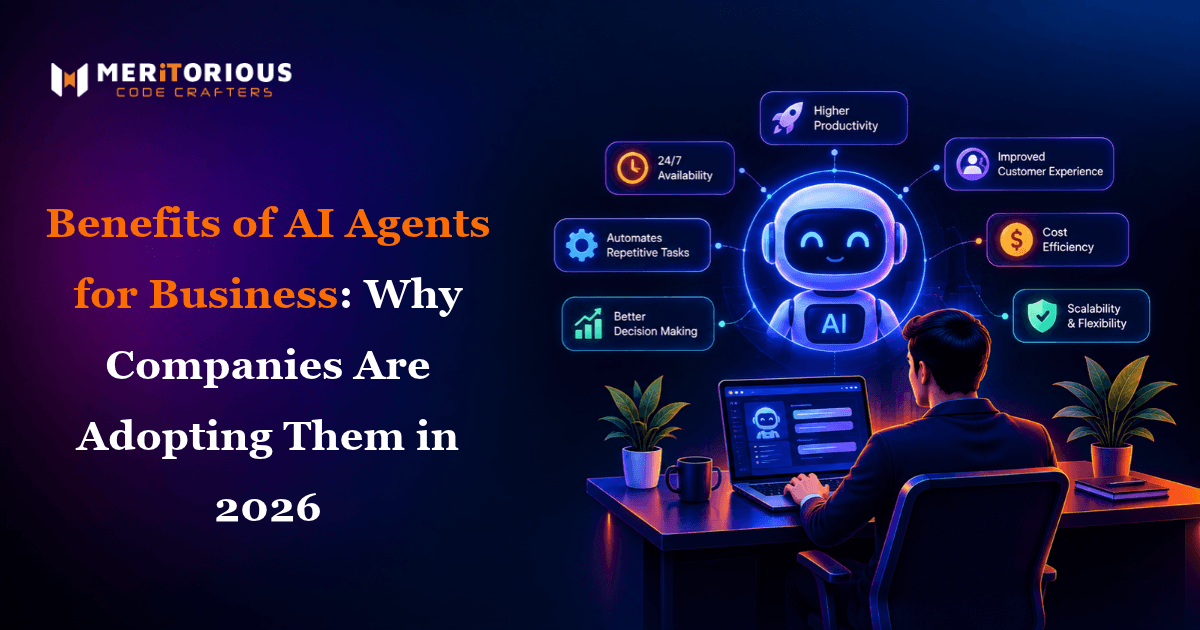
AI agents benefit businesses by automating complex, multi-step tasks that traditional automation tools can’t handle, reducing operational costs, improving response times, and freeing employees to focus on higher-value work. Built on large language models, AI agents can interpret unstructured requests, make decisions, and take action across connected systems without needing a human to manage every step.
This distinguishes AI agents from the automation most businesses are already using. Legacy workflow tools execute fixed rules; AI agents interpret intent and adapt their actions accordingly. Many companies now treat this as a core part of their roadmap and work with a partner offering Enterprise AI Agent Development services to scope which processes are worth automating before building anything.
How Do AI Agents Differ from Traditional Automation and RPA?
AI agents differ from traditional automation and RPA because they can handle unstructured inputs, reason through decisions, and adapt to variations in a task, while RPA and rule-based automation only execute pre-defined steps triggered by exact conditions. This difference determines what each tool can realistically be trusted to do without human oversight.
Robotic process automation excels at repetitive, predictable tasks, like copying data between two systems in a fixed format. It fails the moment a task deviates from that exact pattern. AI agents, powered by large language models, can interpret a request that doesn’t follow a rigid script, decide on an appropriate action, and execute it, which opens up automation for tasks that were previously too variable for RPA to handle reliably.
Where RPA Still Makes Sense
RPA remains the more cost-effective option for highly repetitive, unchanging processes where the input format never varies. Businesses don’t need to replace every RPA workflow with an AI agent; the two often work best together, with agents handling the judgment-based parts of a process and RPA handling the purely mechanical steps.
How Do AI Agents Help Businesses Reduce Operational Costs?
AI agents reduce operational costs primarily by handling repetitive, time-consuming tasks, such as data entry, scheduling, first-line customer support, and report generation, that would otherwise require dedicated staff hours. This shifts human effort away from routine work and toward tasks that genuinely require judgment.
Where Cost Savings Typically Show Up
- Customer support operations, where agents can resolve routine queries without escalating every request to a human representative.
- Back-office data processing, where agents can extract, validate, and enter information across systems faster than manual review.
- Scheduling and coordination tasks, where agents can manage calendars and logistics without constant human intervention.
These savings compound over time, since the same agent handles growing transaction volume without a proportional increase in staffing cost, unlike purely human-staffed operations. For a broader look at how this plays out across departments, see how scalable AI solutions for businesses improve day-to-day productivity beyond a single use case.
Can AI Agents Improve Operational Efficiency Beyond Cost Savings?
Yes. AI agents improve operational efficiency by working continuously without the delays inherent in human scheduling, handling multiple requests simultaneously, and completing multi-step processes end-to-end without waiting for manual handoffs between departments. Efficiency gains here aren’t just about doing the same work cheaper; they’re about doing it faster and with fewer bottlenecks.
A support request that previously moved through three different team members, each adding their own delay, can often be resolved by a single AI agent with access to the right systems. This doesn’t just save labor cost; it reduces the total time a customer or internal stakeholder waits for resolution, which has its own business value independent of staffing economics.
How Do AI Agents Improve Customer Experience?
AI agents improve customer experience by providing immediate, consistent responses around the clock and by resolving requests that require pulling information from multiple systems, something a basic chatbot typically cannot do. Faster, more complete resolutions directly influence customer satisfaction and retention.
What’s the Difference Between an AI Agent and a Chatbot?
A chatbot is generally built to hold a conversation and answer predictable questions using decision trees or simple pattern matching. An AI agent goes further: it can take action, such as processing a return, updating an account, or escalating an issue with full context attached, rather than just providing information. It’s worth understanding this distinction clearly before assuming a conversational tool covers the same ground an agent does.
Which Business Tasks Can AI Agents Automate?
AI agents can automate a wide range of tasks including customer support resolution, lead qualification, appointment scheduling, data entry and validation, report generation, and routine IT support tickets. The common thread across these tasks is that they involve some decision-making or variability, not pure repetition.
AI Agent Use Cases by Function
- Sales teams use agents to qualify leads, update CRM records automatically, and follow up on routine inquiries without manual tracking.
- Customer service teams use agents to resolve common issues, check order status, and escalate complex cases with full context. Businesses exploring this specific use case often look atAI-powered chatbot development as a starting point before expanding into fuller agent capability.
- Operations teams use agents to monitor workflows, flag exceptions, and coordinate handoffs between systems without constant manual checking.
This connection to existing systems depends heavily on API integration. Agents that can read from and write to a CRM, support platform, or internal database are far more useful than ones limited to answering questions in isolation.
Building something along these lines?
Tell us what you have in mind. We will come back with scope, stack and a realistic timeline.
What’s the ROI of AI Agents for Businesses?
The ROI of AI agents typically shows up as reduced response times, lower staffing overhead on routine tasks, and increased capacity for existing teams to handle higher volumes without proportional headcount growth. Businesses measuring ROI should track these operational metrics directly rather than relying on general productivity assumptions.
Measuring this accurately requires a before-and-after comparison on specific metrics: average resolution time, cost per ticket or transaction, and the ratio of tasks completed without human escalation. Businesses that track these numbers before deployment have a much clearer picture of actual returns than those evaluating AI agents purely on anecdotal feedback.
Are AI Agents Worth It for Small Businesses?
AI agents can be worth it for small businesses when they’re deployed against specific, high-volume, repetitive tasks where the cost of the agent is clearly lower than the cost of continuing to handle that task manually. Small businesses benefit most by starting narrow, automating one clear process well, rather than attempting broad automation across every function at once.
A small business handling a high volume of similar customer inquiries, for example, may see faster ROI from an agent than a business with highly varied, low-volume requests where the setup cost isn’t justified by the task volume. Scoping the use case correctly matters more than the size of the business itself.
Are AI Agents Safe to Use in Business Operations?
AI agents can be used safely in business operations when deployed with clear permission boundaries, human oversight on high-stakes actions, and proper data handling practices around any systems they’re connected to. Safety isn’t an inherent property of the technology; it depends on how the deployment is scoped and governed.
Businesses should define exactly what an agent is authorized to do autonomously versus what requires human approval before acting, particularly for actions involving financial transactions, customer data, or irreversible changes. This governance layer is as important to get right as the underlying AI capability itself.
Why Are Businesses Adopting AI Agents in 2026?
Businesses are adopting AI agents in 2026 because the underlying large language models have become capable enough to handle genuinely variable, multi-step tasks reliably, closing the gap between what automation could previously do and what actual business processes require. This shift from narrow, rule-based automation to adaptable, reasoning-capable agents is what’s driving broader adoption now rather than in prior years.
Companies that evaluated AI agents a few years ago and found the technology too unreliable for production use are often revisiting that decision, since reliability and integration options have improved substantially. As an AI Solutions Provider, this shift is one businesses across industries are increasingly acting on rather than just monitoring from the sidelines. Teams building this capability internally can also hire dedicated AI developers in India to extend existing engineering capacity without a lengthy hiring cycle.
Conclusion: AI Agents Are a Practical Business Tool, Not Just a Trend
The benefits of AI agents for business come down to measurable operational gains: lower costs on repetitive tasks, faster resolution times, and capacity freed up for higher-value work. Unlike traditional automation or basic chatbots, agents can reason through variable tasks and take action across connected systems, making them suited to a much wider range of business problems.
Meritorious CodeCrafters, an offshore software development company, helps businesses identify the right use cases and deploy agents safely into existing workflows. Contact our development team to discuss where AI agents fit into your operations.
Frequently Asked Questions
1. What are the benefits of AI agents for businesses?
AI agents reduce operational costs by automating repetitive and variable tasks, improve response times through continuous availability, and free employees to focus on higher-value work. Unlike basic automation, they can reason through unstructured requests and take action across multiple connected systems.
2. How do AI agents save money for companies?
AI agents save money primarily by handling tasks like data entry, scheduling, and routine customer support without requiring dedicated staff hours for each transaction. Savings grow over time since agents handle increasing volume without a proportional rise in staffing costs.
3. What is the difference between an AI agent and a chatbot?
A chatbot typically holds conversations and answers predictable questions using scripted logic. An AI agent goes further by taking action, such as updating a record or processing a request, often across multiple connected systems, rather than only providing information.
4. Which business tasks can AI agents automate?
AI agents can automate customer support resolution, lead qualification, appointment scheduling, data entry and validation, report generation, and routine IT support tasks. These tasks typically involve some decision-making or variation, which is where agents outperform traditional rule-based automation.
5. Are AI agents safe to use in business operations?
Yes, when deployed with clear permission boundaries and human oversight on high-stakes actions. Businesses should define what an agent can do autonomously versus what requires approval, particularly for tasks involving financial transactions or sensitive customer data.