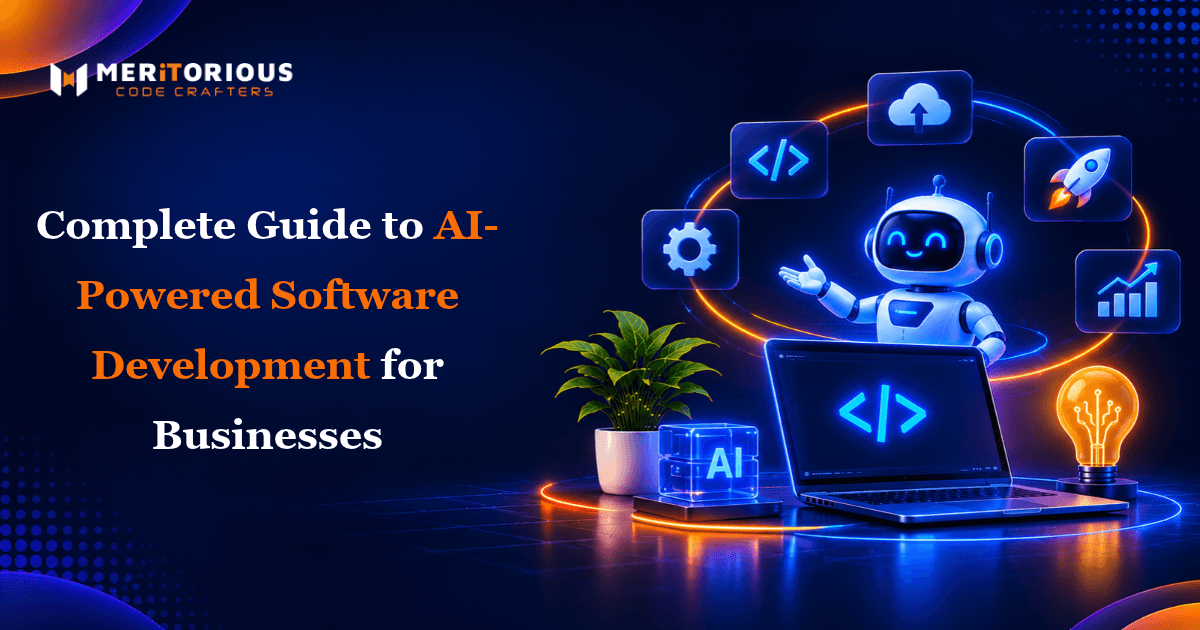
Quick Answer: AI-powered software development is the process of building applications that use technologies like machine learning, large language models (LLMs), natural language processing (NLP), and computer vision to learn from data, make predictions, and automate decisions. Unlike traditional software, AI-powered software adapts to new information instead of relying only on fixed, hand-coded rules.
Traditional software follows fixed rules. AI-powered software learns from data, understands language, and improves over time.
This guide explains how AI-powered software development works, what it takes to build it, and where it delivers the most value. Whether you're exploringAI Software Solutions or planning your first AI product, use this as your starting point.
What Is AI-Powered Software Development and How Does It Work?
AI-powered software development combines software engineering with AI models trained on data. The software processes inputs through models and returns predictions, recommendations, generated content, or automated actions.
Core technologies include:
- Machine learning: Finds patterns to make predictions, like demand forecasts.
- Large language models (LLMs): Understand and generate human-like text.
- Natural language processing (NLP): Interprets emails, documents, and messages.
- Computer vision: Analyzes images and video.
AI-Powered Software vs Traditional Software
How is AI-powered software different from traditional software?
| Factor | Traditional Software | AI-Powered Software |
|---|---|---|
| Logic | Fixed, hand-coded rules | Learns patterns from data |
| Adaptability | Changes require code updates | Improves with new data |
| Inputs | Structured data | Text, images, voice, and structured data |
| Output | Predictable and rule-based | Predictions, recommendations, generated content |
Types of AI-Powered Software
Common types of AI-powered software include:
- Predictive analytics software: Forecasts sales, demand, or risk.
- Intelligent document processing: Extracts and classifies information from files.
- Recommendation engines: Suggest products, content, or next actions.
- Computer vision systems: Inspect quality, read documents, or monitor safety.
- AI-powered workflow automation software: Routes tasks and automates decisions.
Machine Learning vs Generative AI in Business Software
Machine learning suits predictions from structured historical data. Generative AI, powered by LLMs, creates content like summaries and drafts. Many applications use both.
Benefits of AI-Powered Software
- Smarter decisions: Predictions based on real data, not guesswork.
- Automation: Repetitive, rules-heavy tasks run with less manual effort.
- Personalization: Experiences tailored to each customer or user.
- Continuous improvement: Models get better as new data arrives.
AI-Powered Software Use Cases
Which business processes benefit most from AI-powered software?
- Sales and marketing: Lead scoring, customer segmentation, and churn prediction
- Finance: Fraud detection, invoice processing, and forecasting
- Operations: Demand planning and inventory optimization
- Customer service: Ticket classification and response suggestions
- Manufacturing: Predictive maintenance and visual quality inspection
AI-Powered CRM and ERP Software
AI-powered CRM and ERP software adds intelligence to core systems, like predicting which deals will close or flagging unusual transactions.
Key Components of AI-Powered Business Software
What are the key components of AI-powered business software?
- Data layer: Databases, data pipelines, and storage
- AI models: Machine learning models, LLMs, or computer vision models
- Application layer: Business logic, APIs, and user interfaces
- Integration layer: Connections to CRM, ERP, and other systems
- MLOps layer: Model deployment, monitoring, and retraining
- Security and governance: Access control, compliance, and audit logs
AI Software Architecture for Business
A typical AI software architecture for business separates the AI model from the application, so models can be updated without rebuilding the product.
How to Build AI-Powered Software
How can businesses build AI-powered software? Most successful projects follow these steps:
1. AI Software Requirements Planning
Define the business problem, users, and success metrics, and confirm AI is the right fit.
2. Data Requirements for AI-Powered Software
How do you plan data for an AI-powered software project?
- Identify the data sources the solution needs
- Check and clean data quality and volume
- Set rules for privacy, access, and retention
Data quality matters more than model choice.
3. Choosing an AI Tech Stack for Business Software
How do you choose the right AI tech stack for business software?
| Layer | Common Options |
|---|---|
| Machine learning frameworks | TensorFlow, PyTorch |
| Language models | Commercial LLM APIs or open-source models |
| Cloud infrastructure | AWS and other major cloud platforms |
| MLOps | Model tracking, deployment, and monitoring tools |
| Backend | Python is the most common language for AI |
Choose tools based on skills, data sensitivity, and scale. Teams thathire remote python developers from indiaoften accelerate this stage, since most AI tooling is Python-based.
4. Build, Train, and Embed AI Into Business Applications
Embedding AI into business applications means connecting trained models to real workflows through APIs, dashboards, and automation.
5. Test, Deploy, and Monitor
Test for accuracy, fairness, security, and performance. After launch, MLOps practices track accuracy, detect data drift, and trigger retraining.
To understand how long these steps typically take, see our AI project timeline in 2026.
Building something along these lines?
Tell us what you have in mind. We will come back with scope, stack and a realistic timeline.
AI-Enabled App Features for Business
Popular AI-enabled app features for business include:
- Smart search and recommendations
- Document summarization and data extraction
- Predictive alerts and forecasting
- Image and document recognition
- Natural language queries over business data
AI Software for Small and Mid-Sized Businesses
AI software for small and mid-sized businesses works best when focused on one high-impact use case, like invoice processing. Cloud services and pre-trained models remove the need for large data science teams.
AI Software Development for Enterprises
AI software development for enterprises requires stronger governance, security, and integration across many systems and departments.
AI Software Data Governance and Compliance
Enterprises must control data access and usage and explain model decisions. Regulations like GDPR make governance essential from day one.
AI Software Scalability Planning
AI software scalability planning prepares systems for more users, data, and models through cloud infrastructure, modular architecture, and MLOps.
AI Software Development Trends 2026
Key AI software development trends in 2026 include:
- Wider use of LLMs inside everyday business applications
- Combining machine learning and generative AI in the same product
- Stronger focus on AI governance and responsible AI
- Growth of smaller, efficient models that run at lower latency
What Should Businesses Know Before Investing in AI-Powered Software?
- Start with a clear business problem, not the technology
- Make sure you have, or can collect, quality data
- Build security and compliance in from the start
- Begin with one use case and expand gradually
For tools that support engineering teams, see our guide toAI tools for developers, and learn more about our development services.
FAQs
What is AI-powered software development?
Building software that uses machine learning, LLMs, NLP, or computer vision to learn from data and automate decisions.
How is AI-powered software different from traditional software?
Traditional software follows fixed rules, while AI-powered software learns from data and improves over time.
What data is needed for AI-powered software?
Relevant, clean, well-organized data, plus clear privacy and access rules.
Which tech stack is best for AI-powered software?
Common choices include Python, TensorFlow or PyTorch, cloud platforms like AWS, and MLOps tools for deployment and monitoring.
Is AI-powered software suitable for small businesses?
Yes. Focused use cases and cloud-based AI services make it practical for small and mid-sized businesses.
Conclusion
AI-powered software development helps businesses move from fixed rules to systems that learn and improve. With a clear goal, quality data, the right stack, and strong MLOps, AI becomes a lasting advantage.
Ready to build? Explore ourCustom AI & Digital Solutions orContact Our Team today.