While large language models (LLMs) are trained to be very competent in almost any scenario, you may want to build a model that uses specific language, format or tone.
This is where fine-tuning comes in. This guide will tell you everything you need to know about LLM fine-tuning, including what is LLM fine-tuning and when it is best suited to your business. Whether you are looking into Custom AI Solutionsor LLM Customization Services.
What Is LLM Fine-Tuning?
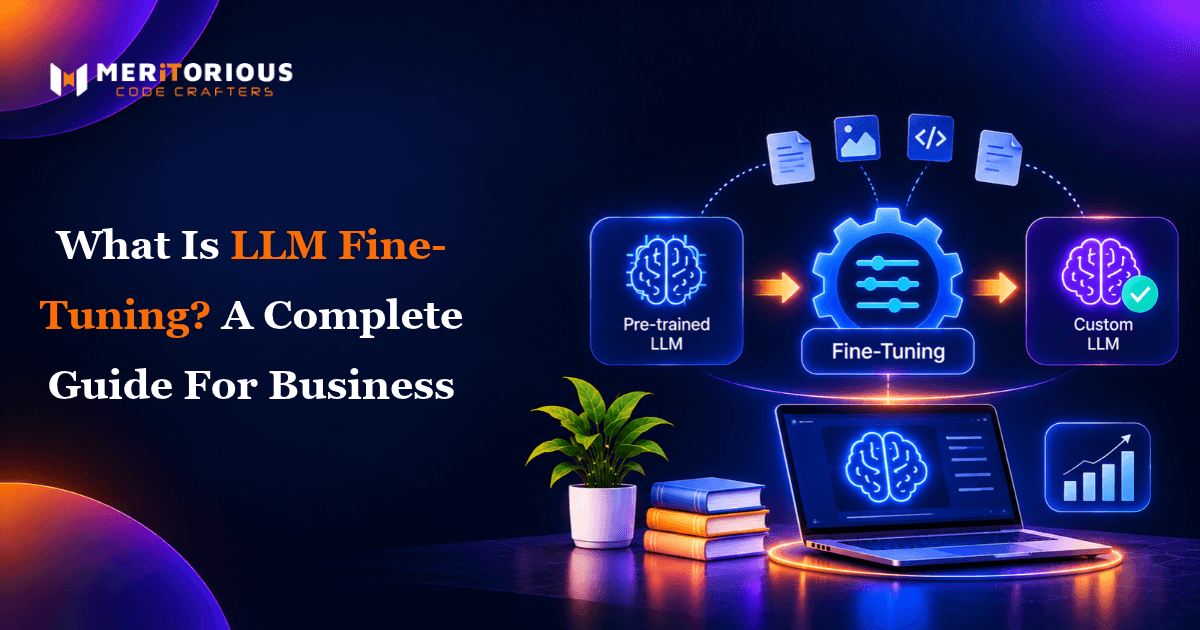
Fine-tuning an LLM is where you train an already trained model with a smaller dataset containing specific examples relevant to your use-case. This means that the model retains its general knowledge while learning new behaviours.
It can be thought of as taking an experienced writer and training them on your style guide.
Pre-Trained or Fine-Tuned LLM
| Factor | Pre-Trained LLM | Fine-Tuned LLM |
|---|---|---|
| Training data | Broad internet-scale text | Your task-specific examples |
| Strength | General knowledge and reasoning | Consistent, specialized output |
| Tone and format | Generic | Matches your requirements |
| Domain language | Basic understanding | Strong command of your terminology |
How Does Fine-Tuning Work?
During the LLM fine-tuning process, the model is trained using numerous examples of inputs and outputs. For example, customer questions and ideal answers. This causes the model to adapt its parameters to produce more accurate outputs.
Over time, the model learns what format, language and tone you want.
Types of LLM Fine-Tuning
Supervised Fine-Tuning
The most common type of fine-tuning, supervised fine-tuning teaches the model from labelled examples of prompts and ideal outputs. This is great for specialised formats, tasks and domain behaviours.
Instruction Tuning
Instruction tuning teaches the model to follow instructions for multiple tasks, whereas fine-tuning generally focuses on a single task or domain.
Parameter-Efficient Fine-Tuning
Fine-tuning can cause the model to take a lot of computational resources as all parameters are updated. However, parameter-efficient fine-tuning (PEFT) only updates a small amount of the model.
LoRA Fine-Tuning
The most popular parameter efficient technique is LoRA (Low-Rank Adaptation). This helps make fine-tuning more efficient by training small adaptation layers rather than the whole model. As the weights of the model are frozen, there are dramatically less trainable parameters. This is also easily available via libraries such as Hugging Face.
RLHF
Reinforcement learning from human feedback (RLHF) trains the model based on human feedback. The model is rewarded for giving the desired answer. Whereas supervised fine-tuning is based on static examples. RLHF has been used to develop assistants like those from OpenAI however supervised fine-tuning is generally more practical for business.
LLM Fine-Tuning Steps
1. Decide on your goal: For example, summarise reports or use your brand tone.
2. Decide on your base model : Either open-source models such as Llama or hosted models from providers such as OpenAI.
3. Create your dataset: Gather quality examples of inputs and outputs.
4. Decide on your fine-tuning method: Full fine-tuning, LoRA or other PEFT techniques.
5. Train your model.
6. Test the model.
7. Deploy the model and monitor quality.
Creating a Dataset for Fine-Tuning
To fine-tune an LLM you will need examples of what a good output looks like. For example, support answers, product descriptions or report summaries. Many projects will start with around hundreds to a few thousand examples.
When creating your training data:
- Use real examples.
- Remove any errors, duplicates and inconsistently formatted data.
- Ensure you have a consistent format.
- Ensure you have a test set.
A smaller, clean dataset is often better.
Building something along these lines?
Tell us what you have in mind. We will come back with scope, stack and a realistic timeline.
Benefits of Fine-Tuning
- Consistent outputs
- Improved domain knowledge
- Brand tone
- Improved task performance
Use Cases
- Fine-Tune for brand tone : Create marketing material, product descriptions and communications.
- Fine-Tune for domain knowledge : Create legal, medical, financial or technical content.
- Document classification : Classify tickets, contracts or claims.
- Data extraction : Extract specific fields of information.
- Generate reports : Create consistent summaries.
Fine-Tuning Large Language Models for Enterprise
When fine-tuning large language models for enterprise you should consider the governance, security and consistency across departments.
Data Security
Depending on your training data you may have sensitive information. Ensure you remove personal data, place in a secure environment and look into what your model providers data usage policy .
When Should You Fine-Tune An LLM?
- You may want to fine-tune an LLM if:
- Outputs aren’t consistent with just prompting.
- You need a specific format or tone.
- Your domain uses specialised language.
- You have enough quality examples.
Fine-Tuning vs Prompt Engineering
While fine-tuning can be a great option, you should begin with prompt engineering. This can be changed quickly. If your prompts become long, your outputs still aren’t consistent or you require a specific behaviour for thousands of requests, fine-tuning should be used.
For a broader understanding of current AI techniques, see Agentic AI and Generative AI explained.
Potential Issues
Catastrophic Forgetting
This occurs when a model loses its general knowledge due to being trained heavily on specific data. This can be mitigated by using LoRA, lower learning rates and a mix of training data.
There is also a risk of overfitting to the small dataset.
How To Evaluate A Fine-Tuned LLM
- Compare the outputs of the fine-tuned model to the base model using the same test set.
- Check how accurate the outputs are for your task, format and tone.
- Add a human check to ensure it fits your brand.
- Check any edge cases.
Best Practice
- Have a specific goal.
- Ensure your data is quality.
- Use parameter efficient techniques such as LoRA.
- Always compare to a baseline.
- Retrain periodically.
Most fine-tuning tools will be in Python. See Python explained for business leader for more information. An experienced team of Hire Dedicated AI Developers in india can help implement best practice.
FAQs
What is LLM fine-tuning?
Training an existing language model with your examples so it can perform better for a specific task or style.
How much data do I need?
It depends on your task but many projects begin with hundreds to a few thousand quality examples.
What is LoRA?
A parameter efficient technique that trains small adaptation layers. This helps reduce computational and memory requirements.
Is fine-tuning better than prompt engineering?
Not always. Begin with prompting. If you require consistent specialised outputs at scale, fine-tuning should be used.
Will it cause the model to forget things?
Yes, this is known as catastrophic forgetting. This can be mitigated by using LoRA and balance training data.
Conclusion
Understanding what is LLM fine-tuning can help your business create specialised models from general models. By having a specific goal, quality data and evaluating your model you will get consistent outputs.
Get your LLM customised today by looking into our Custom AI & Digital Solutions or Start Your Project.