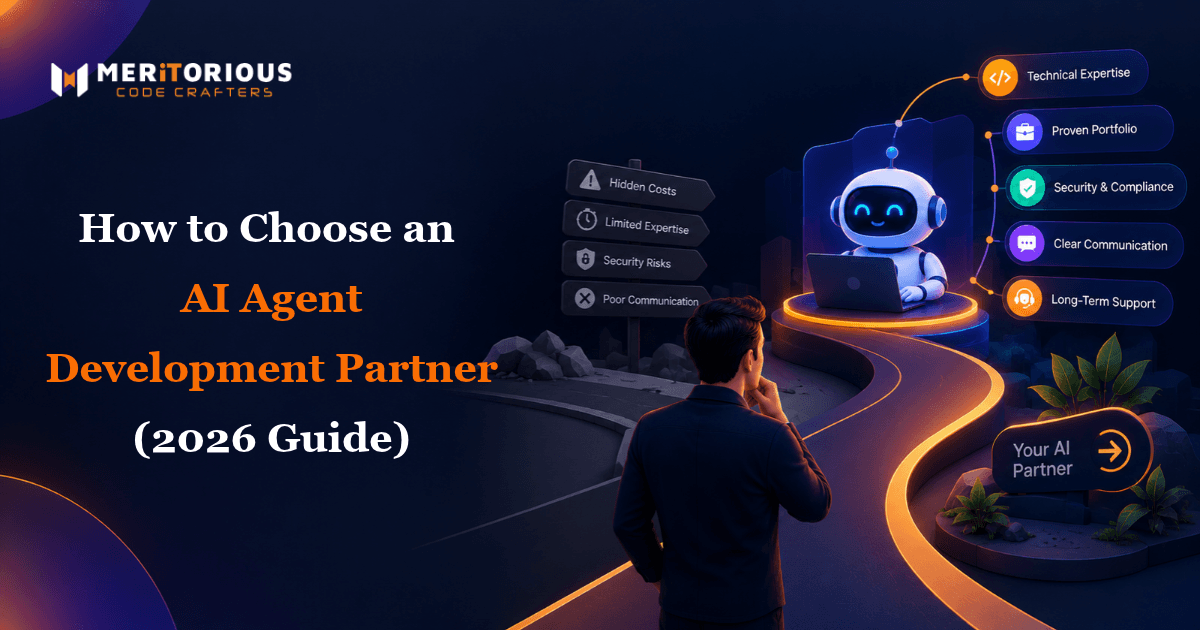
Selecting the right engineering team for custom autonomous systems is the single most critical decision modern enterprises face when automating operations. When evaluating dedicated AI Automation Agent Services, technical decision-makers must move beyond generic portfolio claims and analyze how prospective vendors engineer agentic reasoning, protocol integration, and failure handling. This how to choose an ai agent development partner guide provides a structured engineering and due diligence framework to help CTOs, product leaders, and founders shortlist, evaluate, and select a reliable partner without incurring severe technical debt or budget overruns.
The Shift in 2026: Why Traditional Software Vendors Fail at AI Agent Projects
Building autonomous systems is fundamentally different from building standard SaaS products, mobile apps, or rule-based chatbots. Traditional software engineering relies on deterministic execution: Input A always yields Output B. Autonomous multi-agent systems, however, rely on non-deterministic reasoning loops, live API calls, and dynamic memory state management.
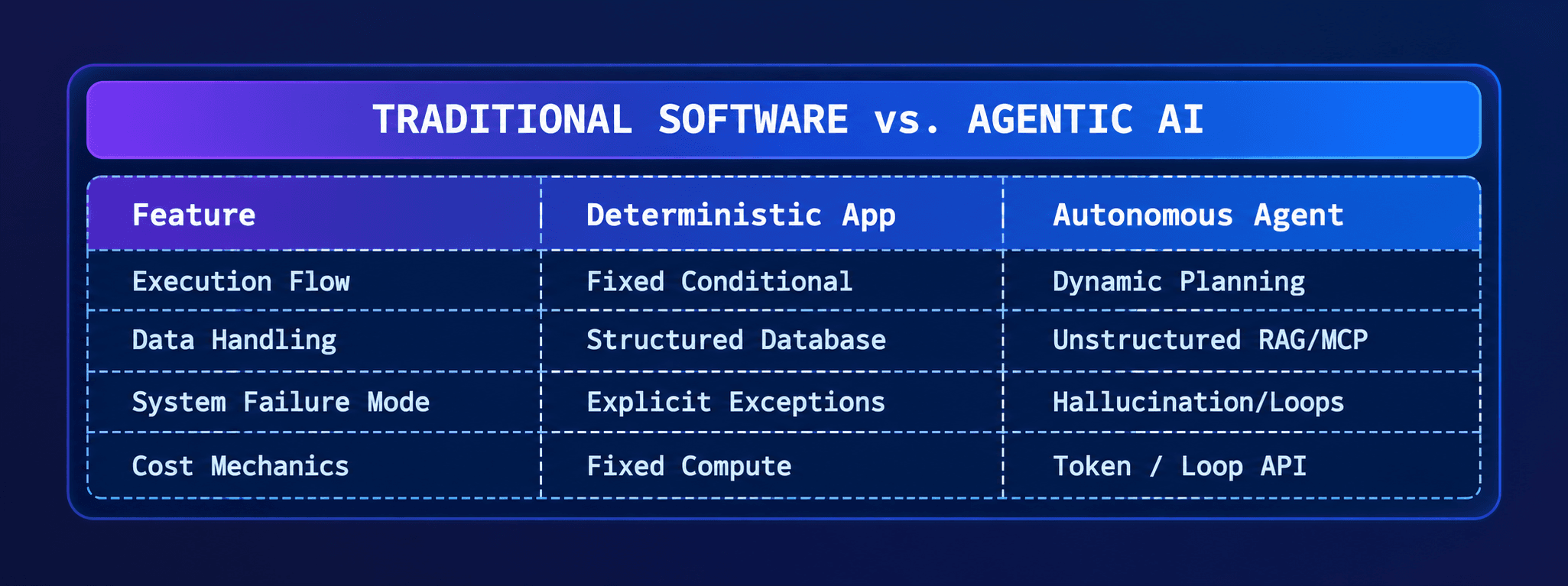
A common failure mode in current enterprise deployments occurs when legacy development agencies apply standard web development workflows to agent orchestration. Without proper agentic architecture, systems suffer from high token burn, infinite hallucination loops, and unhandled tool-calling failures. Finding a qualified partner requires evaluating their deep understanding of autonomous orchestration frameworks rather than basic software delivery.
Build vs Buy AI Agents: Making the Strategic Choice
Before initiating vendor selection, engineering leadership must determine whether building a custom solution or acquiring an off-the-shelf platform aligns with organizational goals.
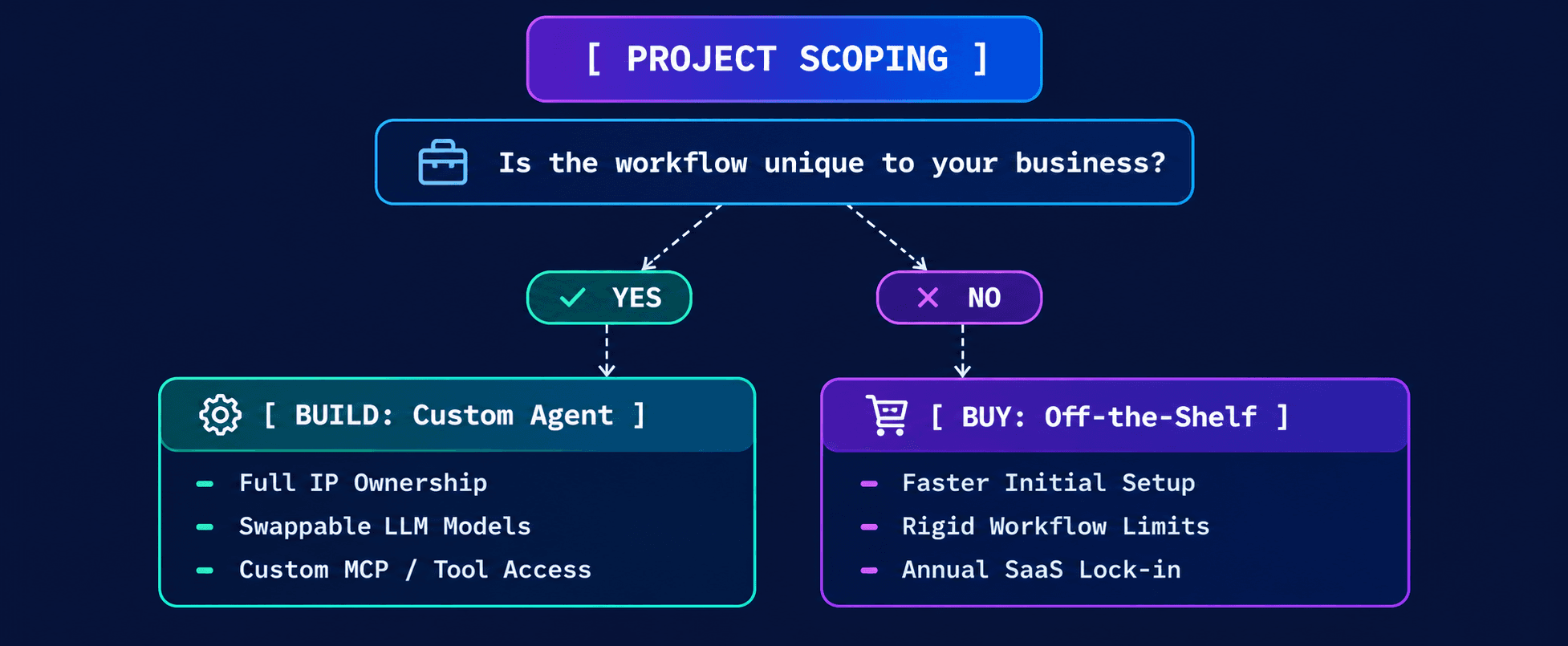
Buying Off-the-Shelf SaaS Platforms
- Best For: Generic, standardized tasks (e.g., basic meeting scheduling, first-line ticket routing).
- Limitations: High vendor lock-in risks, rigid workflow limits, restricted tool integration, and ongoing subscription costs that scale poorly with transaction volume.
Building Custom Autonomous Agents
- Best For: Core business workflows, proprietary operations, multi-step orchestration across legacy software, and strict data security needs.
- Advantages: Complete IP ownership, model-agnostic flexibility (swappable base models), fine-grained permission boundaries, and zero per-seat SaaS markup.
When your business workflows create a competitive advantage, building custom solutions with an experienced partner ensures long-term scalability and security.
7-Step AI Agent Vendor Evaluation Framework
To conduct thorough ai agent vendor due diligence, use this seven-step technical evaluation process:
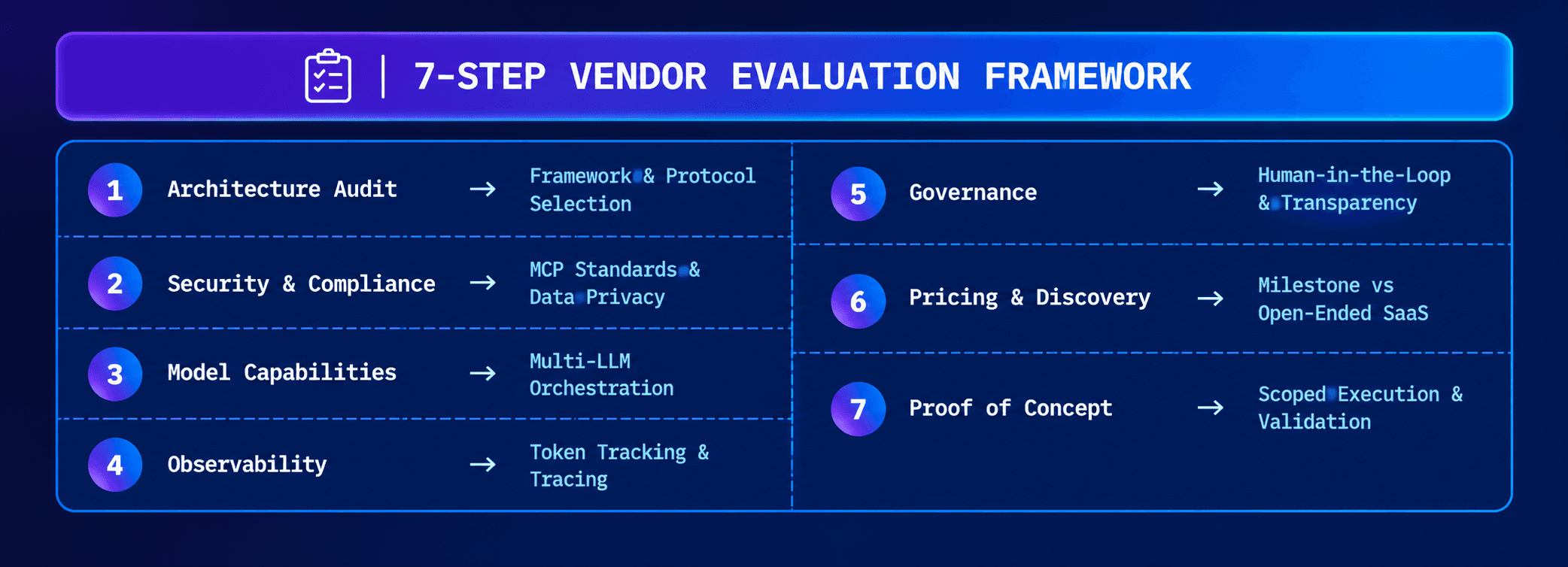
1. Architecture Audit: Framework & Protocol Selection
Evaluate the vendor’s hands-on experience with modern agent frameworks such as LangChain, CrewAI, and advanced orchestration libraries like LangGraph.
Inquire directly about their protocol implementation standards:
- Do they use the Model Context Protocol (MCP) to standardize how agents access databases, APIs, and document repositories?
- How do they handle Agent-to-Agent (A2A) protocols when coordinating horizontal agent squads?
2. Security, Privacy, and Compliance
Agents require write-access credentials to perform operations in enterprise systems. Evaluate the vendor's security architecture:
- Are credentials scoped with least-privilege permission boundaries?
- Is user data isolated from model training pipelines on platforms like AWS Bedrock, Azure AI Foundry, or Google Vertex AI?
- Does the system maintain immutability and complete audit logging?
3. Model Agnosticism & Flexibility
Avoid partners that lock your core architecture into a single model supplier. A resilient agent framework abstracts the model layer, allowing seamless switching between OpenAI, Anthropic Claude, open-source Llama models, or hosted enterprise endpoints as prices and capabilities evolve.
4. Telemetry and Observability Infrastructure
Agentic loops execute multiple reasoning steps per task, which can rapidly increase token usage if unmonitored. Ensure prospective partners integrate production tracing tools like LangSmith, OpenTelemetry, Grafana, or Prometheus from day one to track latency, step counts, and token costs per execution.
5. Human-in-the-Loop (HITL) Governance
Determine how the vendor designs fallback mechanisms. High-risk operations (such as processing financial transactions or updating customer databases) must feature deterministic human approval checkpoints before state-changing execution occurs.
6. Pricing Models and Delivery Structure
Analyze how the vendor quotes engineering labor alongside compute expenses. Beware of open-ended hourly billing models lacking clear milestones or benchmark deliverables.
7. Proof of Concept (PoC) Evaluation Criteria
A prospective partner should be evaluated through a tightly scoped 2-to-4 week Proof of Concept targeting a single high-value workflow. Review completed builds in See Our AI & Software Projects to examine real-world architectural design and deployment performance.
Building something along these lines?
Tell us what you have in mind. We will come back with scope, stack and a realistic timeline.
AI Agent Pricing Models Compared
Budgeting for autonomous systems requires separating one-time engineering development costs from recurring token and cloud infrastructure usage.
| Pricing Structure | Typical Fit | Major Advantages | Potential Risks |
|---|---|---|---|
| Fixed-Price Milestones | Well-scoped workflows with clear inputs/outputs | Predictable budget; strict milestone deliverables | Scope changes require formal re-estimation |
| Time & Materials (Dedicated Team) | Evolving multi-agent systems & complex RAG | Flexible iteration; rapid sprint acceleration | Requires strong internal technical governance |
| Value / Performance-Based | Measurable cost reduction or workflow automation | Directly aligns agency compensation with ROI | Difficult to measure isolated baseline impact |
Critical AI Agent RFP & Technical Interview Questions
During initial discovery interviews, ask these precise questions to ask an ai agent vendor to verify true engineering depth:
- Failure & Loop Handling: "What specific execution limits and retry thresholds do you build into reasoning loops to eliminate infinite hallucination loops?"
- Context Window Management: "How do you structure conversation history, vector retrieval, and state memory when context window limits are reached during multi-step executions?"
- Protocol Standardization: "How do you utilize Model Context Protocol (MCP) servers to isolate tools from core prompt logic?"
- Token Cost Optimization: "How do you track and attribute token consumption per individual workflow execution in production?"
- IP Ownership: "Do we retain complete, unencumbered ownership of the orchestration code, custom tools, and prompt architectures?"
Red Flags When Choosing an AI Agent Vendor
Watch for these primary warning signs during vendor discovery calls:
[ RED FLAG CHECKLIST ]
- Quoting fixed project pricing without evaluating input data quality or API stability.
- Demonstrating basic wrapper interfaces built over raw LLM API endpoints.
- Claiming 100% execution accuracy without human-in-the-loop validation gates.
- Hardcoding API credentials directly inside agent system prompts or tool logic.
- Offering no production tracing or token usage breakdown mechanisms.
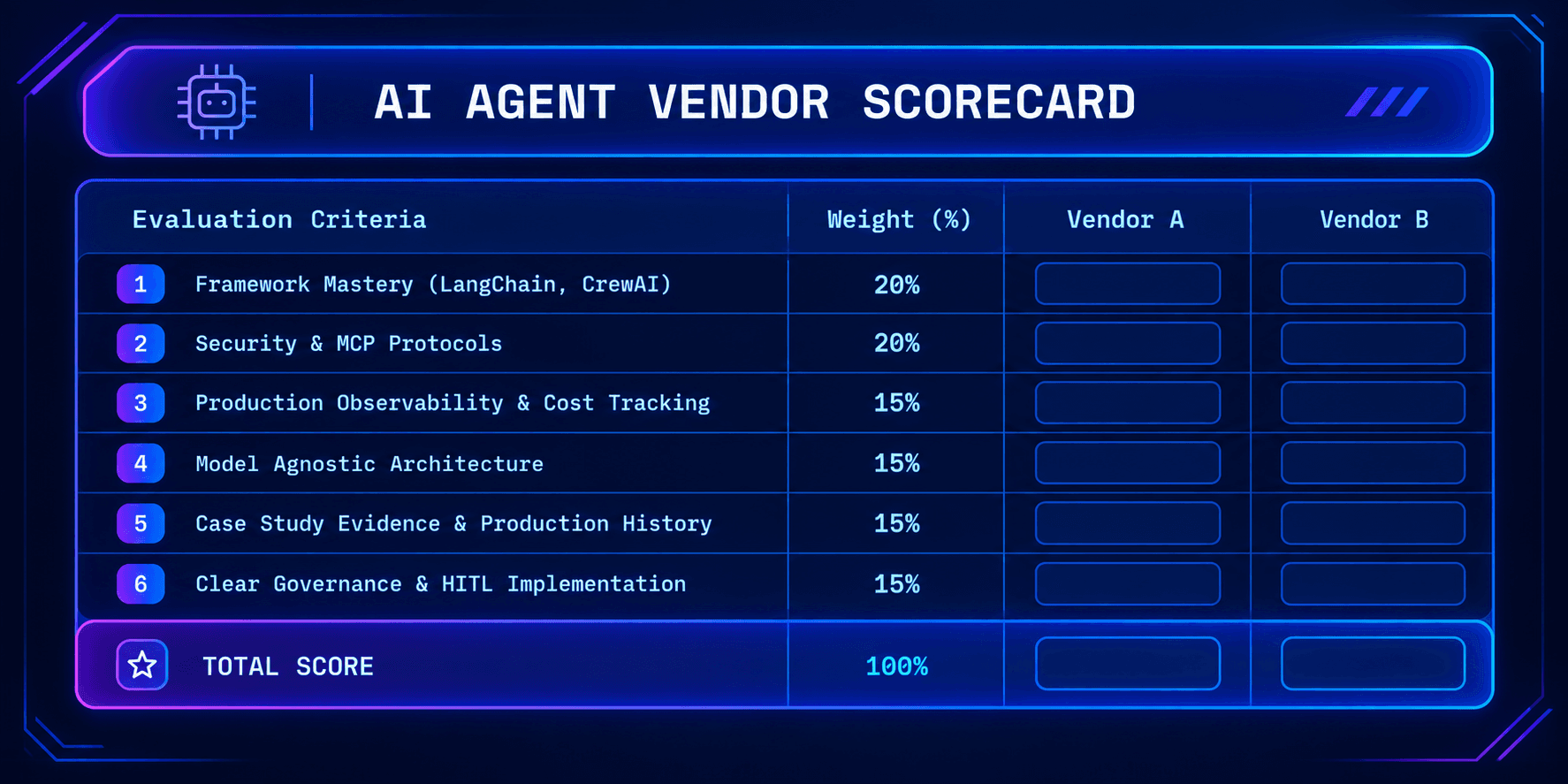
Practical AI Agent Vendor Scorecard
Use this objective evaluation matrix when shortlisting potential development partners:
Mitigating AI Agent Vendor Lock-in Risks
To maintain full control of your technological stack and avoid vendor lock-in, ensure your agreement enforces three non-negotiable engineering requirements:
- Standardized Infrastructure: Require standard protocols like MCP and OpenTelemetry rather than proprietary, closed-source vendor SDKs.
- Swappable LLM Router Layer: Ensure model calls route through unified abstraction layers on platforms like Azure AI Foundry or Google Vertex AI, allowing effortless model upgrades.
- Code Base Repository Access: Secure direct, continuous access to private Git repositories containing all custom tool scripts, prompt templates, and orchestration frameworks from sprint one.
To evaluate real-world multi-agent architectures and production implementations, explore See What We've Built.
Final Recommendation: How to Shortlist and Begin
Choosing an engineering partner requires balancing technical depth, transparent architecture, and business alignment. Follow this actionable roadmap:
- Audit Internal Data & APIs: Ensure your target workflows have accessible endpoints and clean input data.
- Define Baseline Success Metrics: Measure the manual human effort and processing time currently required for the targeted process.
- Run a Scoped Proof of Concept: Engage shortlisted partners on a short, milestone-driven PoC before committing to full enterprise deployment.
If you are ready to evaluate custom multi-agent architectures, establish production observability, and scope your workflow with specialized engineering architects, Talk to Our Experts at Meritorious CodeCrafters for a direct engineering consultation.
Frequently Asked Questions (FAQs)
1. What is the difference between a traditional software vendor and a dedicated custom agent partner?
Traditional software vendors build deterministic applications where inputs follow pre-defined, hardcoded conditional paths. A specialized custom agent partner designs non-deterministic autonomous systems that can dynamically reason, select tools, handle unstructured data via Model Context Protocol (MCP), and manage complex multi-step workflows. Selecting an experienced partner ensures your architecture includes agentic failure handling, token management, and human-in-the-loop governance rather than basic web application code.
2. How much does custom production agent engineering typically cost?
Development costs vary based on system complexity, integration scope, and evaluation requirements:
- Proof of Concept / Pilot (2–4 Weeks): $10,000 to $25,000 for a tightly scoped workflow.
- Production Deployment: $30,000 to $100,000+ for enterprise multi-agent orchestration, custom tool integrations, RAG pipelines, and security controls.
- Recurring Usage Costs: Compute and token costs (e.g., via AWS Bedrock, Azure AI Foundry, or Google Vertex AI) are billed separately based on real-time execution volume.
3. How do we ensure our proprietary enterprise data is not used to train third-party LLM models?
Your partner should implement enterprise-grade API endpoints with explicit zero-data-retention (ZDR) agreements. By deploying models within dedicated cloud environments-such as Private Endpoints on AWS Bedrock, Azure AI Foundry, or self-hosted open-source models (e.g., Llama 3)-your data remains securely isolated from foundation model training pipelines.
4. How long does it take to move a custom autonomous system from discovery to production?
A typical production lifecycle spans 8 to 14 weeks:
- Weeks 1–2 (Discovery & Scoping): Workflow mapping, API accessibility audits, and baseline evaluation dataset creation.
- Weeks 3–6 (PoC & Core Engineering): Framework orchestration using LangChain or CrewAI, tool building, and prompt optimization.
- Weeks 7–10 (Evaluation & Testing): Adversarial red-teaming, hallucination rate benchmarks, and Human-in-the-Loop integration.
- Weeks 11+ (Production Rollout): Telemetry deployment, token tracking, and continuous monitoring.
5. What happens if our engineering partner discontinues support or we decide to change vendors?
To prevent vendor lock-in, ensure your contract specifies complete IP assignment and standard engineering delivery from day one. This includes continuous access to private Git repositories containing all custom orchestration scripts, prompt templates, and evaluation datasets, as well as model-agnostic abstraction layers that allow your team or a new vendor to update components without rebuilding the platform.